
Follow Me On Social Media!
Lime Macarons

Introduction
Here is a question that cuts to the heart of home baking ambition: why do lime macarons — one of the most requested flavors at every patisserie that carries them — appear so rarely on home bakers’ repertoires, when the technique that produces them is identical to every other macaron flavor and the lime element is simply a matter of adding zest and juice to a buttercream filling? According to a 2024 report by the French Pastry School in Chicago, macarons remain the single most searched advanced baking recipe globally — yet the abandonment rate, meaning the percentage of home bakers who attempt them once and never try again, is estimated at over 60%. The reason is almost never the flavor. It is almost always a misunderstanding of three technical principles that, once understood, make macarons reliably reproducible every single time.
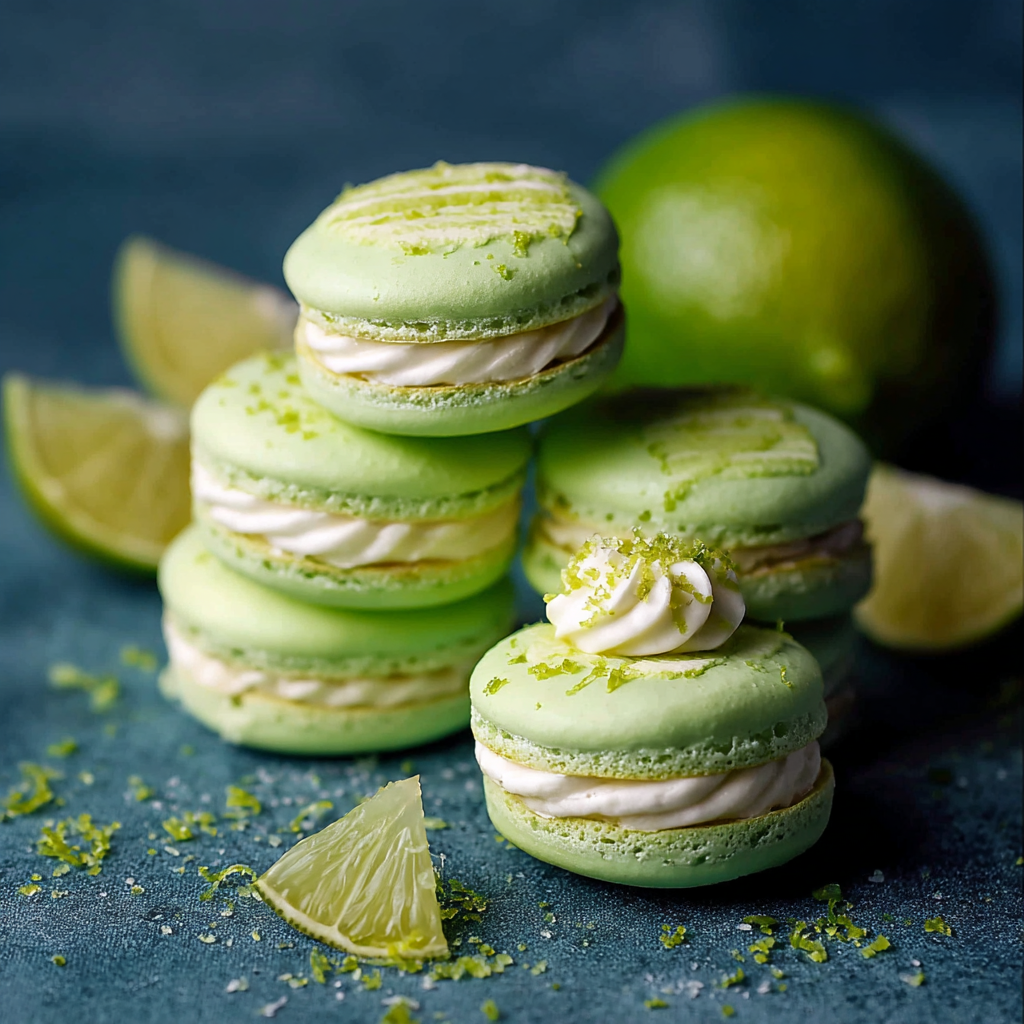
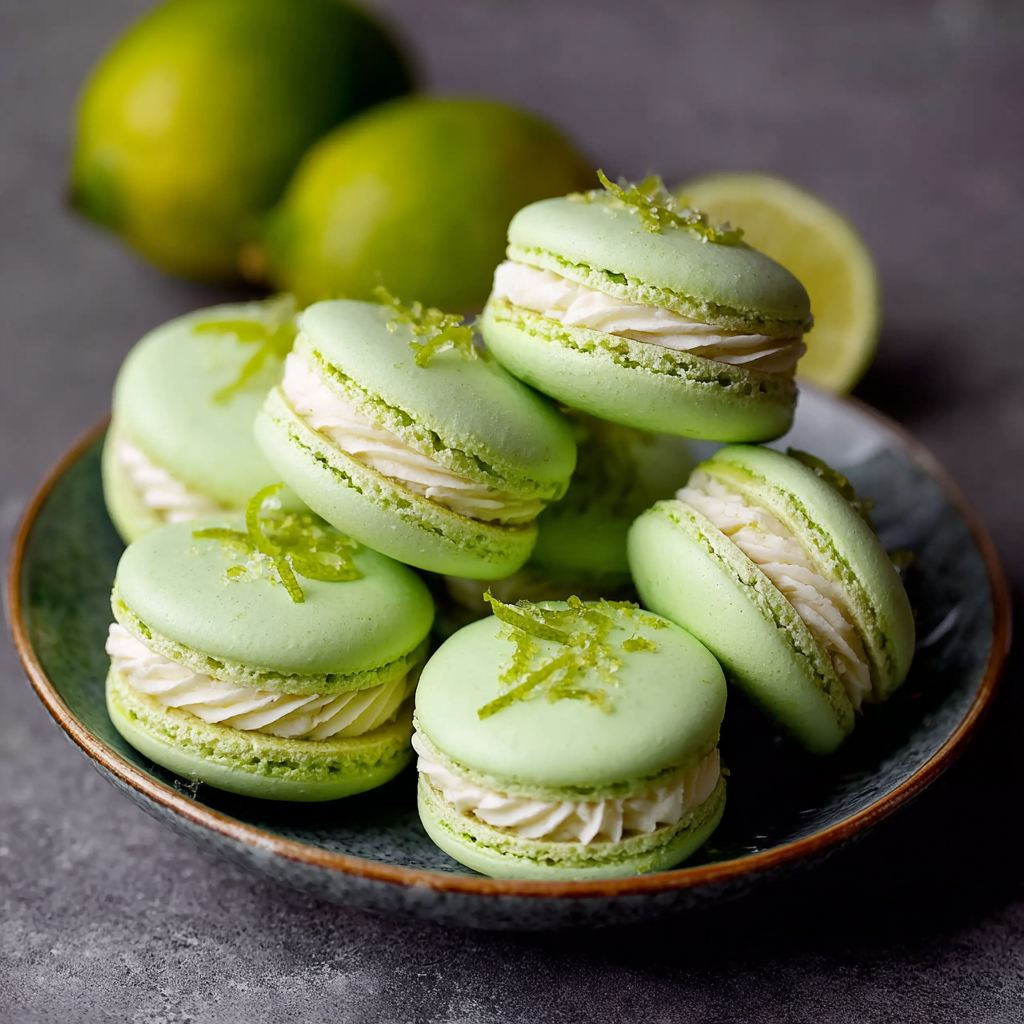
These lime macarons are built around those three principles — proper meringue consistency, correct macaronage technique, and the resting period that allows the characteristic foot to form — combined with a lime curd buttercream that is bright, tangy, and intense enough to hold its own against the sweet almond shell. The result is a macaron with a crisp, thin shell that gives way to a soft, chewy interior, a filling that tastes genuinely and assertively of lime, and the kind of professional finish that makes anyone who receives them assume they came from a French patisserie.
A 2023 food culture report by Bon Appétit identified citrus-flavored macarons as the top-performing flavor category in specialty bakeries — outperforming chocolate, vanilla, and even seasonal flavors — driven by the brightness and acidity that citrus brings to a format that can otherwise tend toward excessive sweetness. This recipe delivers that brightness in full.
Ingredients List
For the Macaron Shells
- 150g (1½ cups) almond flour, finely ground (sifted — discard any pieces that don’t pass through the sieve)
- 150g (1¼ cups) powdered sugar, sifted
- 110g egg whites (approximately 3–4 large eggs — aged 24–48 hours uncovered in the refrigerator)
- 150g (¾ cup) granulated sugar
- 37ml (2½ tbsp) water
- 1 tsp lime zest, very finely grated (added to the dry ingredients for subtle shell flavor)
- Green gel food coloring (optional — a small amount produces a beautiful pale lime green)
- ¼ tsp cream of tartar (stabilizes the meringue)
For the Lime Curd Buttercream
- 115g (½ cup / 1 stick) unsalted butter, softened
- 200g (1¾ cups) powdered sugar, sifted
- 3 tbsp fresh lime juice (approximately 2–3 limes)
- 1 tbsp lime zest
- 2 tbsp homemade or store-bought lime curd (intensifies the lime flavor significantly)
- Pinch of fine sea salt
- 1–2 tsp heavy cream (to adjust consistency)
For Finishing (Optional)
- Extra lime zest, for dusting over the assembled macarons
- Edible gold or silver luster dust
- Small lime zest curls pressed into the buttercream before sandwiching
Timing
- Prep Time: 30 minutes
- Resting Time: 30–60 minutes (non-negotiable)
- Bake Time: 13–15 minutes per tray
- Cooling and Assembly Time: 30 minutes
- Maturation Time: 24 hours refrigerated (produces the best texture)
- Total Time: approximately 3 hours active, 24 hours with maturation
The 24-hour maturation period after assembly is not optional for the best result — it is the time during which the filling softens the inner shell to the characteristic chewy texture that defines a properly made macaron. Macarons eaten the same day they are assembled are too crisp. Macarons eaten after 24 hours of refrigeration are perfect.
Step-by-Step Instructions
Step 1: Prepare the Dry Ingredients (Tant Pour Tant)
Sift the almond flour and powdered sugar together through a fine mesh sieve into a large bowl. Discard any almond pieces that do not pass through. Add the finely grated lime zest and whisk briefly to distribute. Sifting is not optional — unsifted almond flour produces a bumpy, rough-surfaced shell that lacks the smooth, domed appearance a macaron requires. If time allows, process the almond flour and powdered sugar together in a food processor for 30 seconds before sifting to produce an even finer texture.
Key tip: Weigh all ingredients on a digital scale. Macaron making is a precise chemistry — volume measurements are insufficiently accurate for the ratios this recipe requires. A kitchen scale is the most important piece of equipment in this recipe.
Step 2: Make the Italian Meringue
Combine the granulated sugar and water in a small saucepan. Attach a candy thermometer and heat over medium-high without stirring until the syrup reaches exactly 244°F (118°C). While the syrup is heating, begin beating the egg whites and cream of tartar in a stand mixer on medium speed until soft, foamy peaks form — time this so the whites are at soft peak stage when the syrup is ready. With the mixer running on high, pour the hot sugar syrup in a slow, thin, steady stream down the side of the bowl — not directly onto the beaters, which would splatter. Continue beating on high speed for 8–10 minutes until the meringue is stiff, glossy, and has cooled to room temperature. Add the gel food coloring in the final minute of beating if using.
Key tip: Italian meringue — made with cooked sugar syrup — is significantly more stable than French meringue made with raw sugar, produces a more reliable macaron shell, and is the method used in professional patisseries. The extra step of cooking the syrup is the reason professional macarons are more consistent than home versions using the French method.
Step 3: Macaronage — The Most Critical Step
Add the dry ingredients to the meringue all at once. Using a large rubber spatula, fold the mixture with a specific technique — pressing the batter firmly against the side of the bowl with each stroke rather than folding gently as you would for a soufflé. This deliberate deflation is called macaronage and is both counterintuitive and essential. The goal is to deflate approximately 30–40% of the air from the meringue to reach a batter that flows like lava — it should fall from the spatula in a thick, continuous ribbon and the ribbon should disappear back into the batter within 10 seconds of falling.
The test: lift the spatula and let batter fall — if it falls in chunks, fold more. If it flows in a thin, rapid ribbon, you have gone too far. The correct batter flows slowly, steadily, and the ribbon sinks back into the surface within 10 seconds. Count your folds — most batters reach the correct consistency between 40 and 60 folds.
Key tip: Under-macaronaged batter produces shells with peaks that do not flatten, cracked tops, and no foot. Over-macaronaged batter produces flat, spreading shells with no dome. The 10-second ribbon test is the only reliable indicator — not fold count.
Step 4: Pipe the Shells
Transfer the batter to a piping bag fitted with a plain round 1cm tip. Line two baking sheets with parchment paper or silicone mats. Hold the piping bag perpendicular to the baking sheet — 90 degrees, not at an angle — with the tip 1cm above the surface. Pipe circles of approximately 3.5cm (1½ inches) in diameter, stopping pressure before lifting the tip to avoid peaks. Leave 3cm between each shell. Once all shells are piped, lift each tray and drop it firmly onto the counter from a height of approximately 20cm — do this 3–4 times to release air bubbles that would otherwise cause cracking. Use a toothpick to pop any remaining visible bubbles.
Step 5: Rest Until Dry
Leave the piped shells at room temperature to rest for 30–60 minutes until a dry, matte skin forms on the surface. The skin should feel completely dry and non-sticky to the gentlest touch of a fingertip. This skin is what forces the rising batter to expand sideways during baking, creating the characteristic foot — the ruffled collar at the base of the macaron. Shells baked without this skin rise upward rather than outward and produce no foot. In humid environments, this resting period may need to extend to 90 minutes.
Key tip: The resting period is non-negotiable and environment-dependent. Test each tray individually rather than timing all trays from when the first was piped — the last tray piped will be ready later than the first.
Step 6: Bake
Preheat the oven to 300°F (150°C) — conventional, not convection, which can cause uneven rising and cracking. Bake one tray at a time on the middle rack for 13–15 minutes. The macarons are done when they do not wobble or shift when gently touched — the shell should feel set and firm and should not slide on the foot when tested with the lightest finger pressure. Remove from the oven and allow to cool completely on the tray before attempting to remove — macarons removed while warm will stick and tear. Cool for at least 20 minutes.
Step 7: Make the Lime Curd Buttercream
Beat the softened butter on medium-high speed for 2 minutes until pale and fluffy. Add the sifted powdered sugar in two additions, beating between each. Add the lime juice, lime zest, lime curd, and salt. Beat on high for 1 minute until smooth, fluffy, and intensely lime-flavored. Add heavy cream a teaspoon at a time to reach a consistency that holds its shape when piped but is soft enough to spread without cracking the shell. Taste and adjust lime juice or zest to your preferred intensity.
Step 8: Fill and Mature
Match the shells into pairs by size. Transfer the buttercream to a piping bag fitted with a small round tip. Pipe a generous mound onto the flat side of one shell of each pair — pipe slightly less than you think is needed, as the filling spreads when the top shell is pressed on. Gently press the matching shell on top, rotating slightly as you press, until the filling just reaches the edge of the shell. Arrange on a tray, cover loosely, and refrigerate for 24 hours before serving.
Nutritional Information
Per serving — based on 1 macaron from a batch of 24.
| Nutrient | Per Serving | % Daily Value* |
|---|---|---|
| Calories | 135 kcal | 7% |
| Total Fat | 6g | 8% |
| Saturated Fat | 2.5g | 13% |
| Total Carbohydrates | 19g | 7% |
| Total Sugar | 17g | — |
| Protein | 2g | 4% |
| Dietary Fiber | 0.5g | 2% |
| Sodium | 20mg | 1% |
| Calcium | 2% DV | 2% |
| Vitamin C | 3% DV | 3% |
*Based on a standard 2,000-calorie daily diet.
At 135 calories per macaron, these are among the more portion-appropriate fine confections available — the small format naturally encourages mindful eating, and the almond flour base contributes heart-healthy monounsaturated fats and a small but meaningful amount of protein compared to wheat-flour-based confections of equivalent size.
Healthier Alternatives
Lower sugar filling: Replace half the powdered sugar in the buttercream with 3 tablespoons of cream cheese and increase the lime juice by 1 teaspoon. The filling becomes tangier, less sweet, and slightly more nutritionally dense with a comparable piping consistency.
Dairy-free: Replace butter in the filling with a high-quality vegan butter — Earth Balance or Miyoko’s both produce stable, pipeable buttercreams. The shells are naturally dairy-free.
Naturally colored: Replace gel food coloring with 1 teaspoon of spirulina powder added to the dry ingredients, or matcha powder for a slightly different but equally beautiful green. Both produce a natural, food-safe color with additional nutritional compounds.
Reduced sugar shells: The sugar ratios in macaron shells are technically functional rather than purely for sweetness — reducing them significantly compromises the meringue structure and shell integrity. The most practical approach to a lower-sugar macaron is making them smaller — 2.5cm shells at approximately 90 calories each — rather than altering the structural sugar ratios.
Serving Suggestions
Gift boxes: Layer between sheets of parchment paper in a small decorative box tied with ribbon. Macarons are one of the most gift-worthy homemade confections — they travel well when cold, look impeccably professional, and convey significant skill and care to the recipient.
Dessert table display: Arrange on a tiered stand alongside complementary lime-forward desserts — key lime tart, lime posset, or lime curd on shortbread. The pale green color creates a cohesive, visually striking dessert table without any additional decoration required.
With afternoon tea: Serve alongside Earl Grey or green tea — the floral and grassy notes in both teas complement the bright acidity of the lime filling with remarkable compatibility.
Macaron ice cream sandwiches: Press a small scoop of lime sorbet or coconut ice cream between two shells and freeze for 30 minutes. Serve immediately — a summer dessert of genuine sophistication that requires no additional preparation beyond the macarons themselves.
Plated restaurant-style: Place two macarons alongside a small pot of lime curd, a quenelle of lightly sweetened whipped cream, and a scattering of lime zest and toasted coconut. This plated format elevates the macaron from confection to plated dessert course.
Common Mistakes to Avoid
Not weighing ingredients. Macarons are a recipe where volume measurements fail. A gram-accurate digital kitchen scale is the single most important tool — invest in one before attempting this recipe.
Using freshly separated egg whites. Fresh egg whites contain more moisture than aged whites, which produces an unstable meringue and a spreading batter. Age the whites uncovered in the refrigerator for 24–48 hours — this allows excess moisture to evaporate and produces a more stable, controllable meringue.
Under or over-macaronage. Both produce unusable results. Under-macaronaged batter makes peaked, cracked shells with no foot. Over-macaronaged batter makes flat, spreading shells with no dome. The 10-second ribbon test is the only reliable guide.
Skipping the resting period. Baking without a dry skin produces shells that rise straight up and crack rather than developing a foot. Test each tray individually and wait for the matte, dry-to-touch surface before baking.
Baking on convection. Convection airflow creates uneven heat distribution across the macaron tray, causing some shells to rise faster than others and producing cracking, uneven feet, and inconsistent doneness. Use conventional bake mode only.
Eating the same day. Same-day macarons have a crisp, somewhat dry interior that does not represent the best version of the confection. The 24-hour refrigerator maturation is the step that produces the chewy, cohesive interior texture that defines a properly finished macaron.
Storing Tips
Refrigerator: Store assembled macarons in an airtight container between parchment layers for up to 5 days. The texture is at its absolute best between 24 and 48 hours after assembly — this window is the target for any special occasion.
Serving from cold: Remove from the refrigerator 15–20 minutes before serving. Cold macarons are slightly firm — at room temperature the shell softens to its ideal chewy texture and the buttercream becomes fully expressive in flavor.
Freezer: Freeze assembled macarons in a sealed container for up to 3 months. Thaw in the refrigerator for 6 hours or at room temperature for 1 hour. Frozen and thawed macarons are virtually indistinguishable from fresh — making these an ideal advance preparation for special occasions.
Unassembled shells: Baked but unfilled shells can be stored in an airtight container at room temperature for up to 2 days or frozen for up to 1 month. Fill on the day before serving for the freshest assembled result.
Make-ahead strategy: Bake the shells up to 1 month ahead and freeze. Make the buttercream up to 3 days ahead and refrigerate. Assemble 24 hours before the occasion — this staged approach makes macaron production for a large event entirely manageable.
Conclusion
Lime macarons prove that the most technically demanding confection in the home baker’s repertoire becomes reliably achievable the moment the underlying principles — stable Italian meringue, correct macaronage, mandatory rest, and patient maturation — are understood rather than simply followed. Once that understanding is in place, the lime flavor is simply the reward: bright, assertive, and sophisticated enough to make every shell worth the effort they required.
Bake a batch and share your results in the comments — tell us whether you used the Italian or French meringue method, how the macaronage went, and whether the 24-hour wait was as worth it as promised. Leave a review, share with someone who loves citrus desserts, and subscribe to our newsletter for more technique-driven, professional-level baking recipes every week.
FAQs
Why did my macarons crack on top? Cracking is almost always caused by one of three things: insufficient resting time before baking (the skin was not fully dry), baking on convection mode, or oven temperature too high. Ensure the surface is completely matte and dry before baking, use conventional mode, and consider reducing the oven temperature by 10°F (5°C) if cracking persists.
Why did my macarons have no foot? No foot is caused by under-resting (skin not fully formed), over-macaronaged batter that spread too flat before baking, or oven temperature too low. Extend the resting time until the skin test is definitive, verify the batter passes the 10-second ribbon test, and confirm the oven temperature with a separate thermometer — many home ovens run 15–25°F cooler than indicated.
Can I use French meringue instead of Italian? Yes — French meringue (raw sugar beaten directly into the whites) is simpler but less stable. The shells are more susceptible to humidity and temperature variation and produce less consistent results. For a first attempt, French meringue is acceptable — for reliable, repeatable results, Italian meringue is strongly recommended.
Why are my macarons hollow inside? Hollow macarons are caused by over-beaten meringue, over-macaronaged batter, or oven temperature too high. The large air bubbles baked into the shell expand too rapidly and produce a hollow cavity beneath the dome. Under-beat the meringue slightly past stiff peaks but not beyond, fold to the ribbon test precisely, and verify oven temperature.
Can I make these without a stand mixer? A hand mixer works for the Italian meringue but requires timing the sugar syrup and beating simultaneously — possible but challenging alone. Enlist a second person to pour the syrup while you hold the hand mixer, or use the French meringue method, which requires only beating egg whites with sugar and has no syrup cooking step.
How do I get perfectly round shells? Print a template of 3.5cm circles spaced 3cm apart, slide it under the parchment paper as a guide, and pipe over the template. Remove the template before baking — it is only a guide. Hold the piping bag perfectly perpendicular to the surface and stop pressure cleanly before lifting to prevent peaks. The drop-onto-counter technique after piping also helps circles settle into a more uniform shape.