Follow Me On Social Media!
Veal Tagine with Artichokes and Green Peas

Introduction
Here is a question that reframes the entire category of slow-cooked stew: when was the last time a single dish carried you — through nothing more than its aroma filling the kitchen — to a place you have never been, and made you feel certain you would want to go? According to a 2024 global food culture report by the World’s 50 Best Restaurants organization, North African cuisine represents the fastest-growing culinary interest category among Western food consumers — driven by a combination of complex spicing, slow-cooking traditions, and a philosophical generosity of flavor that most modern weeknight cooking entirely lacks.
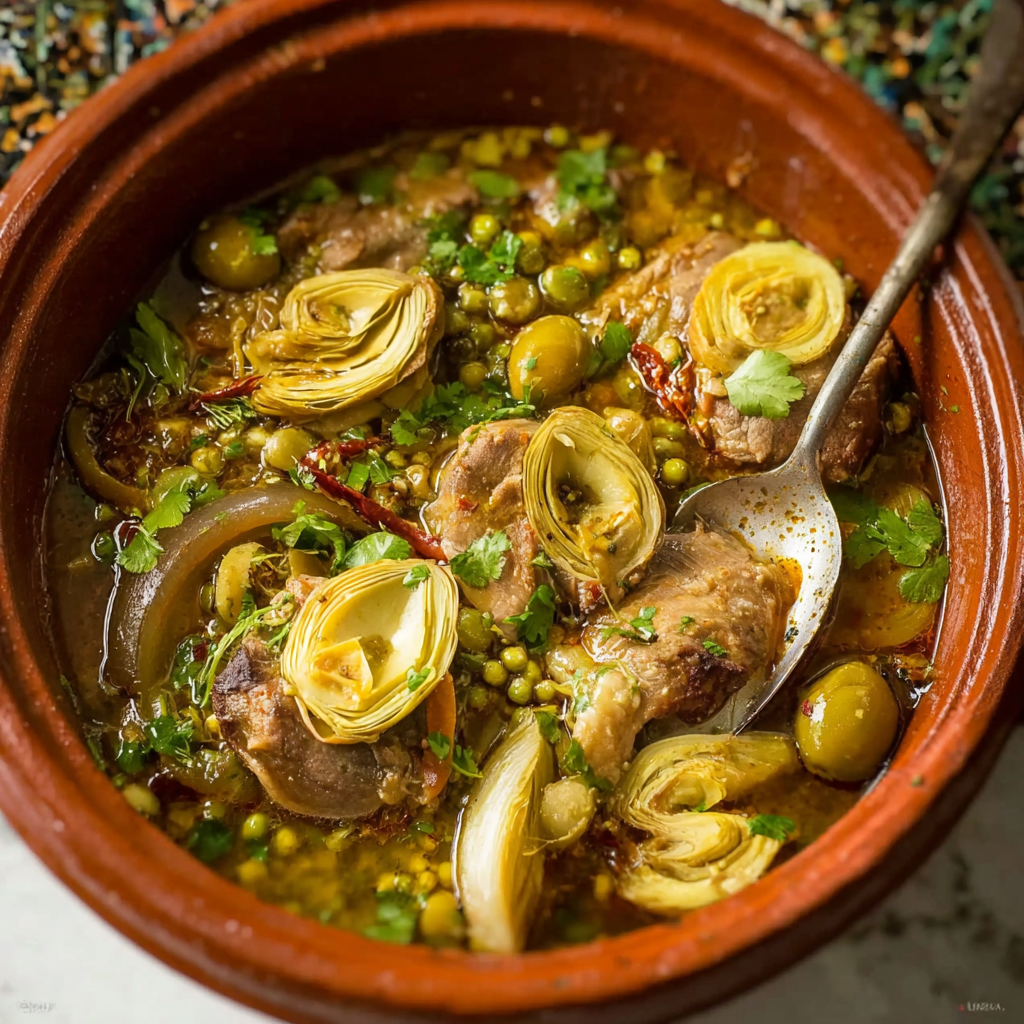
This veal tagine with artichokes and green peas sits at the most refined end of that tradition. The tagine — North Africa’s defining slow-cooked dish, named for the conical earthenware vessel in which it is traditionally prepared — is a method as much as a recipe: aromatics and protein layered with spices, a small amount of liquid, and time, producing a braise with a concentration of flavor that faster cooking methods cannot replicate. Veal brings a delicacy and tenderness to the tagine format that lamb and chicken cannot — the mild, clean sweetness of good veal absorbs the warm spices of ras el hanout, cumin, and ginger and becomes something more complex than its starting point. The artichokes contribute a mineral, slightly bitter note that grounds the sweetness of the peas and the richness of the braising liquid in a combination that feels architecturally complete.
A 2023 culinary ethnography published in the Oxford Companion to Food identified the tagine as one of the most nutritionally efficient cooking methods in world cuisine — the sealed, low-heat environment preserves water-soluble vitamins, retains volatile aromatic compounds, and produces collagen-rich braising liquid from the meat that would be lost in higher-heat preparations.
Ingredients List
For the Veal
- 900g (2 lbs) veal shoulder or veal shank, cut into 5cm (2-inch) pieces (sub: lamb shoulder for a more robust, gamey flavor)
- 1½ tsp fine sea salt
- 1 tsp freshly ground black pepper
- 1 tsp ground cumin
- 1 tsp ras el hanout (the defining spice blend of North African cooking — see tip below)
- ½ tsp ground ginger
- ½ tsp ground turmeric
- 2 tbsp olive oil
For the Tagine Base
- 1 large onion, grated or very finely diced (grated onion dissolves into the sauce — the preferred traditional method)
- 4 garlic cloves, minced
- 1 preserved lemon, pulp discarded, rind finely chopped (the single most transformative ingredient in North African cooking)
- 1 tsp ground coriander
- ½ tsp sweet paprika
- Large pinch of saffron threads, soaked in 3 tbsp warm water for 10 minutes
- 1 cup (240ml) chicken or veal stock
- ½ cup (120ml) water
- 3 tbsp olive oil
- 1 tbsp unsalted butter
For the Vegetables
- 6 artichoke hearts, fresh or frozen (canned in water work well — avoid marinated)
- 1½ cups (220g) fresh or frozen green peas
- 1 lemon, juice only (to prevent artichoke browning and to finish the sauce)
- 2 tbsp fresh flat-leaf parsley, roughly chopped
- 2 tbsp fresh cilantro, roughly chopped
For Serving
- Couscous, steamed with butter and a pinch of saffron
- Warm Moroccan khobz bread or any good flatbread
- Harissa or chermoula, on the side
Timing
- Prep Time: 20 minutes
- Cook Time: 1 hour 45 minutes – 2 hours
- Total Time: approximately 2 hours 15 minutes
The active hands-on preparation is under 25 minutes. The remainder is the tagine doing what it does best — converting patience into extraordinary flavor through gentle, sustained heat. The dish can be made entirely on the stovetop in a heavy Dutch oven if a tagine vessel is unavailable, with identical results.
Step-by-Step Instructions
Step 1: Season and Sear the Veal
Pat the veal pieces completely dry. Combine the salt, pepper, cumin, ras el hanout, ginger, and turmeric in a small bowl and rub the spice mixture firmly into every surface of the veal. Heat the olive oil in a large heavy-bottomed tagine base, Dutch oven, or deep skillet over medium-high heat. Sear the veal in batches — never crowded — for 3–4 minutes per side until deeply golden on all surfaces. Transfer to a plate. The caramelized crust on the veal is the foundation of the braising liquid’s flavor — every batch deserves the full searing time.
Key tip: Ras el hanout — Arabic for “top of the shop” — is a complex North African spice blend containing anywhere from 12 to 30 spices. Look for it at Middle Eastern grocery stores or online. In its absence, combine 1 teaspoon of cinnamon, ½ teaspoon each of cardamom and coriander, ¼ teaspoon each of cloves and allspice, and a pinch of cayenne as an approximation.
Step 2: Build the Aromatic Base
Reduce the heat to medium and add the olive oil and butter to the same pot. Add the grated onion — it will sizzle and steam immediately. Cook for 6–8 minutes, stirring frequently, until the onion has softened completely and the excess moisture has evaporated, leaving a fragrant, golden paste. Add the minced garlic, ground coriander, paprika, and the preserved lemon rind. Cook for 2 minutes until the garlic is fragrant and the spices have bloomed in the fat.
Key tip: Grating the onion rather than dicing it is a traditional Moroccan technique that allows the onion to dissolve entirely into the sauce during braising, contributing body and sweetness without any identifiable onion pieces in the finished dish. A box grater over the pot makes this effortless.
Step 3: Add the Liquid and Braise
Return the seared veal to the pot along with any accumulated juices. Pour over the saffron water — threads and all — along with the stock and water. The liquid should come approximately halfway up the sides of the meat, not cover it completely — tagine is a steam braise, not a submerged stew. Bring to a gentle simmer, cover tightly, and reduce the heat to the lowest setting. Cook for 1 hour 15 minutes, turning the veal pieces gently at the halfway mark.
Step 4: Add the Artichokes
If using fresh artichokes, trim down to the hearts, rub with lemon, and cut into quarters. If using frozen or canned, drain thoroughly. Add the artichoke hearts to the tagine, nestling them among the veal pieces. Cover and continue cooking for 20–25 more minutes until the artichokes are tender and the veal is completely fork-tender — it should pull apart at the slightest pressure.
Step 5: Add the Peas and Finish
Add the green peas to the tagine and cook uncovered for 5 minutes — just long enough to heat them through and allow them to absorb some of the braising liquid without losing their vivid color. Squeeze the lemon juice over the entire dish and taste the sauce — adjust salt, preserved lemon, or lemon juice as needed. The sauce should be deeply savory, warmly spiced, faintly sweet, and bright with citrus. Scatter the fresh parsley and cilantro generously over the top.
Step 6: Serve
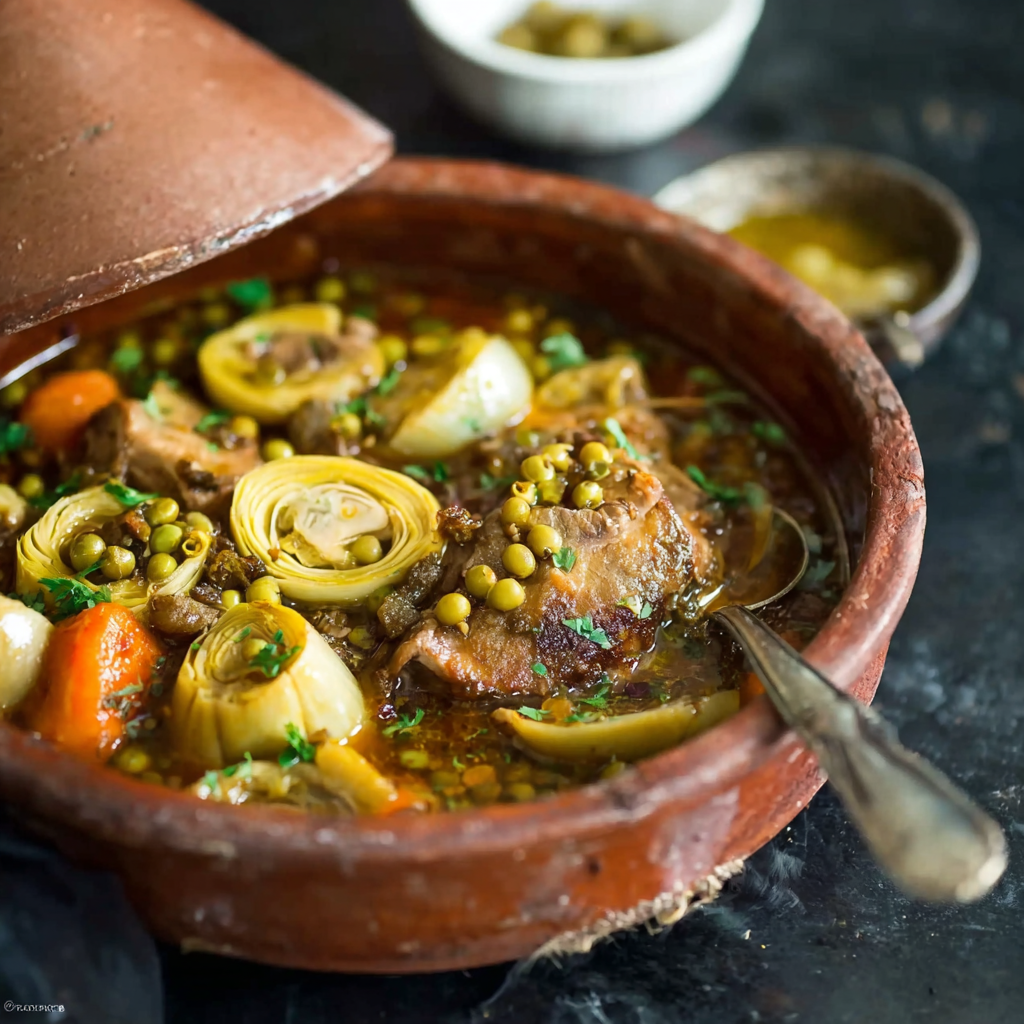
Bring the tagine directly to the table — the vessel itself is the serving dish. Set it on a protective trivet and lift the lid at the table for the full aromatic impact. Serve over saffron couscous or alongside warm bread with harissa or chermoula on the side.
Nutritional Information
Per serving — based on 4 servings without couscous or bread.
| Nutrient | Per Serving | % Daily Value* |
|---|---|---|
| Calories | 460 kcal | 23% |
| Total Fat | 22g | 28% |
| Saturated Fat | 6g | 30% |
| Total Carbohydrates | 18g | 7% |
| Total Sugar | 5g | — |
| Protein | 48g | 96% |
| Dietary Fiber | 7g | 25% |
| Sodium | 720mg | 31% |
| Potassium | 940mg | 20% |
| Vitamin C | 35% DV | 35% |
| Iron | 30% DV | 30% |
| Folate | 25% DV | 25% |
*Based on a standard 2,000-calorie daily diet.
At 48 grams of protein per serving with 7 grams of dietary fiber and 30% of the daily iron requirement, this tagine delivers a nutritional profile that is exceptional for a slow-cooked braise. The artichokes contribute a meaningful dose of folate and prebiotic fiber — compounds associated with gut microbiome diversity and cardiovascular health — making this one of the more nutritionally complete single-dish meals in the slow-cooking category.
Healthier Alternatives
Leaner protein: Replace veal shoulder with veal loin or veal tenderloin medallions, seared and added in the final 20 minutes of cooking rather than braised for the full duration. The result is leaner with a comparable spice profile, though the braising liquid will be slightly less gelatin-rich.
Lower sodium: Replace the preserved lemon with 2 teaspoons of fresh lemon zest combined with ½ teaspoon of fine sea salt — a combination that approximates the citrus-brine flavor profile of preserved lemon with significantly less sodium. Use a low-sodium chicken stock throughout.
Vegan adaptation: Replace the veal with a combination of chickpeas and large cubes of firm eggplant. The braising time reduces to 45 minutes — add the artichokes at the 20-minute mark and the peas and eggplant at the 35-minute mark. The spice profile of the tagine is entirely plant-compatible and the result is a deeply flavorful vegan main course.
Higher vegetable content: Add 2 medium zucchini cut into large pieces alongside the artichokes, and double the pea quantity. These additions increase the fiber, Vitamin C, and potassium content meaningfully without disrupting the balance of the dish.
Lower fat: Reduce the olive oil to 1 tablespoon for the searing step and use only olive oil — no butter — for the aromatic base. The braising liquid becomes slightly less rich but remains deeply flavorful from the spices and preserved lemon.
Serving Suggestions
Classic Moroccan table: Serve the tagine in its vessel at the center of the table, surrounded by a bowl of saffron couscous, a small dish of harissa, a plate of warm khobz bread, and a simple salad of grated carrot with cumin and lemon. This is the format that communicates the dish’s cultural context most fully.
Dinner party centerpiece: The tagine vessel arriving at a dinner table still steaming from the oven is one of the most dramatically impressive serving moments in home entertaining — requiring no plating skill and generating guaranteed admiration. Pair with a Moroccan mint tea service for the full experience.
Over couscous with almonds and raisins: Stir a handful of toasted slivered almonds and plump golden raisins into the saffron couscous before serving. The combination of savory braised veal, sweet raisins, crunchy almonds, and fragrant couscous is one of the defining flavor profiles of Moroccan celebratory cooking.
Next-day sandwiches: Shred any leftover veal and combine with the thickened braising liquid. Pile onto warm flatbread with sliced cucumber, fresh cilantro, a drizzle of harissa, and crumbled feta. Leftover tagine meat makes one of the finest flatbread sandwiches in any cuisine.
With fried eggs for brunch: Reheat the tagine in a wide skillet and crack 4 eggs directly into the sauce. Cover and cook until the whites are set and the yolks are still runny. The combination of spiced braising liquid, tender veal, and runny egg yolk is an extraordinary brunch preparation that requires almost no additional effort.
Common Mistakes to Avoid
Not searing the veal before braising. The Maillard reaction on the surface of the veal produces flavor compounds that the braising liquid cannot develop any other way — they dissolve into the sauce and form its backbone. Grey, unseared veal produces a flat, pale braising liquid regardless of the quality of the spices. Sear every piece, every time, without crowding.
Using too much liquid. A tagine is a steam braise — the conical lid is designed to condense steam and return it to the pot. Too much liquid produces a watery stew rather than a concentrated, glossy braising sauce. The liquid should reach halfway up the meat, not cover it.
Adding the peas too early. Green peas require 5 minutes of gentle heat to warm through and absorb flavor. More than 10 minutes at braising temperature turns them grey, mealy, and flavorless. Add them last, cook briefly, and serve promptly.
Skipping the preserved lemon. Preserved lemon is not a substitutable ingredient in this recipe — it provides a fermented, salty, deeply aromatic citrus note that fresh lemon, lemon zest, or any other ingredient cannot replicate. It is available at Middle Eastern grocery stores, specialty food shops, and online, and keeps indefinitely in the refrigerator once opened. The investment is worth it.
Braising on too high a heat. A tagine braised at too high a temperature boils rather than simmers — toughening the veal collagen rather than slowly dissolving it and producing a dry, stringy result rather than a meltingly tender one. The gentlest possible simmer — barely visible movement at the surface of the liquid — is the correct and only appropriate heat level.
Storing Tips
Refrigerator: Store in an airtight container for up to 4 days. Tagines improve dramatically overnight as the spices, preserved lemon, and braising liquid continue to develop and meld — this is one of the few dishes that is definitively better reheated the following day than served fresh.
Reheating: Reheat gently in the tagine vessel or a covered saucepan over the lowest heat, adding a splash of water or stock if the sauce has thickened during refrigeration. Do not boil — sustained high heat at the reheating stage breaks down the artichoke texture and toughens the veal.
Freezer: Freeze without the peas and artichokes for up to 3 months — both vegetables deteriorate in texture during freezing. Thaw overnight in the refrigerator and add freshly cooked peas and artichokes when reheating. The veal and braising liquid freeze exceptionally well and the spiced sauce is virtually indistinguishable from fresh after gentle reheating.
Make-ahead: This is an ideal make-ahead dish for entertaining. Prepare the entire tagine including the artichokes up to 2 days ahead. Add the peas only at the moment of reheating and serving. The 2-day-old tagine served with freshly added peas is the best version of this dish.
Conclusion
Veal tagine with artichokes and green peas is the slow-cooked dinner that rewards every minute it asks of you — not in active effort but in the patience of a gentle braise that transforms modest ingredients into something profound. Tender veal perfumed with ras el hanout and saffron, artichokes contributing their mineral depth, peas providing sweetness and color, and a braising liquid concentrated by time into something that tastes like the distilled essence of North African cooking. Make it for an occasion that deserves more than the ordinary, and bring it to the table in the vessel it was cooked in.
Make it and share your results in the comments — tell us whether you used a tagine vessel or a Dutch oven, whether you found preserved lemon, and how the table reacted when the lid came off. Leave a review, share with someone who deserves an extraordinary dinner, and subscribe to our newsletter for more globally inspired, deeply flavored recipes every week.
FAQs
Do I need a tagine vessel to make this recipe? No — a heavy Dutch oven with a tight-fitting lid produces an identical result. The tagine vessel’s conical lid is designed to condense steam efficiently, but a Dutch oven achieves the same sealed, moist braising environment. If using a Dutch oven, reduce the liquid slightly — by approximately ¼ cup — as the tighter seal retains more moisture than a traditional tagine.
Where can I find preserved lemon? Middle Eastern grocery stores, specialty food shops, and the international aisle of well-stocked supermarkets all carry preserved lemon. Online retailers are the most reliable source. Alternatively, make your own — pack quartered lemons into a jar with a generous amount of kosher salt and cover with lemon juice. Leave at room temperature for 3–4 weeks before using. Homemade preserved lemon is superior in flavor to most commercial versions.
Can I use lamb instead of veal? Yes — lamb shoulder is the most traditional tagine protein and produces a richer, more robustly flavored result. The braising time increases slightly to 2 hours for lamb shoulder to achieve the same fork-tender result. The spice profile is identical and equally well-suited to lamb’s more assertive flavor.
What is ras el hanout and where can I find it? Ras el hanout is a complex North African spice blend that varies by producer but typically includes cinnamon, cardamom, coriander, cumin, ginger, turmeric, allspice, cloves, and several other spices. It is available at Middle Eastern grocery stores, specialty spice shops, and online. The approximation in the recipe notes above — cinnamon, cardamom, coriander, allspice, cloves, and cayenne — produces a reasonable facsimile for a first attempt.
Can I make this in a slow cooker? Yes. Sear the veal and build the aromatic base as directed, then transfer everything to the slow cooker. Cook on low for 7–8 hours or high for 4–5 hours. Add the artichokes in the final 90 minutes and the peas in the final 15 minutes. The result is excellent — slightly less concentrated than the stovetop or oven version but deeply flavorful and entirely hands-off.
How do I prepare fresh artichokes for this recipe? Fill a large bowl with cold water and squeeze in the juice of one lemon. Remove the outer leaves of each artichoke until you reach the pale, tender inner leaves. Cut off the top third of the artichoke and trim the stem to 3cm. Quarter the artichoke and use a small spoon to scoop out the fuzzy choke from the center. Drop immediately into the lemon water to prevent browning. Add to the tagine directly from the water without drying.