
Follow Me On Social Media!
Traditional Stuffed Cabbage

Introduction
Here is a question that reframes the entire category of comfort food: why does stuffed cabbage — a preparation that has sustained families across Eastern Europe, the Middle East, and the Mediterranean for centuries, that appears in virtually every culinary tradition that has ever had to feed many people well from modest ingredients, and that consistently ranks among the most emotionally resonant foods in the memories of anyone who grew up eating it — remain so underrepresented in the repertoires of home cooks who have never encountered it in childhood, when it is both simpler to prepare and more deeply satisfying to eat than its reputation suggests?
According to a 2024 global food culture report by the Oxford Companion to Food, stuffed cabbage preparations — known as gołąbki in Poland, sarma in Turkey and the Balkans, holishkes in Jewish tradition, holubtsi in Ukraine, malfuf mahshi in the Arab world, and by dozens of other names across the cuisines that claim them — represent one of the most geographically distributed single-dish formats in human culinary history, appearing independently in cultures with no historical contact as the logical solution to the same culinary challenge: how to make a small amount of meat feed many people well, by combining it with grain, seasoning it generously, and wrapping it in something that holds it together during the long, gentle cooking that transforms modest ingredients into something extraordinary.
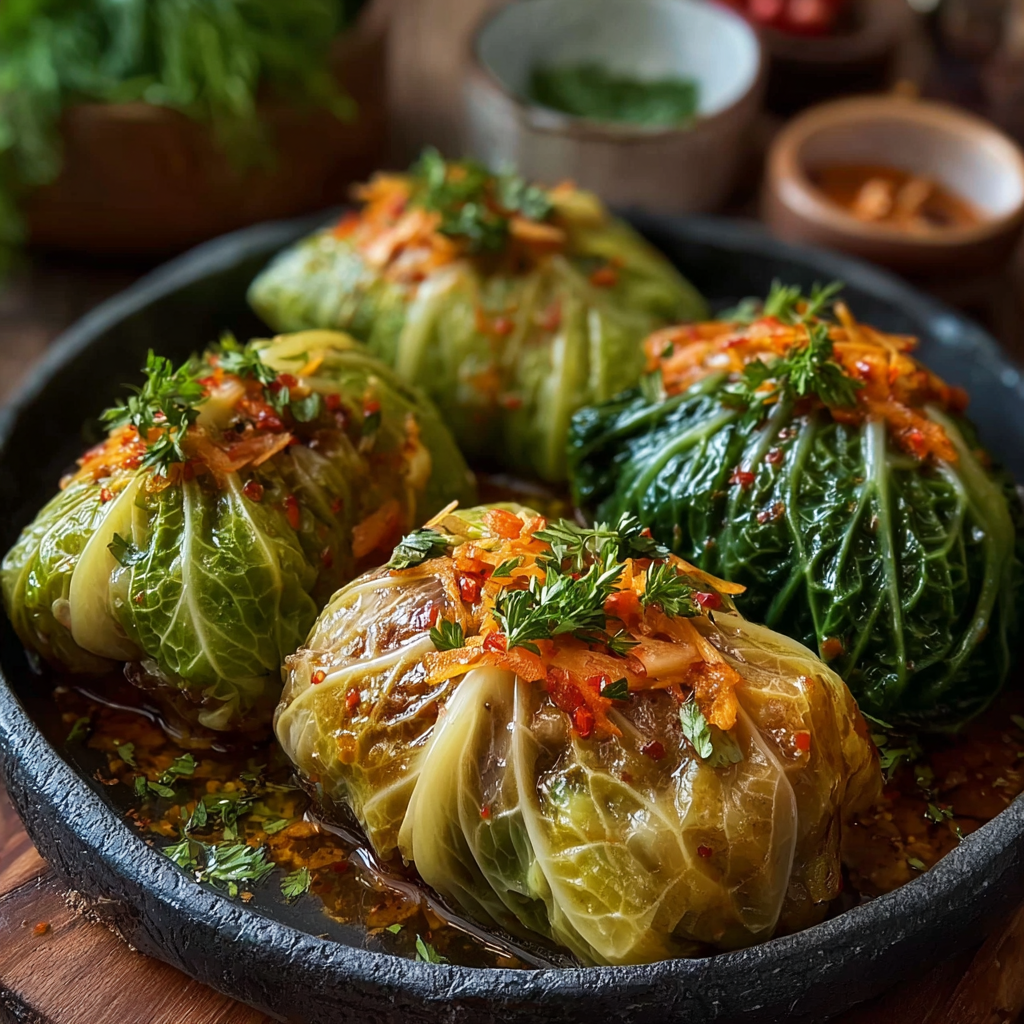
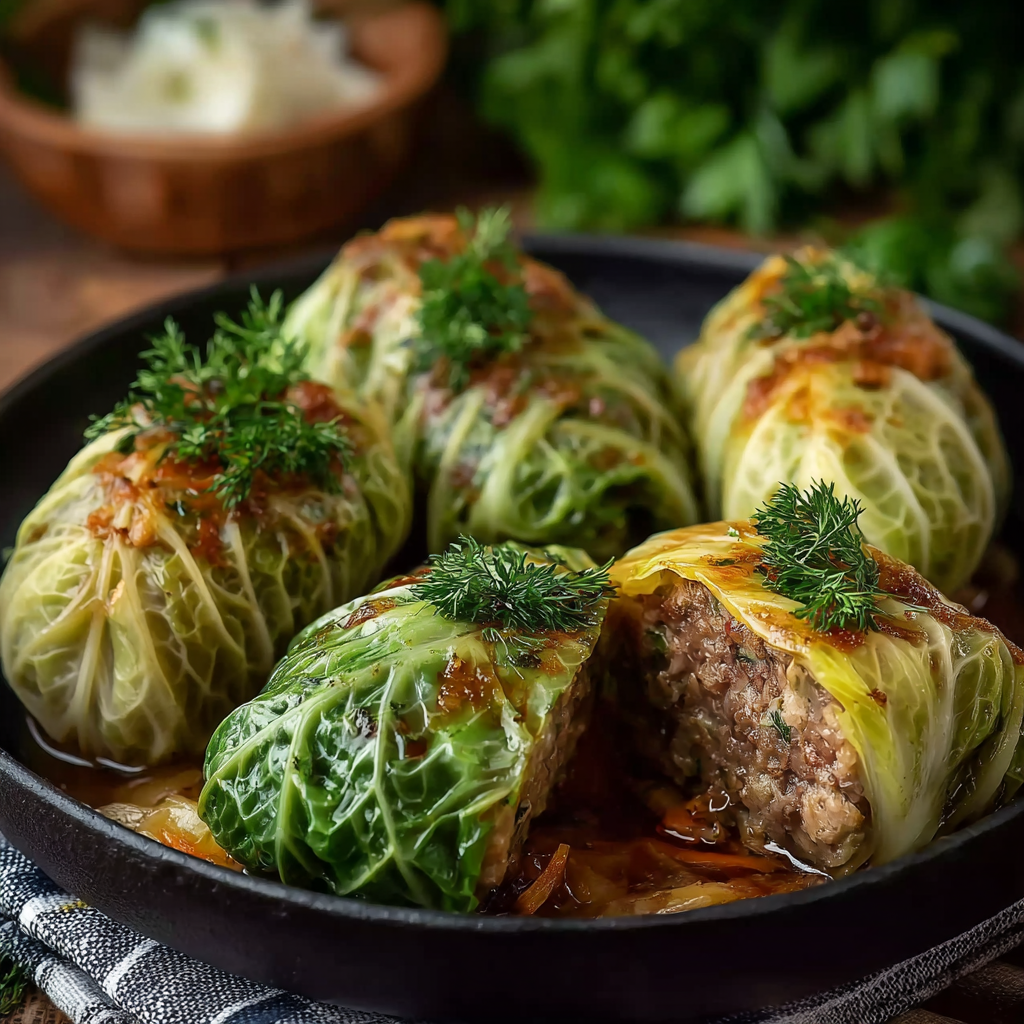
This traditional stuffed cabbage follows the Eastern European preparation most familiar in American home cooking — ground beef and pork combined with rice, seasoned with garlic and onion, wrapped in softened cabbage leaves, and braised in a sweet-sour tomato sauce that reduces during the long oven cook into something deeply concentrated and complex. The braising liquid is both the cooking medium and the sauce — and it is in the braising liquid that the dish reveals its true character, as the meat juices, the cabbage sweetness, the tomato acidity, and the brown sugar produce a sauce that is simultaneously familiar and extraordinary.
A 2023 nutritional review in the European Journal of Nutrition identified the combination of cabbage braised in tomato sauce as one of the most significant dietary sources of combined glucosinolates and lycopene — the glucosinolates from the cabbage and the lycopene from the cooked tomatoes both being fat-soluble compounds whose bioavailability increases significantly during the long, slow cooking process, making a properly braised stuffed cabbage measurably more nutritious than either ingredient consumed raw or briefly cooked.
Ingredients List
For the Cabbage
- 1 large head green cabbage (approximately 1.5–2kg / 3–4 lbs — you need large, intact outer leaves)
- Large pot of boiling salted water (for blanching)
For the Filling
- 400g (14 oz) ground beef (80/20)
- 200g (7 oz) ground pork (adds fat and richness — sub: all beef for a leaner version)
- 1 cup (185g) long-grain white rice, uncooked (it finishes cooking in the roll during braising)
- 1 medium onion, finely grated (grated onion dissolves into the filling — diced onion creates texture inconsistencies)
- 4 garlic cloves, finely minced
- 1 large egg
- 2 tbsp fresh flat-leaf parsley, finely chopped
- 1½ tsp fine sea salt
- 1 tsp freshly ground black pepper
- ½ tsp smoked paprika
- ½ tsp dried marjoram or dried thyme (the defining herb of Eastern European stuffed cabbage)
- ¼ tsp ground allspice (adds the warm, slightly sweet note that distinguishes traditional stuffed cabbage from a generic meat roll)
For the Braising Sauce
- 1 can (800g / 28 oz) crushed tomatoes
- 1 can (400g / 14 oz) diced tomatoes
- 1 cup (240ml) beef stock or chicken stock
- 2 tbsp brown sugar (the sweet element of the traditional sweet-sour sauce)
- 2 tbsp apple cider vinegar (the sour element)
- 1 medium onion, finely diced
- 3 garlic cloves, finely minced
- 1 tbsp olive oil
- 1 tsp smoked paprika
- 1 tsp Worcestershire sauce
- 1 tsp fine sea salt
- ½ tsp freshly ground black pepper
- 1 bay leaf
Timing
- Cabbage Blanching: 15 minutes
- Filling Preparation: 10 minutes
- Rolling: 20–25 minutes
- Braise Time: 1 hour 45 minutes to 2 hours
- Total Time: approximately 2 hours 45 minutes (mostly hands-off)
The active hands-on preparation is under 45 minutes — the remainder is the oven braise, during which the rolls become tender, the rice cooks through, and the braising sauce reduces into the deeply flavored, slightly sweet-sour tomato sauce that defines the dish.
Step-by-Step Instructions
Step 1: Blanch the Cabbage Leaves
Bring a very large pot of salted water to a rolling boil. Remove the tough outer leaves from the cabbage and discard. Using a sharp paring knife, cut a deep cone around the core at the base of the cabbage — removing as much of the core as possible to allow the leaves to separate more easily during blanching.
Lower the entire head of cabbage into the boiling water core-side down. As the outer leaves soften — approximately 3–4 minutes — they will begin to peel away from the head. Use tongs to peel these outer leaves off carefully and transfer to a colander to drain and cool. Return the head to the boiling water and continue removing leaves every 3–4 minutes until you have 14–16 large, pliable leaves. Reserve the smaller inner leaves and any cabbage fragments — these will be used to line the baking dish.
Key tip: The leaves must be genuinely pliable — soft enough to roll without cracking or tearing at the thick central rib. If a leaf is too stiff to bend gently without cracking, return it to the boiling water for another minute. Cracked leaves during rolling produce rolls that open during braising and lose their filling into the sauce.
Step 2: Trim the Thick Ribs
Place each blanched cabbage leaf flat on a work surface. The thick central rib runs from the stem end partway up the leaf — it is too rigid to roll over without causing the leaf to crack. Using a sharp knife or kitchen scissors, cut a shallow V-shape to remove the thickest portion of the rib — cutting approximately 3–4cm (1½ inches) into the leaf from the base. This creates a more flexible base for rolling without removing any meaningful leaf surface area.
Step 3: Make the Braising Sauce
Heat the olive oil in a large, oven-safe Dutch oven or casserole over medium heat. Add the diced onion and cook for 4–5 minutes until softened. Add the garlic and cook for 30 seconds. Add the crushed tomatoes, diced tomatoes, beef stock, brown sugar, apple cider vinegar, smoked paprika, Worcestershire sauce, salt, pepper, and bay leaf. Stir to combine and bring to a gentle simmer. Cook for 5 minutes to allow the flavors to begin integrating. Taste and adjust — the sauce should taste distinctly sweet-sour, as these flavors will mellow significantly during the 2-hour braise.
Step 4: Make the Filling
In a large bowl, combine the ground beef, ground pork, uncooked rice, finely grated onion, minced garlic, egg, parsley, salt, pepper, smoked paprika, marjoram, and allspice. Mix with your hands until just combined — the same just-combined principle that applies to meatballs applies here. Over-mixing develops the protein network and produces a dense, tough filling; under-mixing leaves unmixed pockets of seasoning.
Key tip: The rice goes into the filling uncooked — it finishes cooking during the braise, absorbing the meat juices and the braising sauce liquid and expanding to create the characteristic texture of properly made stuffed cabbage. Cooked rice added to the filling produces a mushy, over-soft result.
Step 5: Roll the Cabbage
Place a blanched, trimmed cabbage leaf on the work surface with the concave side facing up and the stem end pointing toward you. Place approximately 3–4 tablespoons of filling in the lower center of the leaf — shaped into a rough log approximately 7–8cm (3 inches) long. Fold the bottom edge of the leaf up and over the filling. Fold both sides inward — tucking them tightly against the filling. Roll the leaf away from you, wrapping the filling firmly and evenly as you go, until you reach the end of the leaf. The finished roll should feel firm and compact — neither so loose that the filling moves inside nor so tight that the roll splits when the rice expands during braising.
Repeat with the remaining filling and leaves — yielding approximately 14–16 rolls depending on leaf size.
Step 6: Arrange and Braise
Preheat the oven to 325°F (160°C). Spread any reserved small cabbage leaves and cabbage fragments across the bottom of the Dutch oven over the sauce — these create an additional layer that prevents the rolls from direct contact with the hot pot base and adding flavor to the sauce during braising. Arrange the stuffed cabbage rolls seam-side down in the pot in a single tight layer — fitting them snugly prevents them from unrolling during cooking. If a second layer is necessary, place it directly on top of the first layer.
Pour the remaining braising sauce over the rolls — it should come at least halfway up the sides of the top layer. If the sauce does not reach this level, add additional beef stock. Place the bay leaf in the sauce. Cover the Dutch oven tightly with a lid or aluminum foil.
Braise at 325°F (160°C) for 1 hour 45 minutes to 2 hours — until the cabbage is completely tender, the rice inside the rolls is fully cooked and expanded, and the sauce has reduced into a thickened, deeply flavored, slightly sweet-sour tomato base. Check at the 1.5-hour mark — insert a knife into the center of the largest roll, the rice should be fully soft with no chalky resistance remaining.
Step 7: Rest and Serve
Remove from the oven and allow to rest, covered, for 15 minutes — the rolls firm slightly during resting and become significantly easier to serve without breaking. Serve directly from the pot, ladling the braising sauce generously over each portion. The sauce is as important as the rolls — do not underserve it.
Nutritional Information
Per serving — based on 6 servings of 2–3 rolls each.
| Nutrient | Per Serving | % Daily Value* |
|---|---|---|
| Calories | 480 kcal | 24% |
| Total Fat | 18g | 23% |
| Saturated Fat | 7g | 35% |
| Total Carbohydrates | 48g | 17% |
| Total Sugar | 12g | — |
| Protein | 32g | 64% |
| Dietary Fiber | 6g | 21% |
| Sodium | 820mg | 36% |
| Iron | 25% DV | 25% |
| Vitamin C | 55% DV | 55% |
| Vitamin K | 65% DV | 65% |
*Based on a standard 2,000-calorie daily value.
The Vitamin C content at 55% of the daily recommended value — from the combined contribution of the tomato braising sauce and the cabbage — and the Vitamin K at 65% from the cabbage make this one of the most micronutrient-complete comfort food preparations available. The iron at 25% of the daily value from the ground beef contributes meaningfully to daily requirements.
Healthier Alternatives
Leaner filling: Replace the ground pork with an equal weight of ground turkey or chicken — the filling will be leaner but benefits from an additional tablespoon of olive oil stirred into the mixture to compensate for the reduced fat content and maintain moisture through the long braise.
Lower carbohydrate: Replace the white rice with an equal quantity of cauliflower rice — the cauliflower will soften completely during braising and its lower carbohydrate density reduces the total carbohydrate per serving by approximately 25 grams. The texture is slightly softer than the rice version.
Whole grain: Replace white rice with an equal quantity of brown rice — note that brown rice requires a longer braise time of 2 hours 15 minutes to cook completely through the filling, and additional stock may be needed to compensate for the longer cooking time.
Lower sodium: Use a low-sodium crushed tomato and reduce the salt in the filling to 1 teaspoon. The Worcestershire sauce and the inherent savory depth of the long-braised meat provide sufficient seasoning without the full salt quantity.
Vegetarian: Replace the ground meat with a combination of cooked lentils, finely diced mushrooms, and walnuts pulsed briefly in a food processor — season identically to the meat filling with garlic, onion, marjoram, allspice, and paprika. The braising time reduces to 1 hour 15 minutes. The filling lacks the same richness as the meat version but absorbs the braising sauce flavors beautifully.
Serving Suggestions
Classic Eastern European presentation: Serve 2–3 rolls per person in a wide, shallow bowl with a generous ladle of the braising sauce over the top and a spoonful of full-fat sour cream on the side — the sour cream stirred into the tomato sauce at the table produces a pink, slightly creamy variation of the sauce that many people prefer to the straight tomato version.
With mashed potatoes: Serve alongside a generous portion of buttery mashed potatoes — the braising sauce spooned over both the rolls and the potato produces a unified plate of concentrated comfort food that is simultaneously simple and deeply satisfying.
With crusty bread: A thick slice of sourdough or rye bread alongside the rolls — for soaking the braising sauce — is the most practical and most traditional accompaniment. The sauce is too good to leave in the pot.
As a make-ahead dinner party dish: This is one of the finest make-ahead dinner party main courses available — made 1–2 days ahead and gently reheated, the flavors deepen and the rolls become more cohesive and tender. The day-two version is demonstrably better than the day-one version.
Family-style at the table: Bring the entire Dutch oven to the table and serve directly from the pot — the visual impact of the tightly packed rolls in their deep, rich sauce is substantial and communicates the generosity and tradition that defines this dish.
Common Mistakes to Avoid
Under-blanching the cabbage leaves. Stiff, incompletely softened leaves crack during rolling and produce rolls that open during braising, losing their filling into the sauce. Every leaf must be genuinely pliable before rolling — return any stiff leaves to the boiling water for additional softening.
Using cooked rice in the filling. Cooked rice produces a mushy, over-soft filling because it has already absorbed its maximum liquid capacity before the braise begins and cannot absorb the meat juices and sauce that produce the characteristic texture of properly made stuffed cabbage. Always use uncooked rice.
Not trimming the thick central rib. The untrimmed rib creates a rigid ridge in the center of the leaf base that prevents a tight, compact roll — producing loose, misshapen rolls that open during cooking. The V-cut is a 5-second step that prevents this entirely.
Insufficient braising liquid. The rice in the filling absorbs significant liquid during the braise — the sauce must cover at least halfway up the top layer of rolls or the upper rolls will be undercooked, with chalky uncooked rice still at their centers when the lower rolls are done. Check the liquid level at the 1-hour mark and add additional stock if needed.
Not tasting and adjusting the sauce before braising. The braising sauce must taste assertively sweet-sour before the braise begins — both elements mellow significantly during the 2-hour cooking process. A sauce that tastes balanced before braising will taste flat and under-seasoned in the finished dish.
Storing Tips
Refrigerator: Store in an airtight container for up to 5 days — this is one of the recipes that improves most dramatically with overnight storage, as the braising sauce continues to permeate the rolls and the flavors integrate and deepen completely. The day-three version is arguably the best version.
Reheating: Reheat covered in a 325°F (160°C) oven for 25–30 minutes with an additional splash of beef stock stirred into the sauce to compensate for thickening during refrigeration. The microwave works at 70% power in 90-second intervals with the rolls covered — add a tablespoon of water before microwaving to prevent the sauce from drying.
Freezer: Freeze cooked rolls in the sauce in airtight containers for up to 3 months — one of the best freezer meals available in any category. Thaw overnight in the refrigerator and reheat as directed. The texture is virtually indistinguishable from fresh after proper reheating.
Make-ahead: Assemble the rolls and arrange in the pot up to 24 hours before braising — cover and refrigerate. Add 15 minutes to the braising time when cooking from cold. Alternatively, braise completely and refrigerate for up to 2 days before serving — reheating a pre-braised dish is faster and the flavor is better than freshly braised.
Conclusion
Traditional stuffed cabbage proves that the most deeply satisfying comfort food is frequently the one that required the most patience — not technical skill or rare ingredients, but the patience to allow a modest combination of ground meat, rice, and cabbage to spend nearly two hours in a sweet-sour tomato braise that transforms every component into something greater than any of them could achieve independently. The dish that has sustained families across generations and continents, made in your own kitchen, in your own Dutch oven, with the same result that made it worth preserving across four hundred years of culinary history.
Make it and share your results in the comments — tell us which variation you made, whether you added sour cream at the table, and how the day-two version compared to the first serving. Leave a review, share with someone who has family memories of stuffed cabbage or has never encountered it, and subscribe to our newsletter for more tradition-rooted, deeply flavored, comfort-first recipes every week.
FAQs
Can I make stuffed cabbage in a slow cooker? Yes — arrange the assembled rolls in the slow cooker seam-side down, pour the braising sauce over, and cook on low for 7–8 hours or high for 4–5 hours. The slow cooker version produces extremely tender rolls and a deeply flavored sauce with a slightly different texture than the oven-braised version — the cabbage becomes very soft and the sauce thickens less than in the oven. Both versions are excellent — the slow cooker is particularly practical for make-ahead preparation.
What if my cabbage leaves tear during rolling? Overlap two smaller or torn leaves slightly to create a larger rolling surface — the overlapping leaves will bond together during braising and the resulting roll will hold together effectively. Alternatively, if the tear is in the center of the leaf, patch it with a small piece of leaf pressed against the tear before adding the filling. Most tears can be accommodated without producing a roll that opens during cooking.
Why is my rice still hard after the full braising time? Two possible causes: insufficient liquid in the braising pot — the rice needs adequate liquid to absorb — or too little braising time. Add ½ cup of hot beef stock, ensure the pot is tightly covered, and return to the oven for an additional 20–30 minutes. Verify the oven temperature with a separate thermometer as ovens that run cool are a common cause of under-cooked rice in braised dishes.
Can I use Savoy cabbage instead of green cabbage? Yes — Savoy cabbage has a more tender, more crinkled leaf than green cabbage and requires slightly less blanching time to achieve the correct pliability. Its flavor is slightly more delicate and sweeter than green cabbage — producing a roll with a more refined character. It is the preferred choice in some European traditions and produces an equally excellent finished dish.
What is the correct internal temperature for the finished rolls? The filling should reach 160°F (71°C) for ground beef and pork — verifiable with an instant-read thermometer inserted into the center of the largest roll. At this temperature, the rice will be fully cooked, the meat will be thoroughly done, and the braising sauce will have reduced to the correct consistency. If the sauce has reduced but the thermometer reads below 160°F, add additional stock, re-cover, and continue braising.
How do I prevent the rolls from opening during braising? Three measures prevent unrolling: ensuring the leaves are sufficiently pliable before rolling; rolling firmly and compactly without leaving excess air inside the roll; and placing rolls seam-side down in the braising pot. The seam-side-down placement is the most important — the weight of the roll and the surrounding sauce hold the seam closed during the entire braise without any additional securing required.