Follow Me On Social Media!
California Sushi Bowl

Introduction
Here is a question that reframes the entire category of sushi-inspired home cooking: why does the California roll — one of the most beloved, most widely consumed sushi preparations in the Western world — remain something that most home cooks order rather than make, when the deconstructed bowl format takes the identical ingredients and eliminates every element of the preparation that makes conventional sushi intimidating — the rolling mat, the precise rice spreading, the tight cylinder forming, the even cutting — while producing something that is simultaneously more casual, more customizable, more generous in its ingredient ratios, and just as delicious?
According to a 2024 consumer food behavior report by the Specialty Food Association, sushi-inspired home cooking represents one of the fastest-growing categories in the meal kit and recipe search space globally — driven by the recognition that the component ingredients of great sushi are not technically demanding to prepare individually, and that the bowl format makes the entire concept approachable without any specialist equipment, any prior rolling experience, or any ingredient that is not available at a well-stocked supermarket.
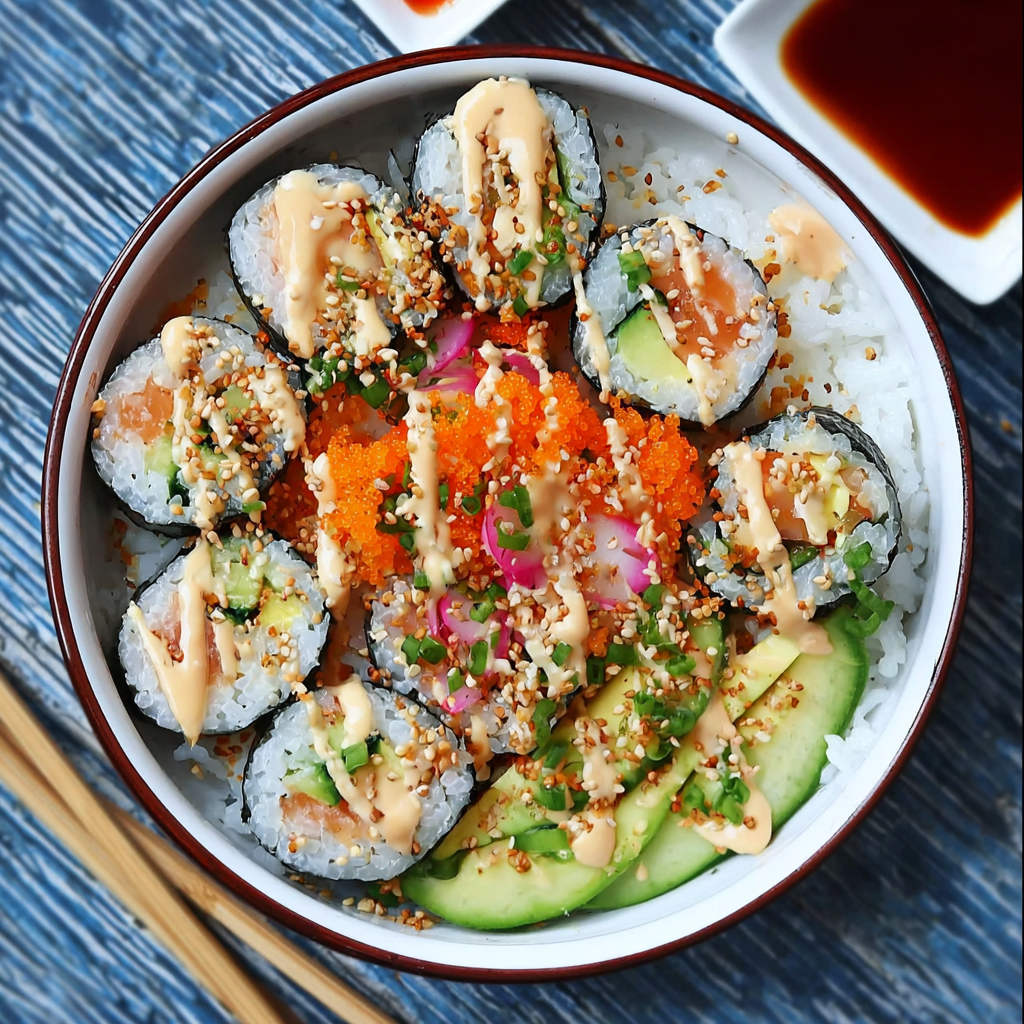
This California sushi bowl takes the three defining elements of the California roll — seasoned sushi rice, imitation crab or real crab, cucumber, and avocado — and builds them into a bowl that also incorporates the sauces, toppings, and textural elements that make restaurant sushi so satisfying: a sriracha mayo that provides richness and heat, a soy-sesame dressing that ties every component together, pickled ginger, toasted sesame seeds, and a sheet of nori torn into pieces that provide the roasted seaweed flavor of sushi in every bite. It is the recipe that makes sushi night at home genuinely, completely possible without a single roll being formed.
A 2023 nutritional review in the Asia Pacific Journal of Clinical Nutrition identified the combination of sushi rice vinegar seasoning, raw cucumber, avocado, and seafood as one of the most complete single-bowl macronutrient profiles available from any bowl-format meal — the complex carbohydrates from the rice, the complete protein and omega-3 from the seafood, the healthy monounsaturated fat from the avocado, and the Vitamin C and fiber from the cucumber and vegetables producing a balanced, satiating meal that covers the major nutritional bases in proportions closely matching current dietary recommendations.
Ingredients List
For the Sushi Rice
- 2 cups (370g) Japanese short-grain sushi rice (Koshihikari or Calrose — the sticky, starchy character is essential)
- 2½ cups (600ml) cold water
- 3 tbsp rice wine vinegar
- 1½ tbsp granulated sugar
- 1 tsp fine sea salt
For the Bowl Components
- 300g (10.5 oz) imitation crab sticks, shredded or chopped (sub: real crab meat, cooked shrimp, or cooked salmon for a premium version)
- 1 large ripe avocado, diced or sliced
- 1 English cucumber, thinly sliced or diced
- 1 cup (150g) edamame, shelled and cooked (from frozen — thawed and patted dry)
- ½ cup (75g) cherry tomatoes, halved (optional)
- 2 spring onions, thinly sliced
- 1 sheet nori, torn into small pieces or cut into thin strips
- 2 tbsp toasted sesame seeds, white and black combined
- Pickled ginger (the essential accompaniment)
- Wasabi paste (to taste)
For the Sriracha Mayo
- 4 tbsp Japanese mayonnaise (Kewpie — its higher egg yolk content and rice vinegar make it distinctly richer than regular mayo)
- 1½ tbsp sriracha (adjust to heat preference)
- 1 tsp fresh lemon juice
- ½ tsp toasted sesame oil
For the Soy-Sesame Dressing
- 3 tbsp low-sodium soy sauce or tamari
- 1 tbsp rice wine vinegar
- 1 tsp toasted sesame oil
- 1 tsp honey or maple syrup
- ½ tsp fresh ginger, finely grated
- 1 small garlic clove, finely minced
Timing
- Rice Cook Time: 20 minutes (plus 10 minutes resting)
- Rice Seasoning and Cooling: 15 minutes
- Assembly: 10 minutes
- Total Time: 55 minutes
Step-by-Step Instructions
Step 1: Cook and Season the Sushi Rice
Rinse the sushi rice in cold water — changing the water 4–5 times until it runs completely clear. The rinsing removes excess surface starch that would make the cooked rice gummy and clumped rather than sticky and distinct. Place the rinsed, drained rice in a medium saucepan with the cold water. Bring to a boil over medium-high heat, then immediately reduce to the absolute lowest heat setting, cover with a tight-fitting lid, and cook for 15 minutes. Remove from heat and rest, covered, for 10 minutes — do not lift the lid during either the cooking or resting period.
While the rice cooks, combine the rice wine vinegar, sugar, and salt in a small saucepan over low heat — or in a microwave-safe bowl at 30-second intervals — until the sugar and salt are completely dissolved. Allow to cool slightly.
Transfer the cooked rice to a large, wide, non-metallic bowl — wood or plastic, as metal conducts the heat unevenly and can react with the vinegar. Pour the vinegar seasoning over the rice and fold gently with a wooden paddle or spatula using cutting and folding motions rather than stirring — stirring breaks the rice grains and produces a paste rather than individual seasoned grains. Fan the rice as you fold to cool it rapidly — a hand-held fan, a folded piece of cardboard, or a partner fanning while you fold are the traditional methods. The correct seasoned sushi rice is glossy, slightly sticky, distinctly tangy, and just above room temperature — not hot, not cold.
Key tip: The cooling step — achieved by fanning while folding — is what produces the characteristic sheen and separate-but-sticky texture of properly seasoned sushi rice. Sushi rice left to cool without fanning develops a dull surface and a slightly damp, clumped texture.
Step 2: Make the Sriracha Mayo
Combine the Japanese mayonnaise, sriracha, lemon juice, and sesame oil in a small bowl. Whisk until completely smooth and uniformly colored. Transfer to a squeeze bottle or a small zip-lock bag with a corner snipped for precise drizzling — the sriracha mayo is a finishing element and its application in a thin, decorative drizzle communicates intentionality more clearly than a spoonful.
Key tip: Kewpie Japanese mayonnaise is worth seeking out for this recipe — its higher egg yolk content, the use of rice vinegar rather than distilled vinegar, and the slightly richer, more umami character make the finished sriracha mayo significantly more complex than the same preparation made with standard mayonnaise.
Step 3: Make the Soy-Sesame Dressing
Combine the soy sauce, rice wine vinegar, sesame oil, honey, grated ginger, and minced garlic in a small bowl or jar. Whisk or shake to combine. Taste and adjust — more honey for sweetness, more soy sauce for depth, more vinegar for brightness.
Step 4: Prepare the Crab and Toppings
If using imitation crab sticks, separate into individual strands by gently pulling apart along the natural grain of the surimi — this produces long, stringy pieces that have more surface area for the sriracha mayo to cling to than roughly chopped pieces. For real crab meat, gently separate into flakes. Dice the avocado and toss immediately with a squeeze of lemon juice to prevent browning. Slice or dice the cucumber. Thaw and pat dry the edamame.
Step 5: Assemble the Bowls
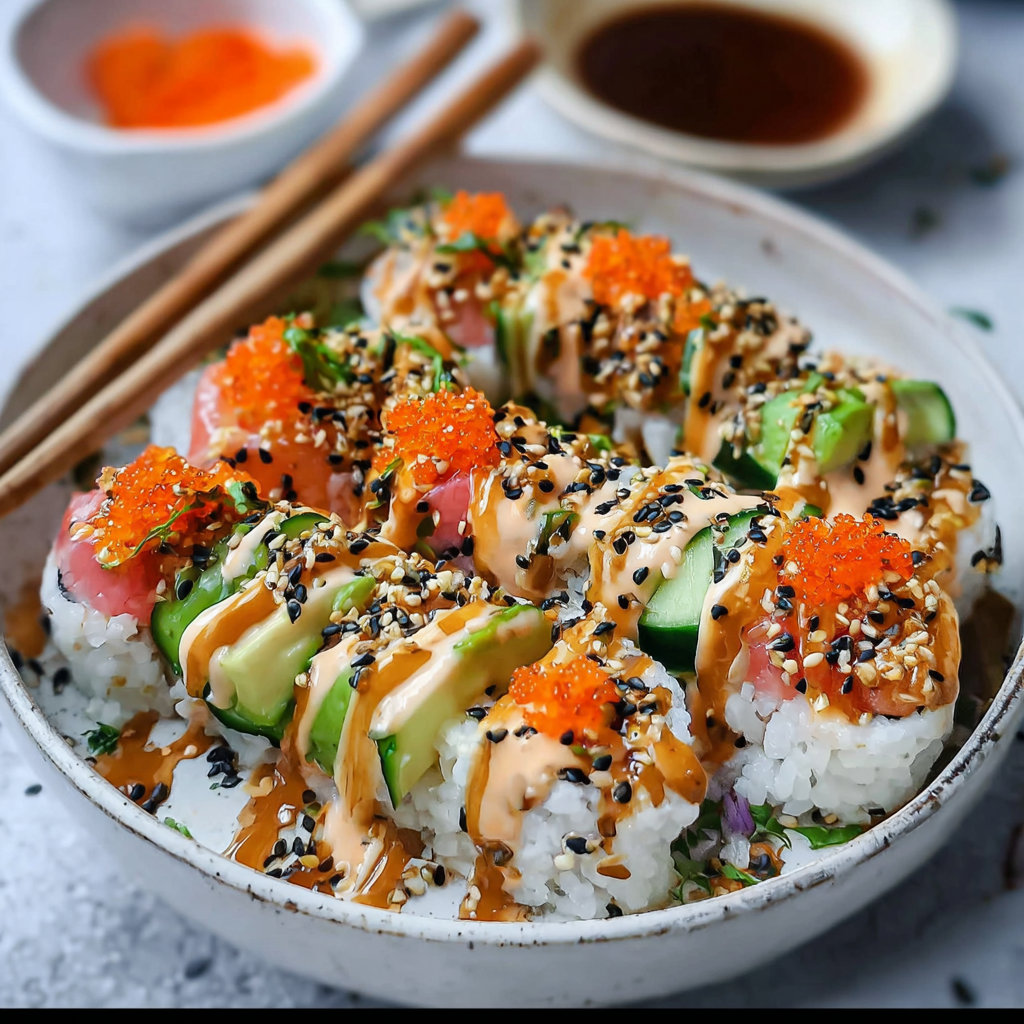
Divide the seasoned sushi rice between 4 wide, shallow bowls — a generous, packed base of approximately ¾ cup per bowl. Arrange the components over the rice — there is no single correct arrangement, but a pattern of adjacent sections rather than a mixed jumble produces a more visually appealing bowl. Position the crab, avocado, cucumber, edamame, cherry tomatoes, and spring onions in distinct sections around the bowl, allowing the white rice to show between components as a visual separator.
Scatter torn nori pieces and toasted sesame seeds over the top. Place a small heap of pickled ginger alongside and a small amount of wasabi paste for those who want it. Drizzle the sriracha mayo over the crab and avocado — and across the entire surface if desired — using the squeeze bottle or snipped bag for a decorative zigzag pattern. Drizzle the soy-sesame dressing over the entire bowl just before serving.
Nutritional Information
Per serving — based on 4 servings with imitation crab.
| Nutrient | Per Serving | % Daily Value* |
|---|---|---|
| Calories | 520 kcal | 26% |
| Total Fat | 18g | 23% |
| Saturated Fat | 3g | 15% |
| Total Carbohydrates | 74g | 27% |
| Total Sugar | 8g | — |
| Protein | 18g | 36% |
| Dietary Fiber | 6g | 21% |
| Sodium | 780mg | 34% |
| Vitamin C | 22% DV | 22% |
| Vitamin K | 35% DV | 35% |
| Folate | 20% DV | 20% |
*Based on a standard 2,000-calorie daily value.
The folate content at 20% of the daily recommended value — from the combined contribution of edamame and avocado — and the Vitamin K at 35% from the avocado and nori make this one of the more micronutrient-complete bowl preparations available in this collection. Replacing imitation crab with real crab or cooked salmon pushes the protein content above 30 grams per serving.
Healthier Alternatives
Higher protein: Replace imitation crab with cooked salmon — either leftover or briefly pan-seared — pushing the protein content to 28–32 grams per serving and significantly increasing the omega-3 content. Sushi-grade raw salmon works equally well for those comfortable with raw fish at home.
Lower carbohydrate: Replace half or all of the sushi rice with cauliflower rice — seasoned with the same vinegar, sugar, and salt mixture. The cauliflower takes the seasoning well and produces a lower-carbohydrate bowl with comparable flavor.
Lower sodium: Use coconut aminos in place of soy sauce in the dressing — approximately 65% less sodium with a naturally sweeter profile. Reduce the salt in the rice seasoning to ½ teaspoon.
Vegan: Replace imitation crab — which typically contains egg white — with marinated and seared tofu cut into strips, seasoned with soy sauce, mirin, and sesame oil. Replace Kewpie mayo with a vegan Japanese-style mayo for the sriracha sauce.
Higher fiber: Add ½ cup of shredded purple cabbage and a handful of mixed sprouts to the bowl — both add significant crunch, fiber, and visual color contrast without disrupting the sushi bowl flavor profile.
Serving Suggestions
Family dinner format: Set out all components separately — the rice in a large bowl, all toppings in individual bowls, and both sauces in squeeze bottles — and allow everyone to build their own bowl. This self-assembly format is particularly popular with children and accommodates different preferences and dietary requirements simultaneously.
Meal prep lunch: Divide the seasoned rice into containers, top with all components except the avocado and dressings, and refrigerate for up to 2 days. Add fresh avocado, the sriracha mayo, and the soy-sesame dressing at the moment of eating. A complete, restaurant-quality sushi bowl available every weekday from a single Sunday preparation session.
Party platter: Arrange all components separately on a large, wide platter or board — the rice in a central bowl, the components arranged around it in sections, the sauces in small squeeze bottles or bowls — for a sushi bowl station where guests build their own. This format scales easily to a crowd of 10–20 and requires no individual plating.
With miso soup: Serve alongside a simple miso soup — miso paste dissolved in hot water with tofu and spring onion — for the complete Japanese meal experience that makes the bowl feel like a restaurant visit rather than a weeknight dinner.
Common Mistakes to Avoid
Not rinsing the rice. Unrinsed sushi rice has excess surface starch that makes the cooked rice gummy, heavy, and clumped — producing a base that cannot be lightly seasoned and fanned to the glossy, separate-but-sticky texture of properly prepared sushi rice. Five cold water rinses until the water runs clear is the minimum preparation.
Not fanning the rice while seasoning. Sushi rice that is not fanned during the vinegar folding step develops a dull surface and a damp, slightly pasty texture — both from the retained steam and moisture. Fanning as you fold removes this steam and produces the characteristic sheen of correctly seasoned sushi rice.
Using regular mayonnaise instead of Kewpie. Standard mayonnaise produces a sriracha sauce that is flat, slightly sweet, and lacking the depth of Kewpie. The investment in a bottle of Japanese mayonnaise — available at most supermarkets and all Asian grocery stores — is immediately justified by the difference in the finished sauce.
Adding the dressing too early. The soy-sesame dressing applied to the assembled bowl more than a few minutes before eating soaks into the rice and produces a heavy, over-dressed base. Apply immediately before eating for the best result.
Not patting the avocado dry. Avocado with excess surface moisture from rinsing or cutting releases juice that dilutes the surrounding sauces. Pat dry and toss with lemon juice immediately after cutting.
Storing Tips
Seasoned rice: Sushi rice is best the day it is made — refrigerated rice hardens significantly as the starch retrogrades. If making ahead, store at room temperature covered with a damp towel for up to 4 hours. For longer storage, refrigerate and re-steam briefly before serving.
Assembled bowls: Not suitable for storage — the avocado oxidizes, the nori softens, and the rice hardens. Assemble immediately before eating.
Components separately: All components except the avocado store separately in the refrigerator for up to 3 days — the crab, edamame, cucumber, and both sauces all hold well. Assemble with fresh avocado daily for meal prep.
Sauces: The sriracha mayo stores in a sealed container for up to 1 week. The soy-sesame dressing stores for up to 2 weeks. Both improve slightly over the first 24 hours as the flavors integrate.
Conclusion
The California sushi bowl proves that the most approachable version of a beloved restaurant experience is not a simplified or inferior version but a different — and in many ways superior — format that delivers the same ingredients, the same flavors, and the same satisfaction without the technique barrier that keeps most people ordering rather than making. Seasoned sushi rice, crab, avocado, cucumber, edamame, sriracha mayo, and soy-sesame dressing: the California roll deconstructed, rebuilt in a bowl, and made achievable on any weeknight without a rolling mat in sight.
Make it and share your results in the comments — tell us whether you used imitation crab or a premium seafood upgrade, which toppings you added, and whether the Kewpie mayo made the difference it always does. Leave a review, share with someone who loves sushi but has never tried making it at home, and subscribe to our newsletter for more globally inspired, approachable, restaurant-quality bowl recipes every week.
FAQs
What is the difference between sushi rice and regular rice? Sushi rice — specifically Japanese short-grain varieties such as Koshihikari and Calrose — has a higher starch content and a rounder grain structure that produces a stickier, more cohesive cooked rice that holds together when pressed but separates into individual glossy grains when lightly tossed. Long-grain rice varieties lack the starch content to achieve this and produce a dry, separate-grained rice that does not hold the vinegar seasoning or the bowl’s components in the same way. Short-grain sushi rice is the non-substitutable base ingredient of this recipe.
Can I use brown sushi rice? Yes — brown sushi rice is available at well-stocked supermarkets and Asian grocery stores. It requires additional water — approximately 2¾ cups per 2 cups of rice — and a longer cooking time of 35–40 minutes. It produces a nuttier, more complex rice with additional fiber. The vinegar seasoning method is identical.
Is imitation crab the same as real crab? Imitation crab — surimi — is made from processed white fish (typically pollock) seasoned and colored to approximate the flavor and appearance of real crab. It is entirely safe and widely used in American-style sushi preparations. Real crab meat produces a sweeter, more complex flavor and a higher protein content — it is worth using when available and within budget. The texture and flavor difference is noticeable but both produce an excellent sushi bowl.
What can I substitute for pickled ginger? Quick-pickled thin-sliced fresh ginger — sliced paper-thin on a mandoline, salted for 5 minutes, rinsed, and dressed with rice wine vinegar and a pinch of sugar — approximates commercially made pickled ginger in approximately 20 minutes. Thinly sliced pickled radish is a visually dramatic alternative. For those who dislike ginger, a small heap of pickled cucumber or pickled daikon provides a comparable palate-cleansing acidic element without the ginger character.
How do I make this bowl suitable for children? Omit the wasabi entirely and reduce or omit the sriracha from the mayo — replace with a small amount of sweet chili sauce for a milder, sweeter sauce. Most children enjoy the rice, avocado, cucumber, edamame, and sesame seeds without any spice component — the bowl remains visually interesting and flavorful without any heat.
Can I add raw fish to this bowl? Yes — sushi-grade raw salmon, tuna, or yellowtail can be sliced and added to the bowl as an additional topping for a genuinely premium sushi bowl experience. Use only fish specifically labeled sushi-grade or sashimi-grade — this designation indicates the fish has been handled and frozen to food safety standards appropriate for raw consumption. Standard supermarket fish, even when fresh, is not suitable for raw consumption.