Follow Me On Social Media!
Crispy Chicken Caesar Salad

Introduction
Here is a question that addresses the gap between the Caesar salad that everyone orders and the Caesar salad that everyone actually wants: why does the version that arrives at most restaurant tables — crisp romaine, adequate dressing, bland croutons, and a protein that was clearly not conceived as part of the same dish — fall so consistently short of the Caesar salad that exists in the imagination, when the techniques required to close that gap are not sophisticated, not time-consuming, and not dependent on any ingredient that cannot be found at a supermarket?
According to a 2024 consumer dining preference survey by the National Restaurant Association, Caesar salad ranks as the single most ordered salad in American restaurants for the twenty-seventh consecutive year — yet it also ranks among the most frequently described as disappointing, with the primary complaints being insufficient dressing, soggy or flavorless croutons, and protein that was added as an afterthought rather than integrated as a defining component. This crispy chicken Caesar salad corrects all three with the same principle that improves every recipe in this collection: deliberate technique applied to every component rather than to one impressive element surrounded by neglected supporting cast.
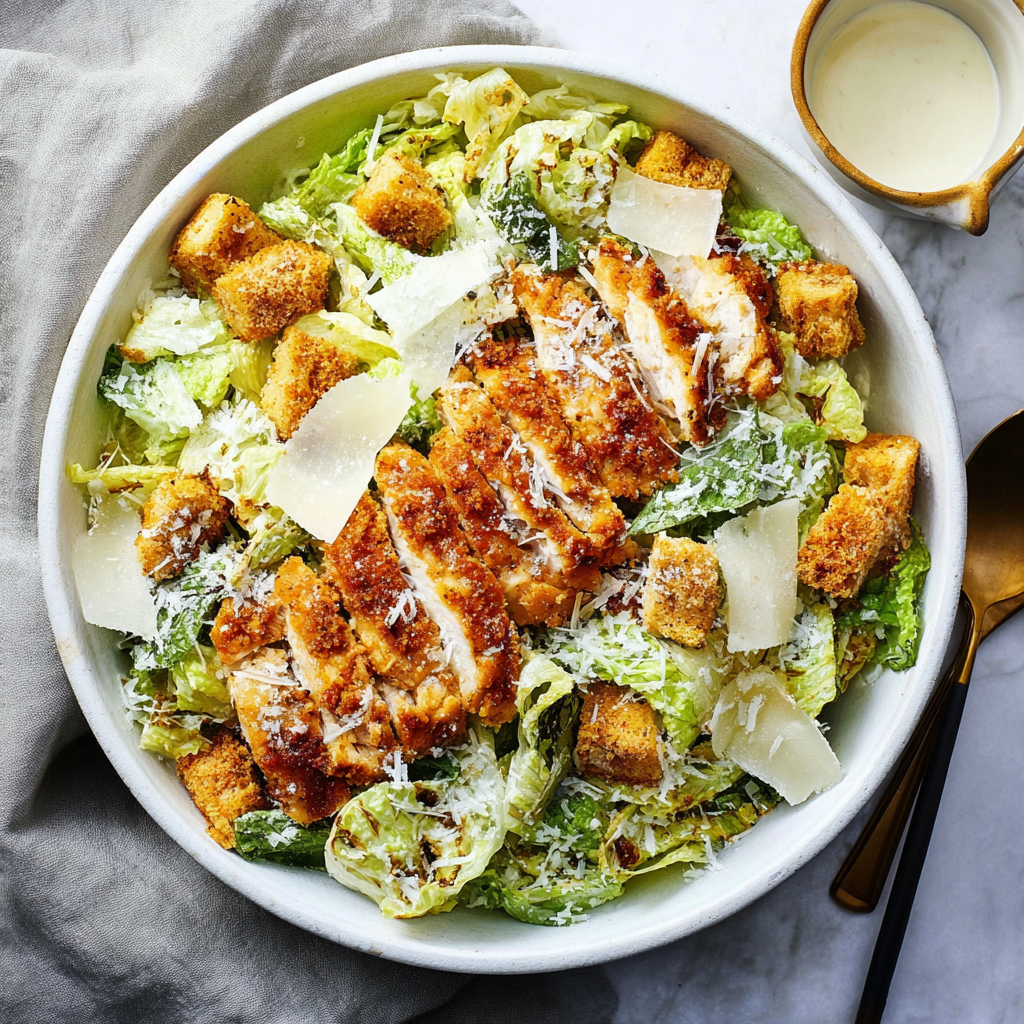
The crispy chicken — seasoned, breaded in panko and Parmesan, pan-fried until shatteringly golden — is not a topping on a Caesar salad. It is the co-equal partner of the dressing, the romaine, and the croutons in a composition where every element is treated as indispensable. The dressing is the classic anchovy-garlic-Parmesan emulsion that Caesar Cardini created in Tijuana in 1924 — not a bottled approximation but the genuine preparation that explains why this salad has been ordered more than any other for a century. The croutons are torn sourdough tossed in garlic butter and toasted until they shatter. And the romaine is properly dried, properly dressed, and served immediately — before the dressing has any time to wilt the leaves it took 30 seconds to dress.
A 2023 culinary history analysis by the Oxford Companion to Food identified the original Caesar salad as one of the most precisely reproducible historic restaurant recipes available — Caesar Cardini’s daughter Rosa released the original recipe in 1948, and it has been verified against contemporary accounts as containing: romaine, olive oil, lemon juice, Worcestershire sauce, coddled egg, garlic, Parmesan, and croutons — no anchovy in the original, though Cardini’s brother Alex’s competing version added anchovy paste and that version has become dominant.
Ingredients List
For the Crispy Chicken
- 4 boneless, skinless chicken breasts (approximately 180–200g / 6–7 oz each)
- 1 tsp fine sea salt
- ½ tsp freshly ground black pepper
- ½ tsp garlic powder
- ½ tsp smoked paprika
- ½ cup (60g) all-purpose flour, seasoned with salt and pepper
- 2 large eggs, beaten with 1 tbsp water (egg wash)
- 1½ cups (90g) panko breadcrumbs
- ½ cup (50g) Parmesan, finely grated (mixed into the panko)
- ½ tsp dried Italian seasoning
- Neutral oil, for pan-frying (approximately ½ cup / 120ml)
For the Caesar Dressing
- 4 anchovy fillets, finely minced to a paste (or 1½ tsp anchovy paste)
- 3 garlic cloves, finely minced or pressed
- 1 tbsp fresh lemon juice
- 1 tsp Worcestershire sauce
- 1 tsp Dijon mustard (emulsifier — holds the dressing together)
- 1 large egg yolk (creates the creamy emulsified base — sub: 2 tbsp mayonnaise for a no-raw-egg version)
- ½ cup (120ml) extra virgin olive oil
- 3 tbsp Parmesan, finely grated
- Salt and freshly ground black pepper to taste
- 1–2 tbsp cold water (to adjust consistency)
For the Croutons
- 4 thick slices sourdough bread, torn into irregular 2–3cm pieces (torn produces more surface area for crispiness than cubed)
- 3 tbsp unsalted butter, melted
- 1 tbsp olive oil
- 2 garlic cloves, pressed or very finely minced
- ½ tsp dried Italian herbs
- Pinch of fine sea salt
For the Salad
- 2 large heads romaine lettuce, outer leaves removed (approximately 400g / 14 oz of inner leaves — the crisp inner leaves are the correct part of the romaine)
- ½ cup (50g) Parmesan, shaved with a vegetable peeler
- Freshly ground black pepper
Timing
- Crouton Time: 12 minutes (can be made ahead)
- Dressing Time: 5 minutes (can be made ahead)
- Chicken Prep: 10 minutes
- Chicken Fry Time: 12 minutes
- Assembly: 5 minutes
- Total Time: 40–45 minutes
Step-by-Step Instructions
Step 1: Make the Croutons
Preheat the oven to 375°F (190°C). Tear the sourdough into irregular pieces — the torn edges and irregular surfaces produce more caramelized, more texturally complex croutons than the uniform surfaces of cubed bread. Combine the melted butter, olive oil, pressed garlic, dried herbs, and salt in a bowl. Add the torn bread and toss thoroughly until every piece is evenly coated — using your hands to ensure the butter reaches every surface. Spread on a parchment-lined baking sheet in a single layer.
Bake for 10–12 minutes until deeply golden across all exposed surfaces and completely crispy throughout — they should shatter when pressed between two fingers rather than compressing. Allow to cool completely before using — warm croutons wilt the surrounding romaine within 2 minutes of contact.
Step 2: Make the Caesar Dressing
In a wide, shallow bowl or large jar, combine the minced anchovy paste, pressed garlic, lemon juice, Worcestershire sauce, and Dijon mustard. Whisk together until the anchovies are completely dissolved into the other ingredients — no visible pieces should remain. Add the egg yolk and whisk to incorporate.
Begin adding the olive oil in the slowest possible stream — drops at first, then a thin thread — whisking continuously. The emulsion will build gradually, thickening from a thin mixture to the creamy, coating consistency of a properly made Caesar dressing. Once all the oil is incorporated, whisk in the grated Parmesan. Taste and adjust with salt, pepper, and additional lemon juice. Add cold water — 1 tablespoon at a time — to reach a dressing that is fluid enough to coat leaves but thick enough to cling rather than pool.
Key tip: The slow oil addition is the technique that produces a stable emulsion — adding oil too quickly causes the dressing to break into a thin, separated liquid rather than the thick, creamy consistency that coats romaine leaves effectively. If the dressing breaks, add 1 teaspoon of cold water and whisk vigorously — it often re-emulsifies.
Step 3: Bread the Chicken
If the chicken breasts are very thick — over 2cm at the thickest point — butterfly or pound to an even thickness of approximately 1.5–2cm. Even thickness is essential for even cooking — thick and thin areas cook at different rates and produce dry thin areas before the thick center is cooked through.
Set up the breading station: seasoned flour in the first dish, egg wash in the second, and the panko-Parmesan-Italian seasoning combination in the third. Season each breast on both sides with salt, pepper, garlic powder, and smoked paprika. Dredge in flour — shaking off all excess. Dip in egg wash — allowing excess to drip off for 3 seconds. Press firmly into the panko mixture — coating all surfaces completely with active pressing rather than gentle dipping.
Key tip: The Parmesan mixed into the panko produces a crust that is more complex, more golden, and more deeply flavored than plain panko — the cheese proteins caramelize alongside the breadcrumb starches during frying, adding a savory, slightly nutty dimension to every bite of the crust.
Step 4: Fry the Chicken
Heat the neutral oil in a large, heavy-bottomed skillet over medium-high heat until it reaches 350°F (175°C) — test with a panko crumb, which should sizzle immediately and turn golden within 15 seconds. Add the breaded chicken breasts — two at a time to maintain oil temperature — and cook undisturbed for 5–6 minutes until the underside is deeply golden. Flip carefully with a thin spatula and cook for another 4–5 minutes until the second side is equally golden and the chicken is cooked through to 165°F (74°C).
Transfer to a wire rack — not paper towels, which trap steam and soften the bottom crust. Rest for 3 minutes before slicing diagonally.
Step 5: Prepare and Dress the Romaine
Separate the romaine leaves, wash in cold water, and spin completely dry in a salad spinner — or pat dry with clean kitchen towels. Any surface water dilutes the dressing and prevents adhesion. Tear or cut the larger leaves into 5–7cm pieces — smaller than most Caesar salads tend to serve, which ensures every forkful catches both dressing and Parmesan in the correct proportion.
In a large bowl, pour approximately two-thirds of the dressing over the romaine and toss thoroughly — using tongs or two large spoons — until every leaf is evenly and completely coated. Taste a leaf and add additional dressing if needed. Season with freshly ground black pepper.
Step 6: Assemble and Serve
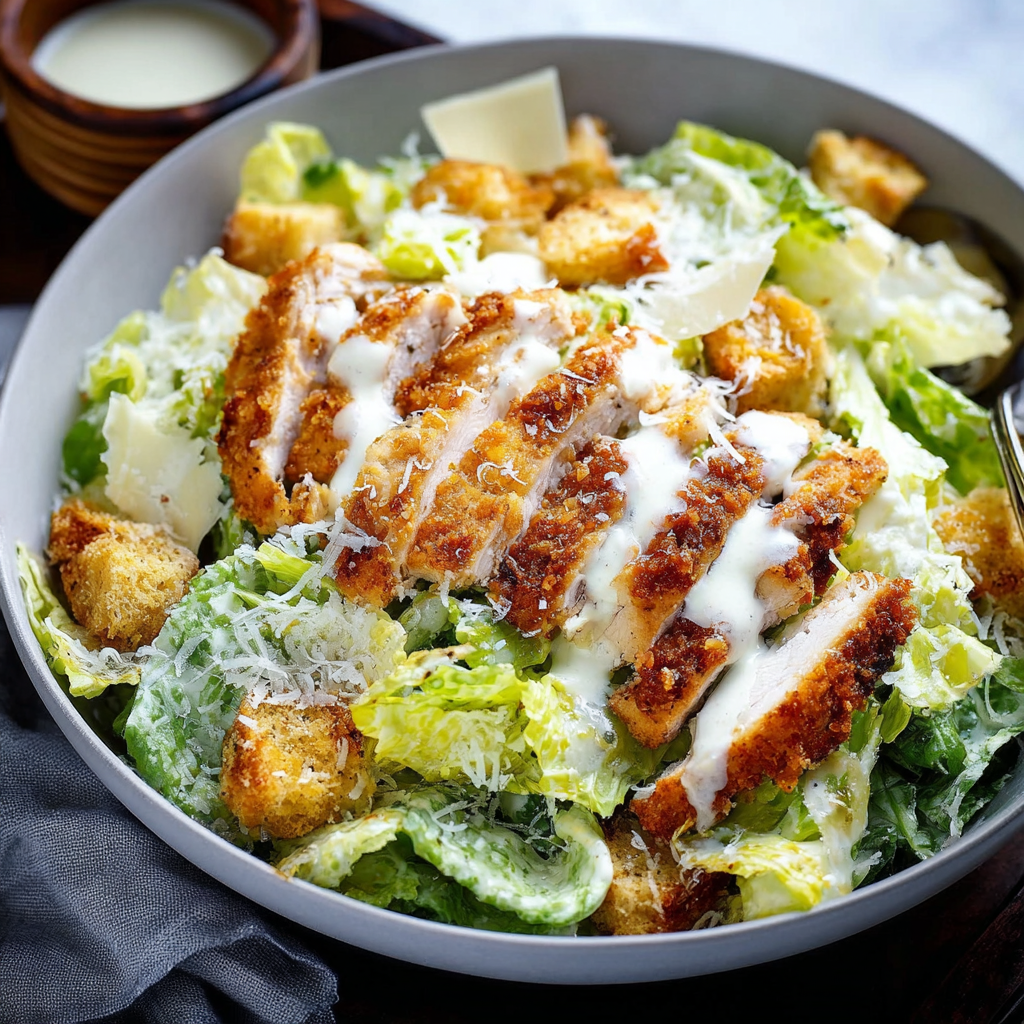
Divide the dressed romaine between plates. Add the croutons over the dressed leaves. Lay the sliced crispy chicken — fanned diagonally across the salad — on top. Scatter shaved Parmesan generously over everything. Add a final grind of black pepper and serve immediately with the remaining dressing alongside.
Nutritional Information
Per serving — based on 4 servings.
| Nutrient | Per Serving | % Daily Value* |
|---|---|---|
| Calories | 620 kcal | 31% |
| Total Fat | 32g | 41% |
| Saturated Fat | 10g | 50% |
| Total Carbohydrates | 38g | 14% |
| Total Sugar | 3g | — |
| Protein | 48g | 96% |
| Dietary Fiber | 3g | 11% |
| Sodium | 860mg | 37% |
| Calcium | 30% DV | 30% |
| Vitamin A | 45% DV | 45% |
| Niacin | 70% DV | 70% |
*Based on a standard 2,000-calorie daily value.
At 48 grams of protein per serving — from the combination of the chicken breast and the Parmesan throughout the preparation — this salad exceeds most dedicated protein-forward dinner preparations while delivering 45% of the daily Vitamin A from the romaine, one of the most Vitamin A-dense commonly consumed salad greens.
Healthier Alternatives
Air fryer chicken: Spray the breaded chicken with cooking spray and air fry at 400°F (200°C) for 18–20 minutes, flipping once — produces a comparable crust with approximately 70% less oil than pan-frying.
Lighter dressing: Replace the egg yolk with 2 tablespoons of good-quality mayonnaise and reduce the olive oil to 3 tablespoons — the dressing remains emulsified and flavorful with meaningfully less fat.
Grilled chicken option: The yogurt marinade from the earlier recipe in this collection produces an outstanding Caesar salad chicken — grilled yogurt-marinated chicken breast over Caesar dressing is an extraordinary combination that is lower in fat than the breaded version.
Anchovy-free: The dressing can be made without anchovy — substitute 1 additional teaspoon of Worcestershire sauce and add a pinch of miso paste for comparable umami depth without any fish product.
Serving Suggestions
Classic plated dinner: Two breaded chicken slices fanned over dressed romaine in a wide, shallow bowl with shaved Parmesan and croutons visible — the format that most clearly communicates the care taken in every component.
Family style: Dress the romaine in a large serving bowl and bring to the table alongside a platter of sliced crispy chicken. Allow guests to serve themselves — this format is more casual and accommodates different appetite sizes better than individual plating.
Without the chicken: The Caesar dressing and crouton preparation produces an outstanding standalone Caesar salad — use as a first course before a protein-forward main.
Sandwich format: Place sliced crispy chicken and dressed romaine in a toasted brioche bun with a generous spoonful of Caesar dressing — a Caesar chicken sandwich that is as satisfying as the salad in an entirely different format.
Common Mistakes to Avoid
Using the outer romaine leaves. The tough, green outer leaves are bitter and too rigid for a Caesar salad. The crisp, pale yellow inner leaves provide the correct texture — yielding enough to receive dressing and croutons without being so tender that they wilt immediately.
Not drying the romaine. Wet romaine dilutes the dressing and prevents adhesion — the most consistently made mistake in all salad preparation. Spin or pat completely dry before dressing.
Bottled Caesar dressing. Bottled Caesar dressing is made from a different formula — stabilizers, preservatives, and a flavor profile engineered for shelf stability rather than fresh-made character. The from-scratch dressing takes 5 minutes and produces a result that makes bottled versions taste like a different, lesser condiment.
Over-dressing. Too much dressing produces a heavy, pool-at-the-bottom result that makes the romaine taste of dressing rather than of a dressed salad. Every leaf should be coated — not dripping. Dress with two-thirds of the dressing and add from the remaining third as needed.
Serving on cold plates. Cold plates chill the chicken immediately and firm the croutons against the still-warm surface — a minor detail that is immediately apparent in the eating experience. Warm the plates in a low oven for 2 minutes before plating.
Storing Tips
Dressed salad: Not suitable for storage — the romaine wilts within 20 minutes of dressing. Dress only the quantity that will be eaten immediately.
Components separately: Undressed romaine, croutons, and dressing all store separately for up to 3 days. The dressing improves over 24 hours as the garlic and anchovy mellow and integrate.
Crispy chicken: Store in an airtight container for up to 3 days. Reheat in an air fryer at 375°F (190°C) for 5–6 minutes to restore crispiness — the best reheating method for any breaded protein.
Caesar dressing: Refrigerate in a sealed jar for up to 5 days. The raw egg yolk is preserved by the lemon juice and salt — the dressing is entirely safe refrigerated and the flavor deepens over the first 24 hours.
Conclusion
Crispy chicken Caesar salad proves that the most ordered salad in America earns its perpetual popularity only when every component is treated with equal intention — the anchovy-emulsified dressing made from scratch, the Parmesan-panko chicken fried to a shattering golden crust, the torn sourdough croutons baked in garlic butter, and the dried, properly dressed romaine served immediately. The salad that has been ordered more than any other for thirty years, finally made the way it deserves to be made.
Make it and share your results in the comments — tell us whether you made the from-scratch dressing, which cooking method you used for the chicken, and whether it replaced your usual Caesar order. Leave a review, share with someone who loves Caesar salad and has never made the dressing from scratch, and subscribe to our newsletter for more technique-driven, composition-conscious recipe recipes every week.
FAQs
Is raw egg yolk in Caesar dressing safe? The raw egg yolk in Caesar dressing is preserved by the acidic environment created by the lemon juice and the salt — which denature surface proteins and inhibit bacterial growth. For healthy adults, properly made fresh Caesar dressing with raw egg yolk presents minimal risk. For immunocompromised individuals, pregnant women, elderly guests, or children, substitute 2 tablespoons of good-quality mayonnaise — which uses pasteurized eggs — in place of the raw egg yolk.
Can I make the chicken gluten-free? Yes — replace the all-purpose flour with rice flour and use certified gluten-free panko breadcrumbs. Rice flour produces a slightly lighter, crispier coating than wheat flour and is one of the most successful gluten-free substitutions in the breading category. Every other component of the recipe is naturally gluten-free.
What is the difference between anchovy fillets and anchovy paste? Anchovy fillets — packed in oil — produce a more complex, more nuanced flavor when minced and incorporated into the dressing. Anchovy paste is pre-processed and more intensely salty with a less fresh, more concentrated character. Both are acceptable — use 1½ teaspoons of paste in place of 4 fillets. Neither produces a detectably fishy dressing — the anchovy provides umami depth rather than a fish flavor when properly incorporated.
How do I keep the croutons crispy in the salad? Three techniques: ensure the croutons are completely cooled before adding to the dressed salad — warm croutons trap steam and soften immediately; add the croutons at the absolute last moment before serving; and do not allow the dressed salad to sit for more than 5 minutes before eating. Crispy croutons in contact with dressed lettuce for more than 10 minutes will always soften — this is physics, not failure.
Can I substitute the chicken with a different protein? Yes — the same breading technique applied to large shrimp (breaded and pan-fried for 2 minutes per side) produces an extraordinary shrimp Caesar. Breaded halloumi is an excellent vegetarian alternative — slice into 1cm planks, bread identically, and fry for 2–3 minutes per side. Grilled salmon placed over the dressed Caesar is one of the most sophisticated and most nutritionally complete salad combinations available.
How do I make the Caesar dressing without a whisk? An immersion blender produces the most reliably emulsified result without a whisk — combine all ingredients except the oil in the blender cup, then add the oil in a slow stream with the blender running. A sealed jar shaken vigorously after adding the oil will produce a temporarily emulsified dressing that should be used immediately before it separates. A food processor works well for larger quantities. The whisk method is most reliable for the traditional preparation but any of these alternatives produces an acceptable dressing.