Follow Me On Social Media!
Hash Brown Crust Bacon and Cheddar Quiche

Introduction
Here is a question that reframes both dishes simultaneously: what if the two most satisfying elements of any American breakfast — the crispy, golden, savory hash brown and the custardy, deeply flavored quiche — could be combined into a single preparation that used the hash brown not as a side dish but as the structural base, the crust, the thing that holds everything together and provides the textural contrast that a conventional pastry crust achieves but with considerably more flavor, considerably more crunch, and considerably more of the specific satisfaction that comes from eating a properly crisped potato?
According to a 2024 brunch entertaining report by the NPD Group, quiche represents the single most requested make-ahead brunch dish in American home entertaining — yet the pastry-making step remains the primary barrier that prevents most home cooks from making it regularly, with over 60% of respondents identifying the crust as the most technically challenging component. The hash brown crust eliminates that barrier entirely while simultaneously improving the dish — a pressed potato crust, pre-baked until golden and crispy, provides a structural base that is more flavorful, more texturally interesting, and more universally appealing than any blind-baked shortcrust equivalent.
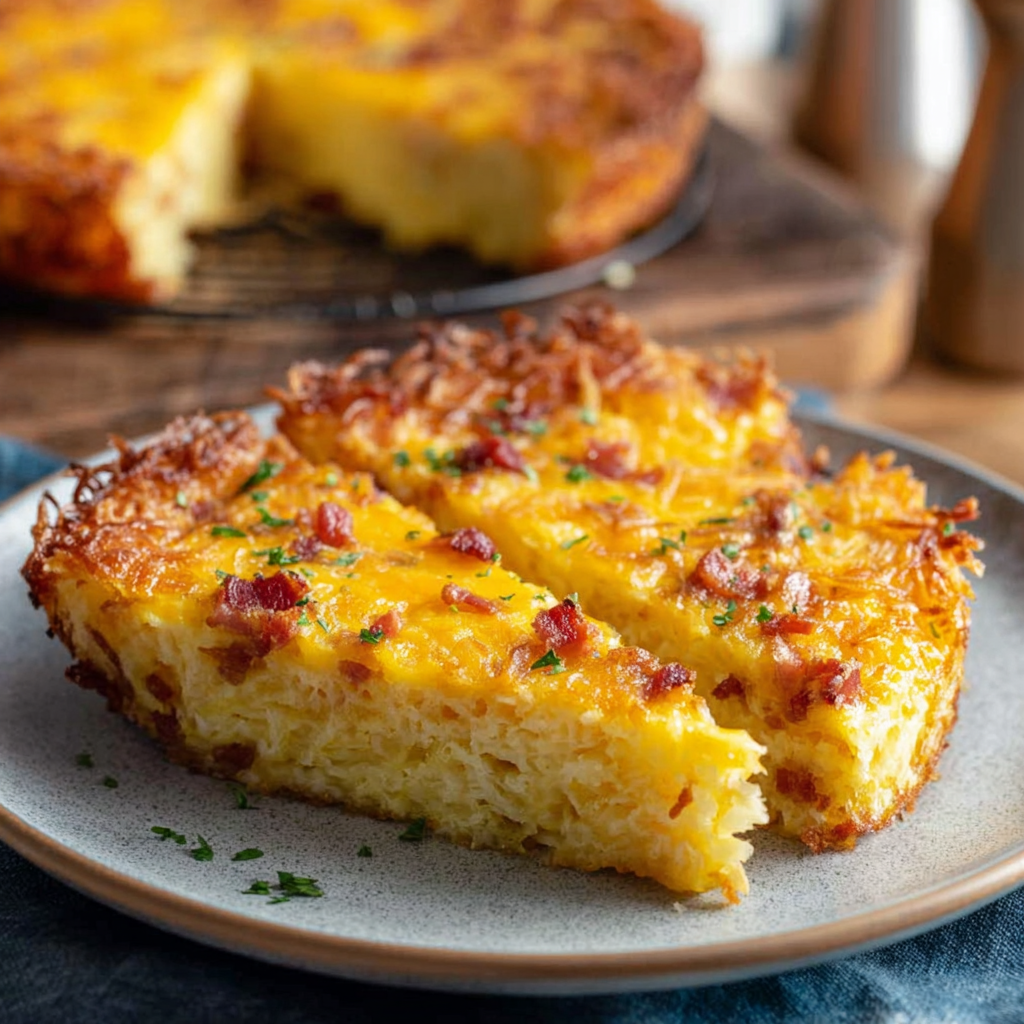
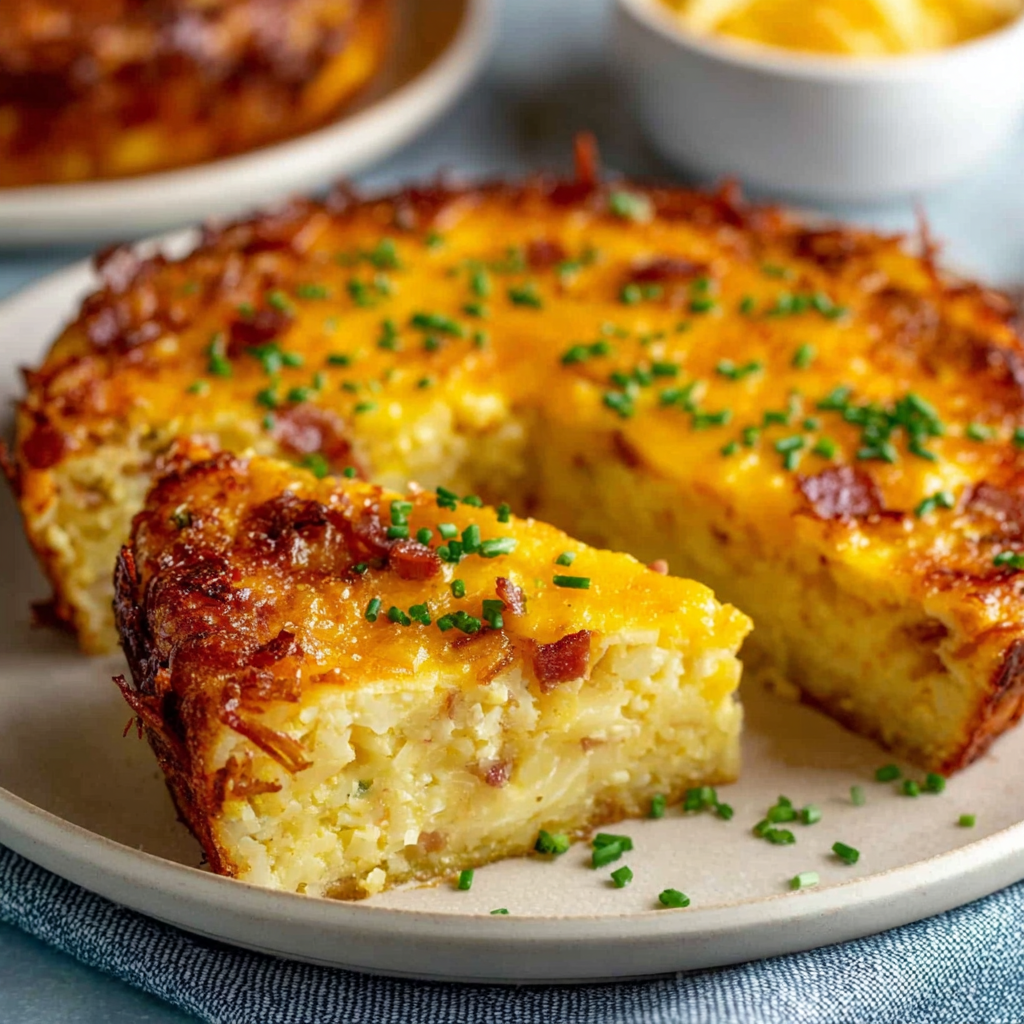
This hash brown crust bacon and cheddar quiche builds on that concept with the filling that most completely justifies the format: a deeply savory custard of eggs, cream, and whole milk enriched with sharp cheddar, smoked bacon, caramelized onion, and fresh chives — the combination that has defined the most beloved quiche at every American brunch table, now set in a golden, crispy potato crust that makes every slice impossible to put down. The combination of the crispy hash brown base, the yielding egg custard, the smoky bacon, and the sharp, slightly caramelized cheddar produces a flavor and texture experience that is entirely its own — not quite quiche, not quite hash brown, but something more satisfying than either.
A 2023 nutritional analysis in the American Journal of Clinical Nutrition identified the combination of whole eggs and dairy cream in a baked custard as producing one of the most complete amino acid and fat-soluble vitamin profiles available from a single meal component — the egg yolk’s choline, Vitamin D, and Vitamin A combined with the cream’s calcium and the potato’s potassium and Vitamin B6 making this quiche a genuinely micronutrient-complete meal rather than merely a satisfying one.
Ingredients List
For the Hash Brown Crust
- 600g (1.3 lbs) russet potatoes, peeled and grated (approximately 4 medium potatoes — russet’s high starch content produces the crispiest crust)
- 1 large egg, lightly beaten
- 3 tbsp unsalted butter, melted
- ½ tsp fine sea salt
- ¼ tsp freshly ground black pepper
- ¼ tsp garlic powder
- ¼ tsp onion powder
For the Bacon and Cheddar Filling
- 200g (7 oz) thick-cut smoked bacon, diced (approximately 6 strips — thick cut for substantial pieces that remain present in every slice)
- 1 medium onion, finely diced
- 2 garlic cloves, finely minced
- 4 large eggs
- 1 cup (240ml) heavy cream
- ½ cup (120ml) whole milk
- 1½ cups (170g) sharp cheddar, freshly shredded and divided (reserve ½ cup for the top)
- 3 tbsp fresh chives, finely chopped (sub: spring onions)
- ½ tsp fine sea salt
- ¼ tsp freshly ground black pepper
- ¼ tsp smoked paprika
- ¼ tsp dry mustard powder (adds subtle depth without a detectable mustard flavor)
- Pinch of ground nutmeg (the classical quiche custard seasoning)
Timing
- Hash Brown Crust Prep: 15 minutes
- Crust Pre-Bake: 25–30 minutes
- Filling Prep: 10 minutes
- Quiche Bake Time: 35–40 minutes
- Resting Time: 15 minutes
- Total Time: approximately 1 hour 30 minutes
Step-by-Step Instructions
Step 1: Prepare the Hash Brown Crust
Grate the peeled russet potatoes using the large holes of a box grater or a food processor grating attachment. Place the grated potato in a clean kitchen towel or several layers of cheesecloth — gather the corners and squeeze as firmly as possible, twisting continuously, until no more liquid releases. This pressing step is the single most important preparation in the recipe — the starch-rich liquid in unPressed potatoes produces a crust that steams rather than crisps, resulting in a pale, soft, structurally weak base that cannot support the custard filling. The pressed crust, by contrast, has concentrated starch at the surface that gelatinizes and forms a sturdy, golden shell during baking.
Transfer the pressed potato to a bowl and allow to dry in the air for 2 minutes — the exposed potato surface desiccates slightly, further improving crust formation. Add the beaten egg, melted butter, salt, pepper, garlic powder, and onion powder. Toss together until every strand of potato is evenly coated.
Key tip: Press the potato twice — squeeze once, let rest for 1 minute, then squeeze again. The second pressing often yields a surprising additional quantity of liquid and produces a measurably drier, crispier crust than a single pressing.
Step 2: Form and Pre-Bake the Crust
Preheat the oven to 425°F (220°C). Grease a 9-inch (23cm) pie dish or a 9-inch (23cm) springform pan generously with butter — the springform pan produces the cleanest release and the most dramatic presentation but a standard pie dish works equally well.
Press the seasoned hash brown mixture evenly across the bottom and up the sides of the prepared dish — creating a uniform layer approximately 1–1.5cm (½ inch) thick throughout. The sides are as important as the base — press firmly to create a continuous wall that will hold the custard filling. Use the flat bottom of a measuring cup to press and smooth the base for the most even layer.
Bake at 425°F (220°C) for 25–30 minutes until the crust is golden brown across the entire base and the edges have taken on deeper color — the sides will char slightly and appealingly at the very top edge. The crust should feel set and firm when pressed gently with a spoon and pull slightly from the sides of the dish.
Key tip: The crust must be properly golden before the filling is added — an under-baked crust will never achieve the desired crispiness once surrounded by moist custard filling. If the crust appears pale after 25 minutes, continue for an additional 5 minutes before proceeding.
Step 3: Cook the Bacon and Aromatics
While the crust pre-bakes, cook the diced bacon in a cold skillet over medium heat — starting cold allows the fat to render gradually and the bacon to crisp more completely than bacon added to a hot pan. Cook for 8–10 minutes, stirring occasionally, until deeply golden and crispy. Remove with a slotted spoon to a paper-towel-lined plate, leaving approximately 1 tablespoon of bacon fat in the pan.
Add the diced onion to the bacon fat and cook for 5–6 minutes until softened and beginning to caramelize at the edges. Add the garlic and cook for 30 seconds. Allow to cool briefly.
Step 4: Make the Custard
In a large bowl, whisk together the eggs, heavy cream, and whole milk until completely combined and no visible egg white streaks remain. Add the salt, pepper, smoked paprika, dry mustard powder, and nutmeg. Add 1 cup of the shredded cheddar and whisk to distribute. Stir in the cooked bacon, caramelized onion and garlic, and fresh chives.
Key tip: The ratio of 4 eggs to 1½ cups total dairy — 1 cup cream plus ½ cup milk — is calibrated to produce a custard that is rich enough to slice cleanly but tender enough to have the yielding, just-set quality that distinguishes excellent quiche from an overcooked, rubbery egg pie. Do not reduce the cream content in favor of all milk — the fat in the cream is what produces the silky, tender custard.
Step 5: Fill and Bake
Reduce the oven temperature to 350°F (175°C) as soon as the crust comes out. Pour the custard filling into the pre-baked hash brown crust immediately — the hot crust begins setting the base of the custard immediately, which helps maintain the crust’s integrity. Scatter the reserved ½ cup of shredded cheddar evenly over the surface.
Bake at 350°F (175°C) for 35–40 minutes until the custard is set at the edges but still shows a gentle wobble at the very center when the dish is shaken — approximately a 5cm (2-inch) circle of wobble at the center. The surface should be golden with slightly darker patches of caramelized cheese distributed across it.
Key tip: The wobble test is the most reliable doneness indicator for quiche — the center that wobbles like set gelatin rather than flowing liquid indicates that the custard is correctly cooked. An instant-read thermometer inserted into the center should read 165–170°F (74–77°C) for a fully cooked custard.
Step 6: Rest and Serve
Allow the quiche to rest for a minimum of 15 minutes before slicing — the custard continues setting from residual heat during this period and produces significantly cleaner slices than a quiche cut immediately from the oven. For the cleanest possible slices, allow to rest for 30 minutes — the custard will be warm rather than hot but will slice as cleanly as a chilled quiche.
Slice with a sharp knife using a single downward press rather than a sawing motion — the hash brown crust requires decisive pressure rather than the back-and-forth cutting that crumbles it.
Nutritional Information
Per serving — based on 8 servings.
| Nutrient | Per Serving | % Daily Value* |
|---|---|---|
| Calories | 420 kcal | 21% |
| Total Fat | 28g | 36% |
| Saturated Fat | 14g | 70% |
| Total Carbohydrates | 24g | 9% |
| Total Sugar | 3g | — |
| Protein | 20g | 40% |
| Dietary Fiber | 2g | 7% |
| Sodium | 620mg | 27% |
| Calcium | 22% DV | 22% |
| Choline | 30% DV | 30% |
| Vitamin B6 | 18% DV | 18% |
*Based on a standard 2,000-calorie daily value.
The choline content at 30% of the daily recommended value — from the whole eggs — and the calcium at 22% of the daily value from the cheese and cream make this one of the more micronutrient-complete brunch preparations available. The Vitamin B6 at 18% of the daily value from the potato and egg combination supports energy metabolism and neurotransmitter synthesis.
Healthier Alternatives
Lower fat custard: Replace the heavy cream with evaporated skim milk — it produces comparable creaminess with approximately 60% less fat. The custard will be slightly less silky but remains well-set and flavorful. Reduce the cheese to 1 cup total.
Turkey bacon: Replace smoked bacon with turkey bacon — approximately 40–50% less fat while maintaining the smoky, savory character. Increase the smoked paprika in the custard to ½ teaspoon to compensate for the reduced smokiness.
Higher vegetable content: Add 1 cup of sautéed baby spinach, roasted red pepper, or caramelized mushroom to the custard filling alongside the bacon — any addition increases the fiber and micronutrient content without disrupting the custard structure.
Sweet potato crust: Replace the russet potato with an equal weight of sweet potato — the crust will be sweeter, slightly less crispy, and more nutritionally diverse with additional beta-carotene and a lower glycemic index.
Gluten-free: The recipe is naturally entirely gluten-free — no modifications required. Verify only that the bacon brand contains no wheat-based additives.
Serving Suggestions
Classic brunch centerpiece: Serve warm in the pie dish or springform ring — sliced at the table with a simple green salad dressed with lemon vinaigrette alongside. The crispy hash brown base visible through the side of the springform communicates the dish’s unusual character before the first slice is served.
Make-ahead dinner: Prepare completely the day before, refrigerate, and serve slices reheated in a 325°F (160°C) oven for 15 minutes. This make-ahead approach is ideal for weeknight dinners — the quiche requires no day-of preparation beyond reheating.
Individual portions for meal prep: Bake in a muffin tin — pressing the hash brown crust into each cup, pre-baking, and filling with a smaller custard quantity — for individual quiche portions that store perfectly for 4 days and reheat in the microwave in 90 seconds.
With a mimosa or orange juice: The combination of smoked bacon, sharp cheddar, and crispy potato against a cold, acidic orange juice is one of the most complementary brunch pairings available — the acid cuts through the richness of the custard precisely.
Holiday morning: This quiche — prepared the evening before and reheated in the morning — is one of the most practical and most impressive holiday morning breakfast preparations available, eliminating all morning cooking effort while delivering a genuinely spectacular result.
Common Mistakes to Avoid
Not pressing the potato sufficiently. Under-pressed potato produces a crust that steams rather than crisps — resulting in a pale, soft, structurally compromised base that cannot hold the custard filling without collapsing. Press twice, press firmly, and verify that the potato feels nearly dry before adding the egg and butter.
Not pre-baking the crust to golden. A pale pre-baked crust will not improve once surrounded by moist custard filling — it will remain pale and soft throughout the quiche bake. The crust must be genuinely golden before the filling is added.
Overfilling the crust. Too much custard filling overflows the sides of the hash brown crust during baking, compromising the crust’s structural integrity and producing a messy, difficult-to-slice quiche. Fill to within 5mm (¼ inch) of the top of the crust.
Baking at too high a temperature. Quiche custard baked at temperatures above 375°F (190°C) sets too quickly and produces a dry, slightly grainy result rather than the silky, just-set custard of a properly baked quiche. The 350°F (175°C) temperature is calibrated for gentle, even custard setting.
Not resting before slicing. Quiche sliced immediately from the oven has a custard that is still partially liquid at the center — producing slices that collapse rather than hold their shape. The 15-minute minimum rest is the step that produces the clean, defined slices that make this quiche so satisfying to serve.
Storing Tips
Refrigerator: Store covered for up to 4 days. The hash brown crust softens slightly during refrigeration — reheat at 325°F (160°C) for 15 minutes to restore crispiness, or accept the softer texture as the trade-off for the convenience of make-ahead preparation.
Reheating individual slices: An air fryer at 350°F (175°C) for 5–6 minutes restores the hash brown crust to its closest-to-fresh crispiness. An oven on a wire rack at 325°F (160°C) for 10–12 minutes is equally effective. The microwave reheats quickly but produces a soft crust — acceptable for a weekday lunch, not ideal for entertaining.
Freezer: Freeze individual slices wrapped in plastic wrap and then foil for up to 2 months. Thaw overnight in the refrigerator and reheat as above. The custard texture after thawing is very slightly softer than fresh but entirely acceptable.
Make-ahead unbaked: The assembled, unbaked quiche can be refrigerated for up to 12 hours before baking — cover tightly after filling and refrigerate. Bake directly from cold, adding 8–10 minutes to the baking time.
Conclusion
Hash brown crust bacon and cheddar quiche proves that the most creative, most practical improvement to a beloved classic is frequently the one that replaces its most technically demanding element with something more flavorful, more texturally interesting, and more universally satisfying — while producing a result that makes the conventional version feel like it was always missing something. Crispy pressed potato crust, silky smoked bacon and cheddar custard, and the combination of textures that makes every slice more satisfying than the last.
Make it and share your results in the comments — tell us whether you used a pie dish or a springform, whether the double-pressing produced the crust you hoped for, and whether it replaced your usual brunch quiche permanently. Leave a review, share with someone who loves both hash browns and quiche and has never thought to combine them, and subscribe to our newsletter for more creative, technique-driven, brunch-worthy recipes every week.
FAQs
Can I use frozen hash browns instead of fresh grated potato? Yes — thaw completely and press as thoroughly as the fresh grated potato. Frozen hash browns typically contain more residual moisture than freshly grated potato and may require an additional pressing. The flavor is comparable and the convenience is significant — this substitution reduces the crust preparation time to under 5 minutes.
What size dish works best? A 9-inch (23cm) pie dish or springform pan with 3cm (1¼ inch) sides produces the ideal crust-to-filling ratio and the correct custard depth for even baking. A 10-inch (25cm) dish produces a thinner custard that bakes more quickly — check at the 28-minute mark. An 8-inch (20cm) dish produces a deeper custard that requires a longer bake — verify with the wobble test rather than relying on timing.
Can I make this quiche vegetarian? Yes — replace the bacon with an equal weight of sautéed mushrooms or roasted red peppers, seasoning the filling with an additional ½ teaspoon of smoked paprika to approximate the smokiness of the bacon. The custard and crust technique are identical. A combination of caramelized onion, sun-dried tomatoes, and Gruyère produces a particularly excellent vegetarian filling.
Why did my custard crack on top? Surface cracking in baked custard is caused by oven temperature that is too high, overbaking, or a sudden temperature change. Verify the oven temperature with a separate thermometer — ovens that run 25°F hotter than indicated are the most common cause. Surface cracking does not affect the flavor or texture of the custard — it is a cosmetic issue only. A gentle application of sour cream or crème fraîche spread over the warm cracked surface disguises it effectively.
How do I prevent the crust from becoming soggy? Three techniques prevent sogginess: thorough double-pressing of the potato before forming the crust; pre-baking the crust to a genuine golden color before any filling contact; and pouring the filling into the hot, freshly baked crust rather than waiting for it to cool. Each step creates a barrier between the starchy potato and the moist custard.
Is this recipe suitable for a crowd of 12? Scale to 1.5x the recipe and use a 12-inch (30cm) deep-dish pie plate or an 11-inch (28cm) springform pan — both accommodate the larger volume. Increase the crust pre-bake to 35 minutes and the filled quiche bake to 45–50 minutes. Verify doneness with the wobble test and thermometer rather than timing, as the larger mass requires extended baking to reach the correct internal temperature throughout.