Follow Me On Social Media!
Jam Donut Focaccia

Introduction
Here is a question that challenges the way most people think about focaccia — a bread so deeply associated with olive oil, rosemary, and the savory Italian table that its sweet potential has been almost entirely overlooked in the Western home baking canon: what happens when you take the technique that makes focaccia the most forgiving, most reliable, most texturally extraordinary bread a home baker can make — the high-hydration dough, the olive oil soak, the dimpling that creates pockets of caramelized richness — and apply it entirely in the service of a sweet preparation that borrows the flavors of the jam donut and produces something that is simultaneously more impressive and more effortless than either the focaccia or the donut it references?
According to a 2024 home baking trend report by King Arthur Baking, sweet focaccia represents one of the single fastest-growing recipe categories in home baking — driven by the discovery that the focaccia technique’s forgiving, stretch-and-fold methodology and its single long proof produce bread results that are dramatic in appearance and extraordinary in texture without any of the rolling, shaping, or timing precision that makes conventional enriched sweet doughs intimidating. The focaccia method — specifically the cold overnight proof that develops flavor through retardation rather than time at warm temperature — gives the baker complete schedule control while producing a crumb that is more open, more flavored, and more tender than any same-day preparation.
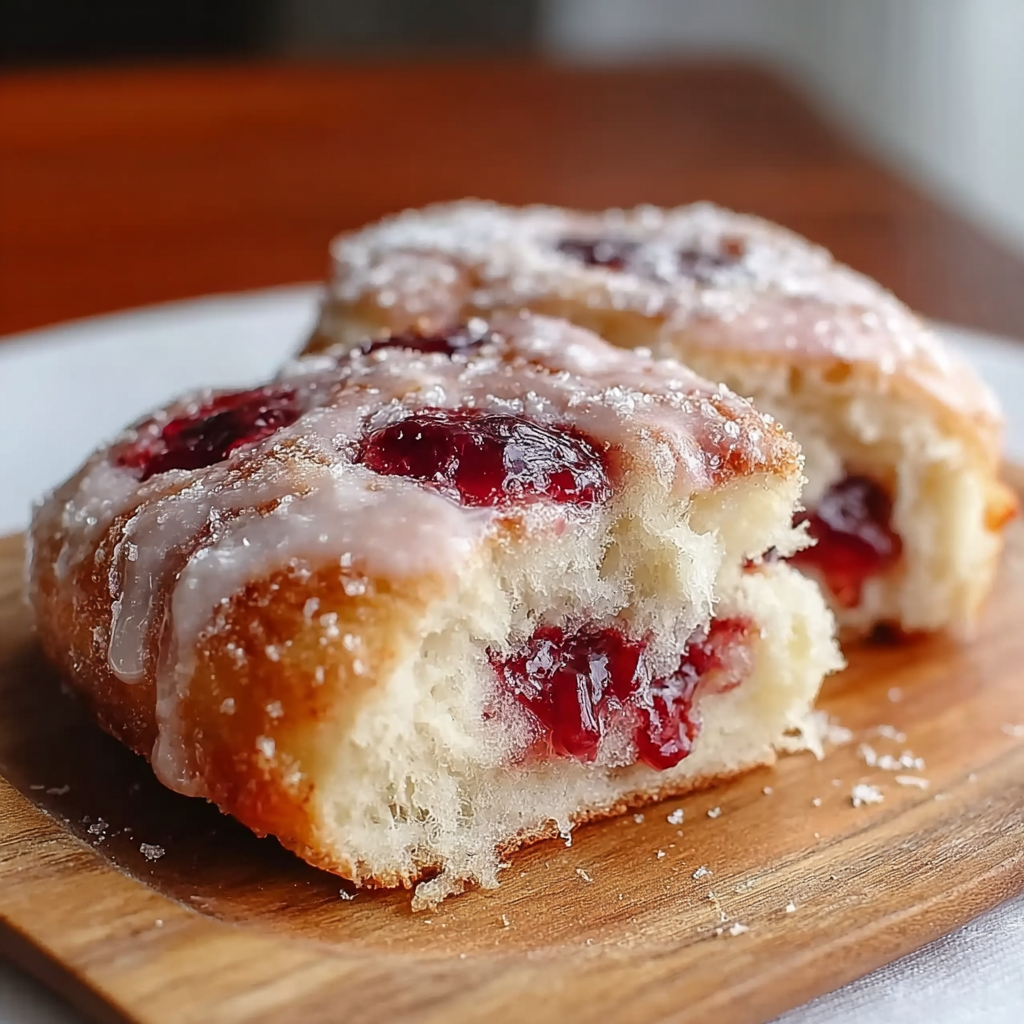
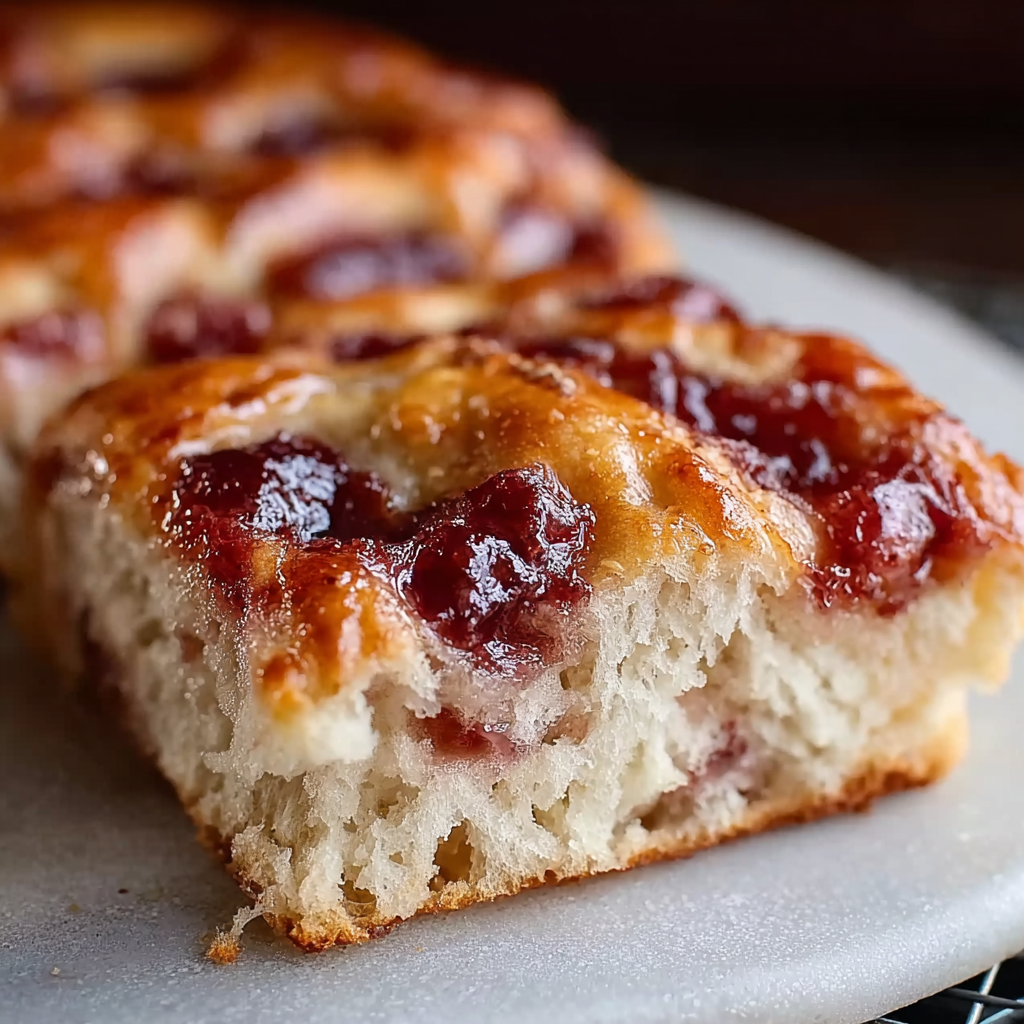
This jam donut focaccia takes the sweet focaccia concept to its most playful and most immediately compelling conclusion — a light, airy, olive oil-enriched sweet dough dimpled deeply, filled in each dimple with a generous spoonful of jam, sprinkled with granulated sugar that caramelizes during baking, and finished with a dusting of powdered sugar and a drizzle of vanilla glaze that closes the visual and flavor reference to the jam donut completely. The result is a bread that looks like it arrived from a skilled bakery, tastes like the best jam donut ever made, and required nothing more than a bowl, a pan, and the willingness to plan 12–18 hours ahead.
A 2023 baking science review in the Journal of Cereal Science confirmed that the cold fermentation method used in overnight focaccia preparations produces measurably more complex flavor compounds — including lactic and acetic acids, complex esters, and aromatic aldehydes — than same-day warm fermentations of equivalent time, explaining why overnight focaccia has a distinctive depth and complexity that fresh-baked versions lack.
Ingredients List
For the Sweet Focaccia Dough
- 500g (4 cups) all-purpose flour (bread flour for a slightly chewier result)
- 7g (2¼ tsp / 1 packet) instant dry yeast
- 1½ tsp fine sea salt
- 2 tbsp granulated sugar (sweetens the dough subtly without producing a cake-like crumb)
- 400ml (1⅔ cups) warm water (110°F / 43°C)
- 4 tbsp extra virgin olive oil (divided — 2 in the dough, 2 for the pan)
- 1 tsp vanilla extract (added with the water — the vanilla note runs through the entire bread)
For the Jam Filling
- 1 cup (320g) good-quality strawberry jam (sub: raspberry, apricot, mixed berry, or any jam with a vivid, assertive flavor)
- 1 tsp fresh lemon juice (stirred into the jam — prevents it from being excessively sweet and brightens the fruit flavor)
For the Topping Before Baking
- 3 tbsp extra virgin olive oil (for the final dimpling step)
- 3 tbsp granulated sugar (sprinkled over the jam-filled dough before baking — caramelizes beautifully)
For Finishing After Baking
- 3 tbsp powdered sugar (for dusting — the donut reference)
- Vanilla glaze (optional but strongly recommended — 100g powdered sugar + 2 tbsp whole milk + ½ tsp vanilla extract, whisked smooth)
- Extra jam, warmed, for drizzling (optional)
Timing
- Dough Mixing: 10 minutes
- First Room Temperature Rest: 1 hour
- Cold Overnight Proof: 12–18 hours (refrigerator)
- Room Temperature Recovery: 1–2 hours
- Bake Time: 22–25 minutes
- Total Time: 14–20 hours (mostly hands-off — 20 minutes active)
The overnight refrigerator proof is the technique that produces both the extraordinary flavor depth and the scheduling flexibility that makes this bread so practical — assemble the dough the evening before and bake any time the following day after a 1–2 hour room temperature recovery.
Step-by-Step Instructions
Step 1: Make the Dough
In a large bowl, combine the flour, instant yeast, salt, and sugar. Whisk together briefly to distribute evenly — ensuring the salt and yeast are not in direct contact before the water is added, as direct contact can inhibit yeast activity. In a separate bowl or measuring jug, combine the warm water, 2 tablespoons of olive oil, and vanilla extract.
Pour the wet ingredients into the dry and mix with a wooden spoon or your hands until a shaggy, cohesive, very wet dough forms — no dry flour should remain. The dough will be far wetter and more fluid than conventional bread dough — this is correct. Sweet focaccia dough at correct hydration cannot be kneaded conventionally; it is shaped entirely through the stretch-and-fold method.
Step 2: Stretch and Fold
Cover the bowl with plastic wrap and allow to rest for 30 minutes at room temperature. After 30 minutes, perform the first set of stretch-and-folds: wet your hand, reach under one side of the dough, stretch it upward as far as it will go without tearing, and fold it over the top of the dough. Rotate the bowl 90 degrees and repeat — completing 4 folds total per set. The dough should feel stronger and more elastic after each set.
Cover and rest for another 30 minutes, then perform a second set of 4 stretch-and-fold repetitions. After the second set, the dough should be noticeably smoother, more elastic, and holding its shape more clearly when released.
Key tip: The stretch-and-fold method develops the gluten network in a high-hydration dough without conventional kneading — each fold builds the gluten structure that will ultimately trap the carbon dioxide bubbles produced by fermentation and produce the characteristic open, airy crumb of properly made focaccia.
Step 3: Cold Overnight Proof
After the second stretch-and-fold set, drizzle 1 tablespoon of the olive oil for the pan into a 9×13-inch (23x33cm) baking pan. Drizzle the remaining 1 tablespoon over the dough in the bowl. Transfer the dough to the oiled pan and turn it once to coat in oil on all sides. Press it gently toward the edges — it will not reach the corners at this stage, which is correct.
Cover tightly with plastic wrap and refrigerate for 12–18 hours. The cold temperature slows fermentation dramatically, allowing a long, slow flavor development without the risk of over-proofing that comes with a warm, fast proof. During this time the dough will expand significantly and develop the complex flavor compounds that distinguish overnight focaccia.
Step 4: Room Temperature Recovery
Remove the pan from the refrigerator and allow to sit at room temperature for 1–2 hours until the dough has relaxed, puffed slightly beyond its refrigerator volume, and fills the pan when gently pressed toward the edges with well-oiled fingers. Preheat the oven to 425°F (220°C) during this recovery period.
Step 5: Dimple and Fill with Jam
Stir the lemon juice into the jam and warm very slightly — 10 seconds in the microwave — until pourable but not hot. With well-oiled fingertips, dimple the dough vigorously across the entire surface — pressing all the way to the bottom of the pan and creating deep, clearly defined wells distributed evenly across the surface. The dimples should be approximately 3–4cm (1½ inches) in diameter with about 5–6cm (2 inches) between them — producing approximately 15–20 wells across the surface of the pan.
Immediately spoon a generous teaspoon of jam into each dimple — the jam should fill each well and sit slightly above the surrounding dough surface. Drizzle the 3 tablespoons of olive oil evenly over the entire surface, including over the jam and between the dimples. Sprinkle the granulated sugar generously across the entire surface.
Key tip: The dimpling must be done with conviction — shallow dimples bake out and disappear, leaving the jam sitting on the surface rather than embedded in caramelized pockets. Press firmly all the way to the bottom of the pan.
Step 6: Bake
Bake at 425°F (220°C) for 22–25 minutes until the bread is deeply golden across the entire exposed surface, the jam in the dimples is caramelized and bubbling, and the bottom of the focaccia is golden brown when the pan edge is lifted slightly. The caramelized sugar on the surface should be golden to amber — not white (under-baked) and not dark brown (over-baked).
Allow to cool in the pan for 10 minutes before removing — the jam in the dimples is molten sugar and will cause serious burns if contacted immediately from the oven.
Step 7: Finish and Serve
Remove from the pan using a thin spatula and transfer to a wire rack or serving board. Dust generously with powdered sugar through a fine sieve — the powdered sugar dusting is the visual element that closes the donut reference and makes the finished bread immediately recognizable as a sweet preparation rather than a savory one.
Drizzle the vanilla glaze over the surface in a thin, decorative stream if using. Serve warm — the jam is still gently flowing and the bread is at its most aromatic and most texturally extraordinary within 20 minutes of baking. Tear and share directly from the board.
Nutritional Information
Per serving — based on 12 servings.
| Nutrient | Per Serving | % Daily Value* |
|---|---|---|
| Calories | 310 kcal | 16% |
| Total Fat | 8g | 10% |
| Saturated Fat | 1g | 5% |
| Total Carbohydrates | 56g | 20% |
| Total Sugar | 22g | — |
| Protein | 5g | 10% |
| Dietary Fiber | 1g | 4% |
| Sodium | 200mg | 9% |
| Iron | 12% DV | 12% |
| Calcium | 4% DV | 4% |
*Based on a standard 2,000-calorie daily value.
At 310 calories per serving with 8 grams of fat from the olive oil — predominantly monounsaturated — this is one of the more favorable sweet bread preparations available from a fat profile perspective. The monounsaturated fat content of extra virgin olive oil is associated in multiple large-scale studies with cardiovascular protection.
Healthier Alternatives
Lower sugar: Reduce the granulated sugar in the dough to 1 tablespoon and use a reduced-sugar jam or a fruit compote made from fresh berries cooked briefly with just a tablespoon of honey. The bread will be less sweet but the jam’s fruit flavor will be more distinctly present.
Whole wheat variation: Replace 150g of the all-purpose flour with an equal weight of whole wheat flour — increasing the fiber content by approximately 2 grams per serving and adding a slightly nuttier, more complex base flavor that pairs unexpectedly well with sweet jam.
Dairy-free and vegan: The base recipe contains no dairy — it is naturally vegan when the vanilla glaze milk is replaced with oat milk or almond milk.
Lower glycemic: Replace the jam with a mashed fresh berry filling — 200g of fresh strawberries mashed with 1 tablespoon of chia seeds, allowed to sit for 20 minutes until thickened — reducing the added sugar significantly while maintaining the fruit character.
Serving Suggestions
Warm for brunch: Torn into irregular pieces and served warm at the center of a brunch table alongside fresh fruit, whipped cream, and additional warm jam — this is the format that most clearly communicates the occasion-appropriate, shareable character of the bread.
As a dessert: Served slightly warm with a scoop of vanilla ice cream and additional caramelized jam spooned alongside — the warm bread against cold ice cream produces the temperature contrast that makes the jam pockets particularly extraordinary.
For afternoon tea: Cut into neat rectangles and served on a cake stand with a pot of strong tea — the powdered sugar dusting and the jam-filled pockets read immediately as a sweet pastry in this formal context.
As a gift: Baked in a disposable foil pan, dusted with powdered sugar, wrapped in cellophane, and tied with a ribbon — one of the most visually impressive and least expected food gifts available from such a simple preparation.
Breakfast toast: Day-old jam donut focaccia sliced and toasted in a toaster oven until the sugar caramelizes on the surface again — served with salted butter for a breakfast that is simultaneously practical and genuinely wonderful.
Common Mistakes to Avoid
Not using enough oil in the pan. Insufficient oil causes the focaccia to stick and the bottom to lack the characteristic golden, slightly crunchy base that distinguishes great focaccia from merely adequate bread. The pan should have a visible pool of olive oil before the dough is transferred.
Shallow dimpling. Dimples that do not reach the bottom of the pan bake out and close during oven spring, leaving the jam on the surface where it slides off rather than caramelizing into the defined pockets that make this bread visually and texturally extraordinary.
Using jam that is too thin. Very fluid jams spread across the surface of the dough rather than staying in the dimples during baking — resulting in a jam-coated rather than jam-filled bread. Thicker, higher-pectin jams or preserves stay in the dimples during baking. If the jam is very fluid, stir in ½ teaspoon of chia seeds and allow to thicken for 20 minutes before using.
Cutting into it immediately from the oven. The jam in the dimples is liquefied sugar at oven temperature — it will burn. The 10-minute pan rest and the subsequent cooling on the rack reduce the jam to a safe, warm, flowing temperature. Fifteen minutes of patience prevents serious burns.
Skipping the overnight proof. A same-day focaccia made with this recipe is entirely possible by allowing 2 hours of warm proofing rather than the cold overnight method — but the flavor depth will be noticeably less complex and the crumb slightly less open. The overnight method is the technique that produces the bakery-quality result.
Storing Tips
Room temperature: Store covered at room temperature for up to 2 days — the olive oil content keeps the bread surprisingly moist and the jam pockets remain soft and flowing when briefly warmed.
Reheating: Warm at 350°F (175°C) for 8–10 minutes — the jam re-liquefies, the sugar re-caramelizes slightly, and the bread returns to close to its fresh-baked texture. The microwave warms quickly but does not restore the caramelized surface.
Freezer: Freeze individual portions wrapped in plastic wrap for up to 2 months. Thaw at room temperature for 30 minutes and warm in the oven for 5–8 minutes.
Same-day is best: Like all focaccia preparations, jam donut focaccia is at its absolute textural peak within 2 hours of baking — the crumb is at its most open and airy, the jam is at its most flowing, and the sugar crust is at its most caramelized. Plan the bake to coincide with the moment of serving wherever possible.
Conclusion
Jam donut focaccia proves that the most playful, most visually extraordinary sweet bread available from a home kitchen is also one of the most technically accessible — the stretch-and-fold method, the cold overnight proof, and the conviction of the dimpling step are the three decisions that produce a result that looks as though it required significantly more skill than it actually did. A bread that tears apart at the table to reveal caramelized jam pockets, dusted with powdered sugar, still warm from the oven: the sweet bread that makes every brunch table or afternoon gathering feel like something genuinely worth gathering for.
Make it and share your results in the comments — tell us which jam variety you used, whether the overnight proof produced the flavor depth it always does, and whether the powdered sugar dusting closed the donut reference as completely as promised. Leave a review, share with someone who loves both focaccia and jam donuts and has never thought to combine them, and subscribe to our newsletter for more playful, technique-driven, occasion-worthy baking recipes every week.
FAQs
Can I make this without the overnight proof? Yes — after the two stretch-and-fold sets, cover the pan with a damp towel and allow to proof at room temperature for 2–3 hours until doubled in size. The flavor will be less complex than the overnight version — lacking the lactic acid and ester development that the cold fermentation produces — but the bread will be entirely delicious and considerably faster. The overnight method is recommended whenever scheduling permits.
What jam works best? High-pectin, relatively thick jams with vivid, assertive fruit flavors perform best — strawberry, raspberry, and apricot are the most reliable and most complementary to the sweet olive oil dough. Avoid very thin jams or preserves with large fruit pieces — both present filling challenges. For an extraordinary result, a homemade jam or a high-quality preserve with a short ingredient list and visible fruit character produces a filling that is as impressive as the bread surrounding it.
Can I use different fillings besides jam? Yes — Nutella dropped into the dimples produces an extraordinary chocolate-hazelnut version. Lemon curd produces a bright, citrusy filling that pairs beautifully with the sweet dough. A mixture of cream cheese, sugar, and vanilla pressed into the dimples before topping with jam produces a cheesecake-adjacent filling. Each filling requires slight technique adjustments — thicker fillings like Nutella and cream cheese can be frozen briefly before adding to the dimples to prevent them from spreading during baking.
Why is my focaccia not airy enough? Four possible causes: the dough was not allowed to fully recover at room temperature after the refrigerator proof; the dimpling deflated the dough excessively rather than just creating defined pockets; the oven was not fully preheated to 425°F before the bread was added; or the yeast was old or insufficiently activated. Verify all four in the next preparation — the open, airy crumb is a function of a properly fermented dough baked in a fully preheated oven.
How do I prevent the jam from burning during baking? The granulated sugar sprinkled over the surface caramelizes at a lower temperature than the jam burns — at 425°F for 22–25 minutes, the jam in well-formed dimples reaches a caramelized, bubbly state without burning if the dimples are deep enough to protect the jam from direct heat exposure. If the jam is darkening too rapidly, reduce the oven temperature to 400°F (200°C) and extend the baking time by 5 minutes. Well-dimpled jam stays in its pocket; shallow jam exposed directly to radiant oven heat burns quickly.
Can I make individual jam donut focaccia rolls instead of one large pan? Yes — divide the proofed dough into 12 equal pieces and place in a greased muffin tin or on a parchment-lined baking sheet with space between each. Allow to proof for 30–45 minutes until puffed, dimple each with your finger to create a deep well, fill with jam, drizzle with olive oil, and sprinkle with sugar. Bake at 400°F (200°C) for 15–18 minutes. The individual format produces a more portable, more precisely portioned version that is ideal for packed lunches or individual gifts.