Follow Me On Social Media!
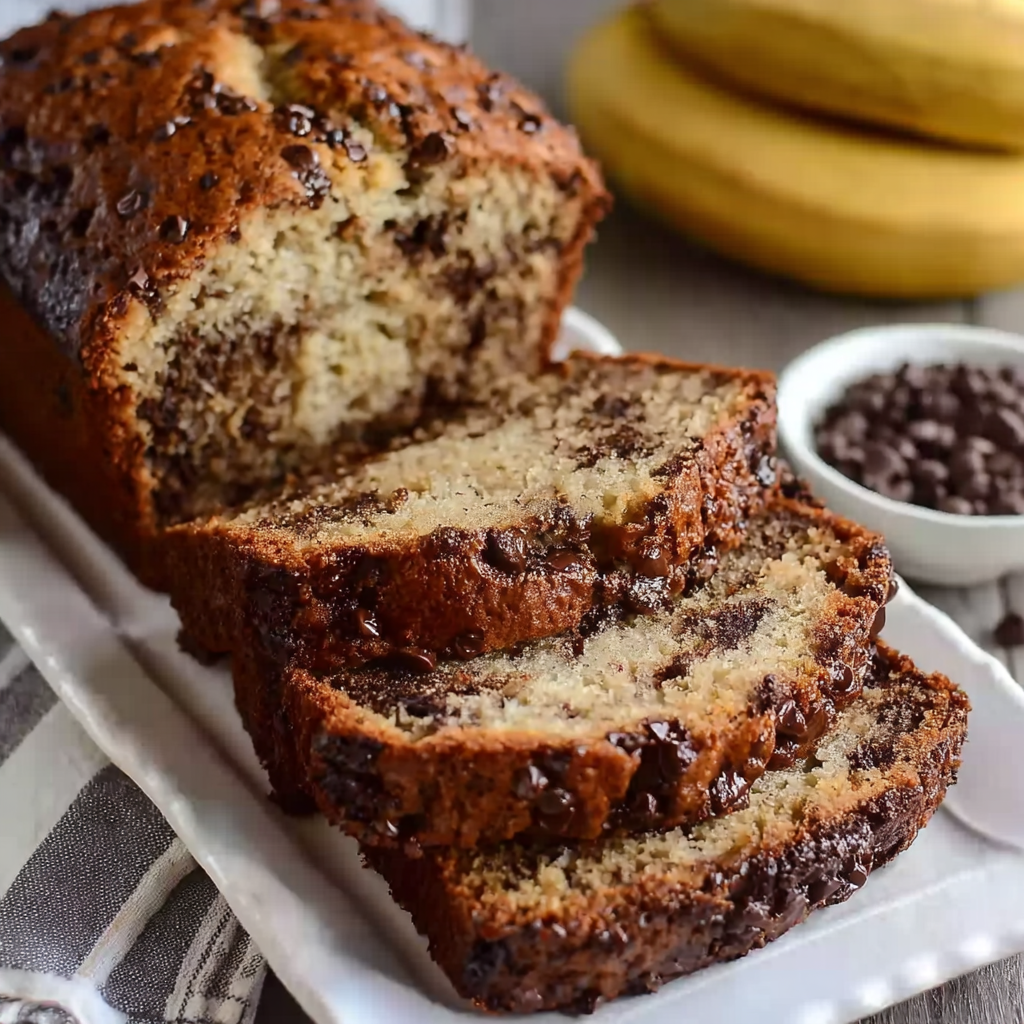
Chocolate Chip Banana Bread

Introduction
Here is a question that every home baker has faced at least once and faces repeatedly thereafter: what do you do with the bananas that crossed the line from ripe to overripe while you were busy with everything else — the ones with the black-spotted, soft, almost liquid interior that makes them too sweet to eat fresh but, as generations of bakers have understood, too valuable to discard?
The answer, for as long as there have been home ovens and overripe bananas in the same kitchen, has been banana bread. But here is the follow-up question that this recipe addresses: what is the difference between the banana bread that is merely acceptable — slightly dense, mildly banana-flavored, produced from a recipe that treats the overripe fruit as an ingredient of convenience rather than an ingredient of character — and the banana bread that makes people ask for the recipe, that produces a kitchen fragrance so compelling that it brings everyone to the table, and that delivers a slice so moist, so deeply banana-flavored, and so perfectly balanced between bread and cake that it is genuinely difficult to stop at one?
According to a 2024 home baking trend report by King Arthur Baking, banana bread remains the single most baked recipe in American home kitchens for the fourteenth consecutive year — yet recipe satisfaction rates have remained consistently below 65%, with the primary complaints being insufficient banana flavor, excessive density, and a texture that stales rapidly. This chocolate chip banana bread addresses all three through the same technique combination applied to the creamy banana bars earlier in this collection: brown butter for caramelized depth, deeply overripe bananas for maximum flavor and natural sweetness, and a ratio of fat to flour calibrated specifically for the moist, tender crumb that distinguishes the best banana bread from the merely adequate version.
The chocolate chips are not an afterthought but a considered flavor decision — the slight bitterness of dark chocolate chips against the sweet, caramelized banana produces a contrast that makes each element taste more intensely of itself. A 2023 food science review in the journal Food Research International confirmed that the pairing of banana with dark chocolate activates complementary aromatic compound pathways — specifically the fruity ester compounds in banana and the roasted pyrazine compounds in dark chocolate — producing a combined perception of complexity that neither ingredient achieves independently.
Ingredients List
For the Banana Bread
- 3 large very ripe bananas (approximately 300g / 10.5 oz peeled — deeply black-spotted, soft throughout)
- 115g (½ cup / 1 stick) unsalted butter (browned — see Step 1)
- 150g (¾ cup) granulated sugar (sub: 130g coconut sugar for a deeper caramel note)
- 50g (¼ cup packed) light brown sugar
- 2 large eggs, room temperature
- 1 tsp pure vanilla extract
- 240ml (1 cup) full-fat sour cream (the moisture and acidity secret — produces a dramatically more tender crumb than buttermilk or plain yogurt)
- 250g (2 cups) all-purpose flour, sifted
- 1 tsp baking soda (not baking powder — the sour cream’s acidity activates baking soda more effectively)
- ½ tsp fine sea salt
- ½ tsp ground cinnamon (adds warmth that complements both banana and chocolate)
For the Chocolate Chips
- 200g (1¼ cups) semi-sweet or dark chocolate chips (60–70% cacao — reserve 3 tbsp for the surface)
- 1 tbsp all-purpose flour (tossed with the chips to prevent them sinking to the bottom)
For the Topping (Optional but Strongly Recommended)
- Reserved 3 tbsp chocolate chips (pressed into the surface before baking)
- 1 banana, halved lengthwise (placed on the surface — caramelizes beautifully during baking)
- 1 tbsp brown sugar (sprinkled over the banana halves)
- Flaky sea salt (a pinch — the finishing detail that makes everything taste more vivid)
Timing
- Prep Time: 12 minutes
- Bake Time: 60–70 minutes
- Cooling Time: 20 minutes in pan, then 30 minutes on rack
- Total Time: approximately 1 hour 45 minutes
Step-by-Step Instructions
Step 1: Brown the Butter
Place the butter in a light-colored saucepan over medium heat. Cook, stirring frequently, as it melts, foams, and the milk solids gradually transition from white to golden to deep amber — approximately 5 minutes from cold. The moment the solids reach a deep golden-brown and the butter smells of toasted hazelnuts and caramel, pour immediately into a large mixing bowl. The transition from correct to burnt is rapid — a light-colored pan and continuous attention are both essential.
Allow the brown butter to cool for 3–4 minutes — it should be fluid but not hot enough to cook the eggs when they are added.
Key tip: Brown butter in banana bread is not a neutral upgrade — it is a transformative one. The Maillard reaction products in the browned milk solids interact with the natural sugars in the overripe banana and produce a caramelized, nutty, toffee-adjacent depth that makes the banana flavor taste more concentrated and more complex simultaneously.
Step 2: Mash the Bananas
Add the peeled overripe bananas to the warm brown butter and mash thoroughly with a fork or potato masher until completely smooth — or leave small chunks deliberately if a more textured bread is preferred. The warmth of the brown butter slightly caramelizes the banana sugars as you mash, adding an additional layer of depth.
Key tip: If the bananas are not yet deeply overripe — black-spotted, soft throughout, intensely fragrant — accelerate the ripening by placing unpeeled bananas on a foil-lined baking sheet in a 300°F (150°C) oven for 15–20 minutes until the skins are completely black and the interior is soft and liquid. This oven method produces the deeply sweet, concentrated banana character of a properly overripe fruit from a banana that was merely very ripe an hour earlier.
Step 3: Build the Batter
To the brown butter and banana mixture, add both sugars and whisk until the sugar begins to dissolve. Add the eggs one at a time, whisking after each. Add the vanilla extract and sour cream and whisk until completely smooth and uniformly combined.
Sift the flour, baking soda, salt, and cinnamon directly into the banana mixture. Fold with a rubber spatula using large, sweeping strokes — cutting down through the center and folding up and over — until the flour is just incorporated with no dry streaks visible. The batter should be thick, lumpy, and slightly uneven — over-mixing at this stage develops gluten and produces a tough, dense bread rather than the tender, moist crumb the recipe is designed around.
Toss the chocolate chips with 1 tablespoon of flour until evenly coated — the flour coating prevents the chips from sinking to the bottom of the loaf during baking by slightly increasing their surface friction against the surrounding batter. Fold the floured chips gently into the batter with 4–5 additional strokes.
Step 4: Fill the Pan and Top
Preheat the oven to 350°F (175°C). Grease a 9×5-inch (23x13cm) loaf pan generously with butter and line with a strip of parchment paper running the length of the pan with overhang on the two long sides — this overhang lifts the finished bread cleanly from the pan.
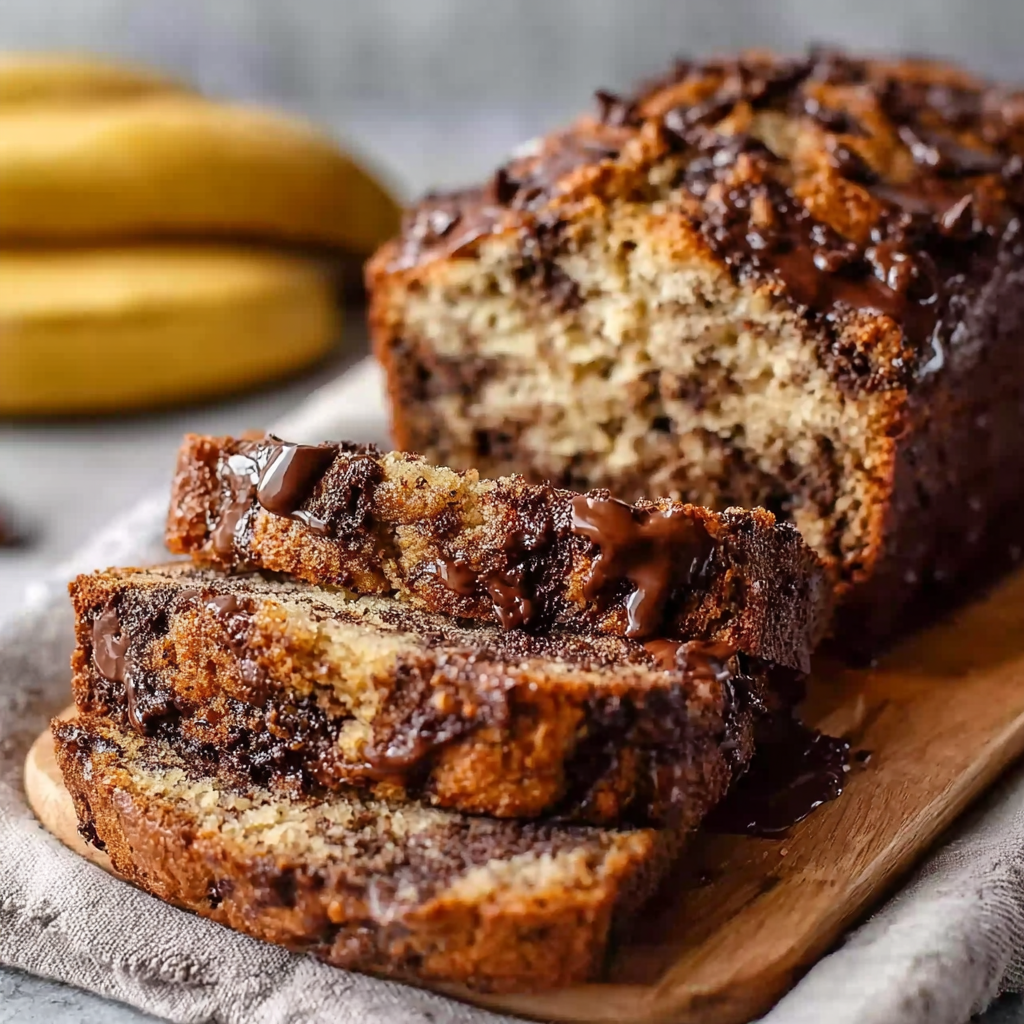
Pour the batter into the prepared pan and spread to an even surface. Place the two banana halves — cut side up — lengthwise on the surface of the batter, pressing very gently to anchor them. Sprinkle the brown sugar over the banana halves. Scatter the reserved chocolate chips over the surface of the batter between and around the banana halves. Finish with a pinch of flaky sea salt scattered over the entire surface.
Step 5: Bake
Bake at 350°F (175°C) for 60–70 minutes — checking at the 55-minute mark — until a skewer inserted into the center of the loaf, between the banana halves, comes out with a few moist crumbs but no wet batter. The surface should be deeply golden-brown, the banana halves caramelized and slightly dark at their edges, and the sides of the bread pulling slightly away from the pan. The loaf will dome during baking and the dome will crack — this crack is normal and desirable, indicating that the loaf rose properly.
If the surface is browning too rapidly before the center is cooked through, tent loosely with aluminum foil at the 40-minute mark — the foil prevents further surface browning while the interior continues to bake.
Key tip: Banana bread consistently under-bakes in the center when removed too early — the moist banana and sour cream batter retains heat poorly and the center registers as solid to the touch before it is fully cooked. Trust the skewer test rather than the visual or touch indicators.
Step 6: Cool and Slice
Cool in the pan for 20 minutes — the bread is too fragile to remove immediately and will break along the chocolate chip inclusions if unmolded hot. After 20 minutes, lift from the pan using the parchment overhang and place on a wire rack to cool for a further 30 minutes before slicing. Slicing too early produces a gummy, compressed interior that does not reflect the bread’s true texture — the crumb needs time to set.
Nutritional Information
Per serving — based on 10 slices.
| Nutrient | Per Serving | % Daily Value* |
|---|---|---|
| Calories | 345 kcal | 17% |
| Total Fat | 16g | 21% |
| Saturated Fat | 9g | 45% |
| Total Carbohydrates | 48g | 17% |
| Total Sugar | 28g | — |
| Protein | 5g | 10% |
| Dietary Fiber | 2g | 7% |
| Sodium | 175mg | 8% |
| Vitamin B6 | 15% DV | 15% |
| Iron | 10% DV | 10% |
| Magnesium | 8% DV | 8% |
*Based on a standard 2,000-calorie daily value.
The Vitamin B6 content at 15% of the daily recommended value per slice — from the bananas — and the magnesium at 8% from the dark chocolate chips provide a genuine micronutrient contribution for a sweet baked good. The iron at 10% of the daily value reflects the combined contribution of the dark chocolate and the flour.
Healthier Alternatives
Reduced sugar: The deeply overripe bananas provide substantial natural sweetness — reduce the granulated sugar to 100g and omit the brown sugar. The chocolate chips and the sour cream provide sufficient richness and the banana flavor is more distinctly present when the surrounding sweetness is reduced.
Whole wheat variation: Replace 80g of the all-purpose flour with an equal weight of whole wheat pastry flour — the bread becomes slightly denser and more complex in flavor with additional fiber. Increase the sour cream by 1 tablespoon to compensate for whole wheat’s higher moisture absorption.
Higher protein: Add 2 tablespoons of almond flour to the dry ingredients and replace 2 tablespoons of the granulated sugar with vanilla protein powder. Both additions increase the protein per slice without significantly altering the flavor.
Dairy-free: Replace the butter with refined coconut oil — which browns comparably to butter at the same temperature — and replace the sour cream with full-fat coconut yogurt. The flavor shifts slightly toward tropical but remains entirely complementary to the banana.
Lower fat: Replace half the butter with an equal weight of unsweetened applesauce — reducing the fat content by approximately 35% while the applesauce’s natural sweetness compensates slightly for the reduced butter flavor.
Serving Suggestions
Plain at room temperature: The most revealing serving format — the full caramelized banana depth, the slight bitterness of the dark chocolate chips, and the moist, tender crumb are all most present at room temperature rather than cold.
Warm with salted butter: Slice and toast briefly — 60 seconds in a toaster oven or under a broiler — until the exterior caramelizes slightly and the chocolate chips begin to soften. Serve with a generous spread of salted butter. This format transforms banana bread from a snack into an experience.
As a dessert: Warm a thick slice in the microwave for 20 seconds and serve with a scoop of vanilla bean ice cream and a drizzle of salted caramel sauce. The warm banana bread against cold ice cream produces the temperature contrast that makes both elements more pleasurable.
For gifting: Wrap the whole cooled loaf in parchment, tie with kitchen twine, and attach a small handwritten card. Homemade chocolate chip banana bread is one of the most universally appreciated food gifts available — familiar enough to feel comforting and well-made enough to feel considered.
Breakfast toast: Toast slices until the exterior is caramelized and the chocolate chips are molten, spread with almond butter or tahini, and serve alongside a glass of cold oat milk for a breakfast that tastes like dessert while delivering fiber, natural fruit sugars, and meaningful fat and protein.
Common Mistakes to Avoid
Using under-ripe bananas. Yellow bananas with minimal spotting produce a banana bread that tastes faintly of banana — over-ripe, black-spotted bananas produce one that tastes intensely, unmistakably, irresistibly of banana. The oven-ripening technique described in Step 2 makes this the most correctable mistake in the recipe.
Not browning the butter. Regular melted butter produces a perfectly acceptable banana bread. Brown butter produces an extraordinary one. The 5 extra minutes and the requirement of continuous attention are both repaid immediately in the first bite.
Over-mixing after adding the flour. Gluten developed by over-mixing produces a tough, chewy, dense bread rather than the moist, tender crumb the recipe is designed around. The fold-until-just-combined principle is non-negotiable — a few visible streaks of flour at the point of adding the chocolate chips will disappear during the final folding and baking.
Not flouring the chocolate chips. Uncoated chips sink to the bottom of the batter during baking, producing a solid chocolate layer at the base of the loaf rather than chips distributed through the crumb. The tablespoon of flour tossed with the chips before folding in is a 30-second step that prevents this entirely.
Slicing too early. A banana bread sliced before the crumb has set — less than 30 minutes after coming out of the oven — produces a gummy, compressed interior that does not represent the bread’s true texture. The crumb needs the resting period to firm and the steam to dissipate.
Storing Tips
Room temperature: Store wrapped in plastic wrap or in an airtight container for up to 3 days. The flavor actually improves over the first 24 hours as the banana flavor deepens and the chocolate chips soften into the surrounding crumb.
Refrigerator: Store for up to 6 days. Remove 30 minutes before eating — cold banana bread has muted flavors and a denser texture. The banana and brown butter flavors are most present at room temperature.
Freezer: Slice the cooled loaf, wrap individual slices in plastic wrap, transfer to a freezer bag, and freeze for up to 3 months. Thaw individual slices at room temperature for 30 minutes or toast directly from frozen. This approach makes a single baking session into months of available banana bread.
Make-ahead: The batter — assembled through Step 3, before the banana halves and sugar topping are added — can be refrigerated overnight in the lined pan and baked the following morning. Add 5–8 minutes to the baking time when cooking from cold batter. This make-ahead approach produces a kitchen fragrance during the morning bake that no other breakfast preparation can match.
Conclusion
Chocolate chip banana bread proves that the most frequently made recipe in American home baking becomes genuinely extraordinary through two decisions — brown butter that transforms a mild dairy fat into a caramelized, nutty cooking medium that makes the banana taste more intensely of itself, and sour cream that produces the moist, tender crumb that makes every slice better than the last. Overripe bananas, dark chocolate chips, a caramelized banana-half topping, and the kitchen fragrance that announces the result: the banana bread that closes the gap between the one people make and the one people remember.
Make it and share your results in the comments — tell us whether you used the oven-ripening technique, whether the brown butter made the difference it always does, and how long the loaf lasted in your household. Leave a review, share with someone who makes banana bread regularly and could be making it better, and subscribe to our newsletter for more technique-driven, deeply flavored baking recipes every week.
FAQs
Why does my banana bread always turn out dense? Three common causes: over-mixing the batter after the flour is added, which develops gluten and produces a tough, compact crumb; insufficient leavening activation from bananas that were not ripe enough to provide the natural acid that activates baking soda; or too much flour measured by the spoon-into-measuring-cup method rather than spooning flour into the cup and leveling. Use a kitchen scale for the most accurate flour measurement.
Can I add nuts instead of or in addition to chocolate chips? Yes — toasted walnuts or pecans are the most traditional addition to banana bread and pair beautifully with both the banana and the dark chocolate. Use ¾ cup of roughly chopped toasted nuts in place of or alongside the chocolate chips. Toast the nuts in a dry skillet for 3–4 minutes before adding to the batter — the toasting amplifies their flavor significantly.
What is the ideal banana ripeness for this recipe? The bananas should be deeply black-spotted — not merely yellow with brown spots, but predominantly black-skinned with flesh that has softened to an almost liquid consistency and developed an intensely sweet, concentrated fragrance. At this stage, the natural starch has converted almost entirely to simple sugars, producing a banana that is too sweet to eat fresh but provides the maximum flavor and natural sweetness in baked goods.
Can I make this recipe into muffins? Yes — divide the batter among 12 greased muffin cups, filling each approximately three-quarters full. Top each with a small piece of banana, a few chocolate chips, and a pinch of brown sugar. Bake at 375°F (190°C) for 20–22 minutes until a skewer comes out with moist crumbs. Muffins cool faster than a loaf and are ready to eat in 15 minutes.
Why do my chocolate chips sink to the bottom? Chocolate chips are denser than the surrounding batter and sink before the batter sets during baking. Tossing the chips in flour before adding — as specified in Step 3 — is the most reliable prevention. Using larger chips or chocolate chunks rather than mini chips also helps, as their greater mass creates more friction with the surrounding batter.
How do I know when the banana bread is done without over-baking? The skewer test is the most reliable method — inserted into the thickest part of the loaf between the banana halves, it should come out with a few moist crumbs but no wet batter. Verify at the 55-minute mark rather than waiting for the full 70 minutes — ovens vary and some run hot. An instant-read thermometer inserted into the center should read 200–205°F (93–96°C) for a fully baked banana bread.