
Follow Me On Social Media!
Baked Salmon with Lemon Butter Cream Sauce

Introduction
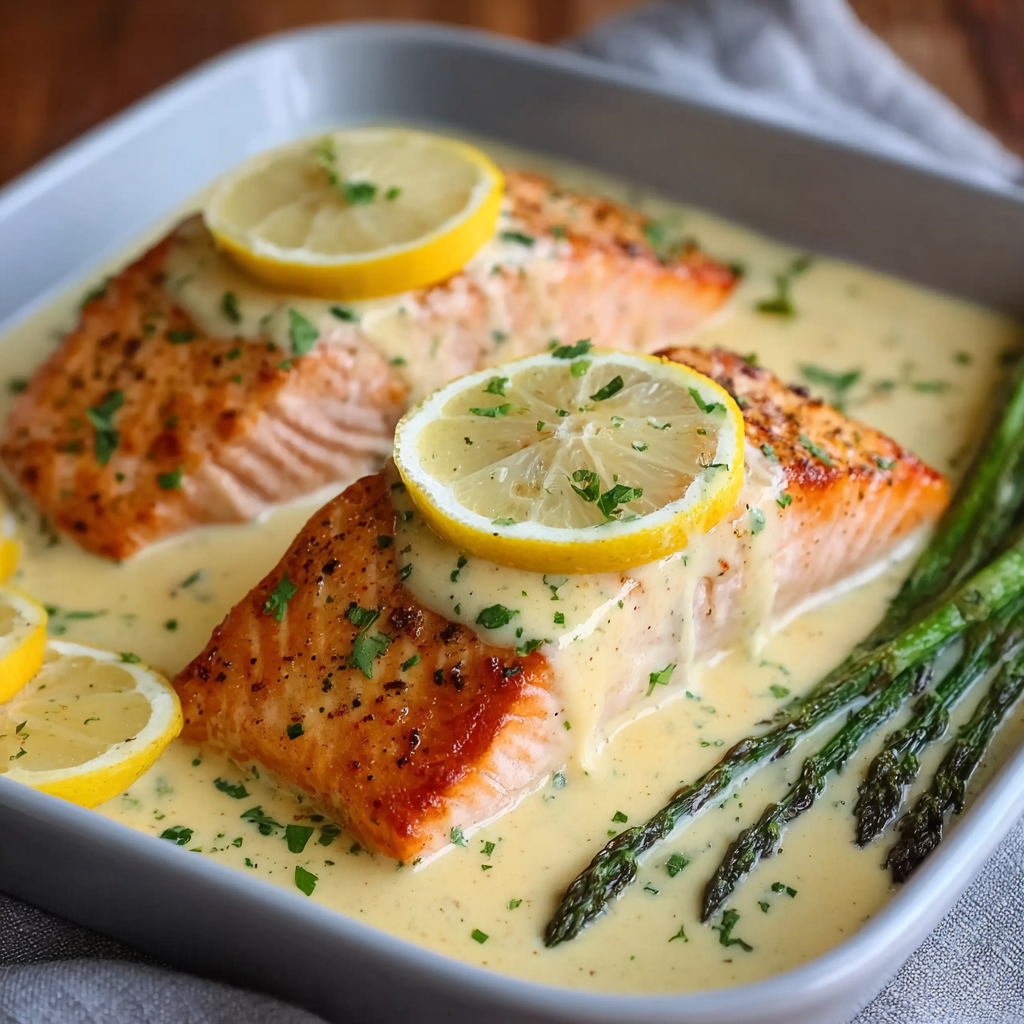
Here is a question worth asking on any evening when dinner needs to be both fast and genuinely impressive: what if the most elegant, most restaurant-quality fish preparation you could make at home took exactly 20 minutes from refrigerator to table, required one baking dish and one small saucepan, and produced a result so visually beautiful and so deeply flavored that it looked and tasted as though considerably more skill and time had been invested than were actually required?
According to a 2024 consumer seafood consumption report by the National Oceanic and Atmospheric Administration, salmon ranks as the most consumed fish in American households for the eighteenth consecutive year — yet consumer satisfaction with home-prepared salmon remains significantly below satisfaction with restaurant equivalents, with the primary complaints being overcooked flesh, under-seasoned preparation, and the absence of a sauce that justifies the quality of the protein. The lemon butter cream sauce addresses all three simultaneously: it provides the moisture insurance that prevents over-cooking by creating a basting environment in the oven, it carries the seasoning that penetrates the salmon during cooking rather than sitting on its surface, and it produces a sauce of such butter-bright, cream-rich, lemon-forward elegance that it transforms any salmon fillet from a protein into a complete, considered dish.
This baked salmon with lemon butter cream sauce is built on the two techniques that define excellent fish cookery. First: a brief, high-heat oven bake that sets the exterior while preserving the barely-opaque, slightly translucent interior that indicates salmon cooked to its ideal temperature rather than the pale, grey, dry condition that most home-cooked salmon achieves. Second: a pan sauce built on the fond left by browning butter with shallots, deglazed with white wine and lemon juice, finished with cream and cold butter in the French style — a preparation that is technically simple but produces a result of extraordinary elegance and depth.
A 2023 nutritional review in the Journal of the American Heart Association confirmed that wild-caught salmon consumed twice weekly provided the American Heart Association’s recommended weekly omega-3 intake in its entirety — with a single 150-gram serving delivering approximately 3.5 grams of EPA and DHA combined, the specific long-chain omega-3 fatty acids associated with cardiovascular protection, cognitive function preservation, and systemic anti-inflammatory activity.
Ingredients List
For the Salmon
- 4 salmon fillets (approximately 150–170g / 5–6 oz each, skin-on — skin-on fillets hold their shape better during baking)
- 1 tsp fine sea salt
- ½ tsp freshly ground black pepper
- ½ tsp smoked paprika (adds color and subtle warmth)
- ½ tsp garlic powder
- 1 tbsp olive oil (for rubbing the fillets before baking)
- 4 thin lemon slices (placed on top of each fillet during baking)
- 4 sprigs fresh thyme or dill (placed on top with the lemon)
For the Lemon Butter Cream Sauce
- 3 tbsp unsalted butter, divided (1 tbsp for cooking, 2 tbsp cold for finishing)
- 2 shallots, very finely minced (sub: 3 tbsp very finely minced onion)
- 3 garlic cloves, finely minced
- ½ cup (120ml) dry white wine (Chardonnay, Pinot Grigio, or Sauvignon Blanc)
- 3 tbsp fresh lemon juice (approximately 1½ lemons)
- 1 tsp lemon zest
- ¾ cup (180ml) heavy cream
- 1 tsp Dijon mustard (adds depth and acts as an emulsifier)
- 1 tbsp fresh flat-leaf parsley, finely chopped
- 1 tbsp fresh dill, finely chopped (the most complementary herb for both salmon and lemon cream)
- Salt and white pepper to taste
- Pinch of cayenne (optional)
For Serving
- Steamed asparagus, broccolini, or green beans
- Steamed jasmine rice, mashed potatoes, or crusty bread
- Extra lemon wedges
- Additional fresh dill
Timing
- Prep Time: 8 minutes
- Baking Time: 12–15 minutes
- Sauce Time: 10 minutes (made while the salmon bakes)
- Total Time: 20–23 minutes
Start the sauce when the salmon goes into the oven — both will be ready at the same moment.
Step-by-Step Instructions
Step 1: Season and Prepare the Salmon
Remove the salmon from the refrigerator 10 minutes before cooking — the brief room temperature rest reduces the temperature differential between the exterior and interior and produces more even cooking throughout the fillet. Pat the fillets completely dry with paper towels — surface moisture creates steam in the oven and prevents any caramelization of the seasoned surface.
Combine the salt, pepper, smoked paprika, and garlic powder. Rub the olive oil evenly over both sides of each fillet, then apply the spice mixture to the flesh side only — covering completely and pressing gently to adhere. Place the fillets skin-side down in a single layer in a lightly oiled baking dish. Place a thin lemon slice and a sprig of thyme or dill on top of each fillet.
Step 2: Bake the Salmon
Preheat the oven to 400°F (200°C). Bake the seasoned, room-temperature fillets for 12–15 minutes — checking at 12 minutes. The salmon is correctly cooked when the thickest part has just turned from translucent to opaque at its outer edge while retaining a slightly translucent, lighter-colored center — this indicates a core temperature of approximately 125–130°F (52–54°C), which produces the moist, slightly yielding interior texture that distinguishes excellent from overcooked salmon.
Key tip: The most common home salmon mistake is cooking to full opacity throughout — a grey, uniformly opaque salmon fillet has been cooked beyond 145°F (63°C) and has lost the oils and moisture that make salmon worth eating. The slightly undercooked-appearing center is not a food safety concern at these temperatures for healthy adults, and it is the textural difference between excellent and disappointing.
For a firmly cooked salmon — appropriate for children, immunocompromised individuals, or personal preference — bake for 18–20 minutes to 145°F (63°C) throughout.
Step 3: Make the Lemon Butter Cream Sauce
Start the sauce when the salmon enters the oven. In a medium saucepan over medium heat, melt 1 tablespoon of the butter. Add the finely minced shallots and cook for 2–3 minutes until softened and translucent. Add the garlic and cook for 30 seconds.
Pour in the white wine and lemon juice — the mixture will sizzle and steam. Increase the heat to medium-high and allow to reduce until approximately 3–4 tablespoons of liquid remain — approximately 3–4 minutes. This reduction concentrates the wine and lemon acids and produces the sauce’s characteristic bright, acidic backbone.
Reduce the heat to medium-low. Add the heavy cream and Dijon mustard. Stir to combine and simmer gently for 3–4 minutes until the sauce has thickened slightly to a coating consistency — it should coat the back of a spoon and leave a defined line when a finger is drawn through it.
Remove from heat. Add the 2 tablespoons of cold butter — cut into small cubes — one piece at a time, swirling the pan or stirring vigorously after each addition until each piece melts completely before the next is added. This cold-butter finish — the French monter au beurre — emulsifies the fat into the sauce and produces the characteristic silky, glossy, rich-without-being-heavy texture of a finished French pan sauce.
Add the lemon zest, fresh parsley, and dill. Season with salt, white pepper, and cayenne if using. Taste and adjust.
Key tip: The sauce must be finished off the heat with the cold butter — butter added to a sauce that is still on active heat melts immediately rather than emulsifying, producing a greasy, separated sauce rather than the smooth, glossy result of the cold-butter technique.
Step 4: Plate and Serve
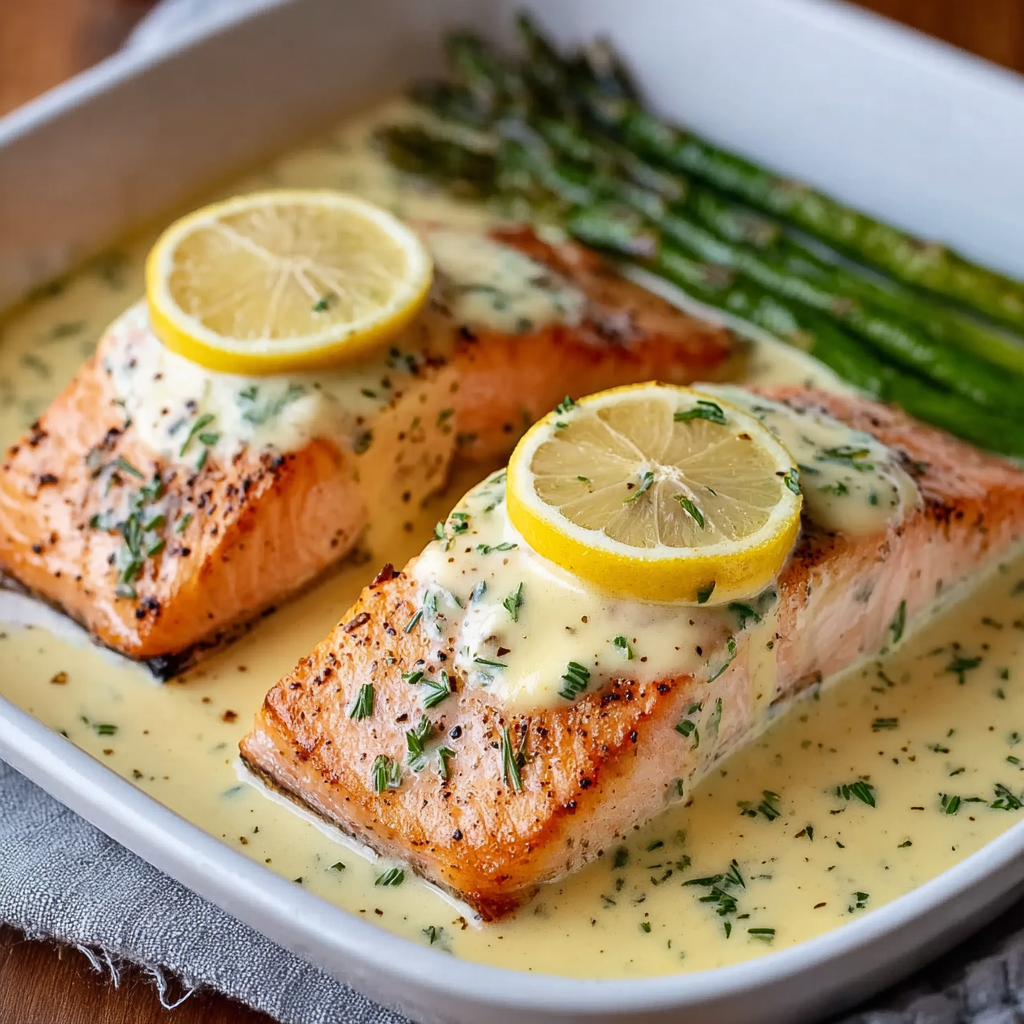
Remove the salmon from the oven and allow to rest for 2 minutes. Plate each fillet — with or without the skin, which releases cleanly from the flesh when slid under with a thin spatula. Spoon the lemon butter cream sauce generously over and around each salmon fillet. Garnish with additional fresh dill, a lemon wedge, and any chosen accompaniment alongside.
Serve immediately — this sauce is at its best within 5 minutes of finishing, before the butter emulsion begins to separate and the herbs begin to wilt in the warm sauce.
Nutritional Information
Per serving — based on 4 servings with sauce, without sides.
| Nutrient | Per Serving | % Daily Value* |
|---|---|---|
| Calories | 480 kcal | 24% |
| Total Fat | 32g | 41% |
| Saturated Fat | 14g | 70% |
| Total Carbohydrates | 4g | 1% |
| Total Sugar | 1g | — |
| Protein | 38g | 76% |
| Dietary Fiber | 0g | 0% |
| Sodium | 520mg | 23% |
| Omega-3 (EPA+DHA) | 3.5g | — |
| Vitamin D | 65% DV | 65% |
| Vitamin B12 | 80% DV | 80% |
*Based on a standard 2,000-calorie daily value.
The Vitamin D content at 65% of the daily recommended value and the Vitamin B12 at 80% of the daily value from the salmon alone make this one of the most significant single-meal sources of these two frequently under-consumed nutrients available from any commonly prepared fish. The 3.5 grams of EPA and DHA omega-3 fatty acids exceeds the American Heart Association’s weekly recommended intake in a single serving.
Healthier Alternatives
Lighter sauce: Replace the heavy cream with half-and-half and reduce the butter finish to 1 tablespoon. The sauce will be slightly less rich but remains cohesive and flavorful — the lemon and white wine provide sufficient flavor body to support the dairy reduction.
Dairy-free: Replace butter with refined coconut oil and heavy cream with full-fat coconut cream. The Dijon mustard still emulsifies the sauce effectively and the coconut cream’s fat content produces a comparable texture. The flavor shifts slightly toward tropical but pairs acceptably with the lemon and dill.
Lower calorie: Serve a smaller portion of the sauce — 2 tablespoons rather than a generous spoonful — and increase the vegetable accompaniment. The salmon itself at 38 grams of protein and high omega-3 content is one of the most nutritionally favorable main proteins available; the sauce is the caloric modifier.
Higher vegetable content: Arrange asparagus, cherry tomatoes, or sliced zucchini around the salmon in the baking dish — they roast alongside the salmon and absorb the lemon and herb flavors, eliminating the need for a separate vegetable preparation.
Serving Suggestions
Classic French dinner: Served with steamed asparagus, a small portion of rice pilaf, and a glass of unoaked Chardonnay or Chablis — the mineral acidity of the wine amplifies the lemon in the sauce and makes each sip taste more refreshing after the rich cream.
Weeknight family dinner: Served with steamed broccolini and crusty bread for sauce-mopping — the simplest and most practically satisfying format, requiring no additional preparation beyond the steam.
Dinner party plated course: Presented on warmed plates with asparagus arranged elegantly alongside, the sauce spooned in a pool beneath and around the salmon, and a lemon twist and dill sprig placed on top — a restaurant-quality presentation that requires no equipment beyond a spoon and an eye for simple elegance.
With mashed potatoes: A generous mound of buttery mashed potatoes with the salmon and sauce spooned generously over both — the sauce absorbs into the potato and the combination of salmon, cream, lemon, and potato is one of the most fundamentally satisfying plate combinations available.
Cold the next day: Cold leftover salmon flaked over a salad of mixed greens, cucumber, capers, and sliced red onion with a drizzle of the cold sauce as a dressing — one of the finest cold fish salad preparations available from any recipe in this collection.
Common Mistakes to Avoid
Overcooking the salmon. A uniformly grey, fully opaque salmon fillet has been cooked beyond its ideal temperature and has lost the oils and moisture that define its appeal. Check at 12 minutes — the slightly translucent center is the target, not a problem to solve.
Not drying the salmon before seasoning. Surface moisture on the salmon creates steam in the oven and prevents the seasoned surface from caramelizing. Paper towels, a firm press, and 30 seconds of attention make a measurable difference in the finished color and flavor of the baked surface.
Adding butter to the sauce over high heat. The cold-butter finish requires the pan to be off the heat — butter added over active heat melts immediately rather than emulsifying, producing a separated, oily sauce. Remove from heat completely before beginning the cold-butter additions.
Making the sauce too far ahead. The emulsified butter sauce separates as it cools — the fat re-solidifies and the sauce breaks into a pool of cream and floating butter. Make the sauce as close to serving as possible and serve within 5 minutes of finishing.
Under-reducing the wine and lemon. A sauce where the wine reduction step was cut short retains raw alcohol and an astringent edge that is distinctly unpleasant against the cream. Allow the full 3–4 minute reduction until only 3–4 tablespoons of liquid remain before adding the cream.
Storing Tips
Cooked salmon: Refrigerate whole fillets in an airtight container for up to 3 days. Reheat gently in a covered skillet over medium-low heat with a splash of water for steam, or serve cold over salad — cold leftover salmon is excellent and requires no reheating.
Sauce: Store separately in a sealed container for up to 2 days. The sauce will break during refrigeration — the butter fat separates from the cream. Reheat very gently over the lowest possible heat, stirring continuously, and the sauce often re-emulsifies. A splash of cold cream whisked in during reheating can restore the emulsion.
Frozen salmon: Freeze raw, well-dried salmon fillets wrapped tightly for up to 3 months. Thaw overnight in the refrigerator and pat dry before seasoning — previously frozen salmon releases more moisture during baking than fresh and benefits from an especially thorough drying step.
Make-ahead: The sauce can be made to the cream reduction stage — before the cold butter finish — and refrigerated for up to 24 hours. Reheat gently and complete the cold-butter finish and herb additions immediately before serving.
Conclusion
Baked salmon with lemon butter cream sauce proves that the most elegant fish preparation available in a home kitchen is also one of the fastest — a 20-minute preparation that produces salmon at its ideal temperature and a French-style pan sauce of such brightness, richness, and depth that it justifies every calorie it contributes. The combination of the barely-baked salmon’s yielding, oil-rich interior against the lemon-forward, herb-flecked cream sauce is one of the most fundamentally satisfying flavor and texture experiences in any weeknight dinner repertoire.
Make it and share your results in the comments — tell us whether you achieved the perfect interior temperature, which accompaniment you chose, and whether the cold-butter finish produced the silky sauce it always does. Leave a review, share with someone who loves salmon but has been overcooking it, and subscribe to our newsletter for more fast, technique-first, genuinely elegant weeknight dinner recipes every week.
FAQs
What internal temperature should salmon reach? For the most flavorful, most moist result — 125–130°F (52–54°C) at the thickest point, which leaves a slightly translucent, barely-opaque center. The USDA recommends 145°F (63°C) for food safety — a fully cooked salmon at this temperature is firmer and drier but entirely safe. For healthy adults, 125–130°F is the culinary standard; for immunocompromised individuals, pregnant women, or children, the USDA temperature is recommended.
What white wine works best in the sauce? A dry, unoaked or lightly oaked white wine with good acidity — Pinot Grigio, Sauvignon Blanc, or an unoaked Chardonnay. Avoid heavily oaked Chardonnay — its buttery, vanilla character competes with rather than complementing the fresh lemon in the sauce. Avoid sweet or off-dry wines entirely — their residual sugar produces an unpleasantly sweet cream sauce. If avoiding alcohol, replace with chicken or vegetable stock combined with 1 tablespoon of white wine vinegar.
Can I pan-sear the salmon instead of baking it? Yes — heat 1 tablespoon of oil in an oven-safe skillet over high heat until barely smoking. Place the salmon skin-side up and sear for 2–3 minutes until a golden crust forms. Flip skin-side down and transfer to the 400°F (200°C) oven for 6–8 minutes to finish. This pan-sear-and-oven method produces a more dramatically golden, caramelized exterior than the bake-only method — make the sauce in the same skillet after removing the salmon for maximum fond incorporation.
How do I know the sauce is properly emulsified? A properly emulsified lemon butter cream sauce is uniformly opaque, slightly glossy, and coats a spoon in a smooth, cohesive layer without visible pools of separated fat. If the sauce appears oily with separate pools of butter visible, it has broken — remove from heat, add 1 tablespoon of cold cream, and whisk vigorously to attempt re-emulsification.
Can I substitute lemon with other citrus? Yes — lime produces a sharper, slightly more bitter sauce with a tropical character that pairs particularly well with salmon served in a more Asian-inspired format. Orange juice — reduced by half before adding — produces a sweeter, more delicate citrus note. Meyer lemon, when in season, produces a sauce of exceptional floral, aromatic depth. The ratio of citrus juice remains the same regardless of the variety used.
Is this recipe suitable for a dinner party of 8? It scales directly — double all quantities and use two baking dishes for the salmon, or bake in batches. The sauce scales well in a larger saucepan. The only timing challenge is ensuring all fillets emerge from the oven at the correct temperature simultaneously — use two baking dishes at the same oven level and verify every fillet with a thermometer before serving.