Follow Me On Social Media!
Flourless Cottage Cheese Pizza Crust

Introduction
Here is a question that cuts to the heart of one of the most persistent frustrations in health-conscious cooking: why does every attempt to make a genuinely satisfying low-carbohydrate pizza crust produce something that is either too soft to pick up, too eggy to taste like pizza, or so far from the original experience that the exercise feels more like deprivation management than actual cooking? According to a 2024 nutritional trend report by the International Food Information Council, pizza remains the most missed food among people following low-carbohydrate, ketogenic, and high-protein dietary patterns — yet the satisfaction rate with available pizza alternatives is consistently below 40%, with texture and protein content identified as the two primary failure points.
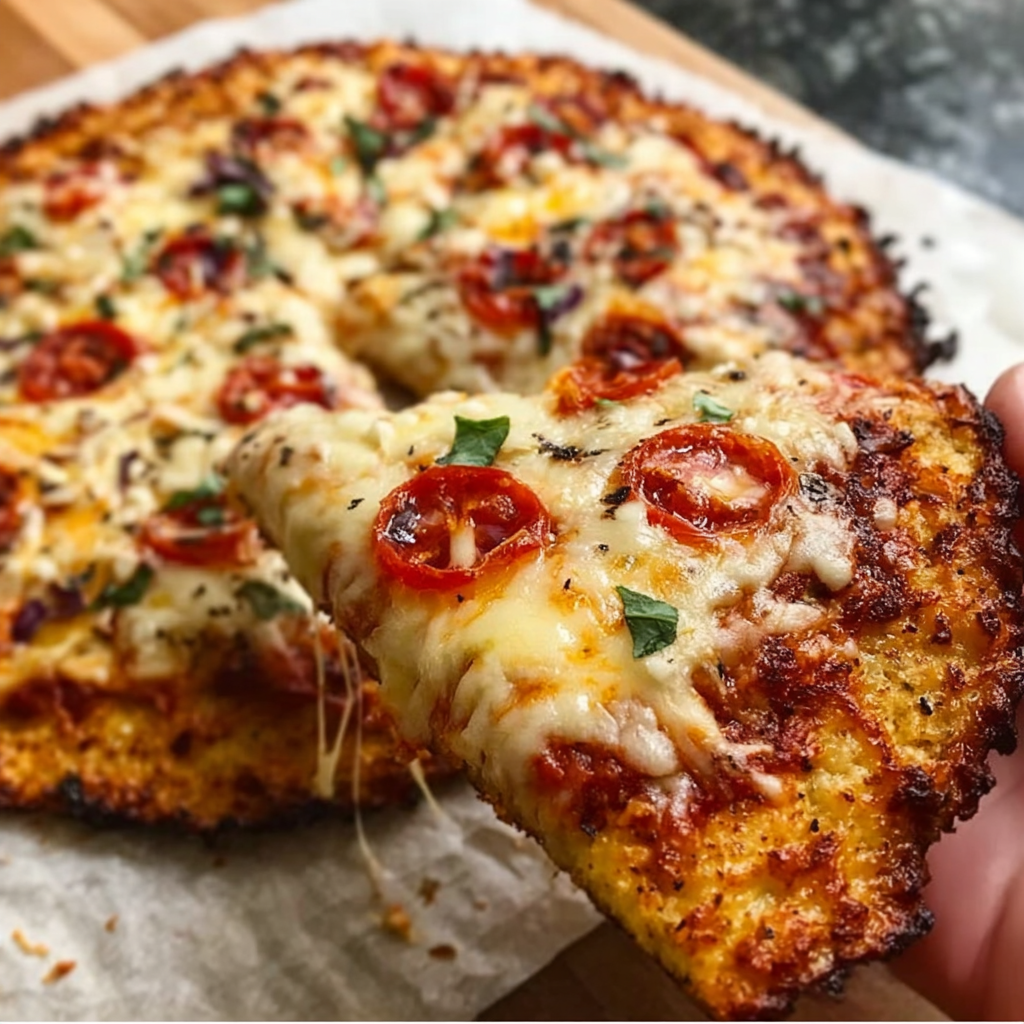
This flourless cottage cheese pizza crust solves both simultaneously. Blended cottage cheese — one of the highest-protein dairy products available at any supermarket, delivering 25 grams of protein per cup at just 206 calories — combined with eggs and a small amount of Italian seasoning produces a crust that firms during baking into something that holds its shape when picked up, browns at the edges, crisps on the bottom with the right pan technique, and has a genuinely neutral, slightly savory flavor that accepts pizza toppings without competing with them. At under 6 grams of net carbohydrates for the entire crust and over 35 grams of protein before any toppings are added, this is the pizza crust that makes the dietary math genuinely favorable.
A 2023 nutritional analysis published in the Journal of the American College of Nutrition identified cottage cheese as one of the most underutilized high-protein ingredients in the average home cook’s repertoire — with a protein density, amino acid completeness, and casein content that makes it superior to many dedicated protein supplements for sustained muscle protein synthesis over a 4–6 hour window.
Ingredients List
For the Crust
- 1 cup (225g) full-fat cottage cheese (full-fat produces a richer, more cohesive crust — low-fat works but produces a drier result)
- 2 large eggs
- ½ tsp garlic powder
- ½ tsp dried Italian seasoning or dried oregano
- ¼ tsp fine sea salt
- ¼ tsp freshly ground black pepper
- ¼ tsp smoked paprika (optional — adds color and depth)
- 2 tbsp Parmesan cheese, finely grated (optional — adds flavor and helps the exterior brown)
For Classic Margherita Topping (Or Choose Your Own)
- 4 tbsp pizza sauce or crushed tomatoes seasoned with garlic and oregano
- 1 cup (115g) low-moisture mozzarella, freshly shredded
- Fresh basil leaves
- Extra virgin olive oil, for drizzling
- Flaky sea salt and cracked black pepper, to finish
Additional Topping Ideas
- Pepperoni and jalapeño
- Roasted vegetables and goat cheese
- Buffalo chicken and ranch drizzle
- Prosciutto and arugula (added after baking)
- BBQ chicken and red onion
Timing
- Prep Time: 5 minutes
- Bake Time (Crust Only): 25–30 minutes
- Bake Time (Topped): 8–12 minutes
- Total Time: 40–45 minutes
The two-stage baking — crust first, then topped — is the technique that produces a properly set, non-soggy crust capable of supporting toppings without collapsing. Skipping the first bake produces an under-set crust that cannot hold the weight and moisture of the sauce and cheese.
Step-by-Step Instructions
Step 1: Blend the Cottage Cheese
Place the cottage cheese in a blender or food processor and blend on high speed for 60 seconds until completely smooth with no visible curds remaining. This blending step is essential — unblended cottage cheese contains visible curds that do not fully integrate into the crust batter, producing an uneven texture with distinct white curd pieces visible in the finished crust. Blended cottage cheese becomes a smooth, protein-rich liquid that distributes evenly through the batter and produces a uniform, cohesive crust.
Key tip: Do not skip the blending step or substitute by mashing with a fork — the residual curd texture produces a crust with a cottage cheese flavor that many people find distracting. Blended smooth, the flavor becomes neutral and genuinely pizza-crust-like.
Step 2: Make the Crust Batter
In a medium bowl, whisk the blended cottage cheese, eggs, garlic powder, Italian seasoning, salt, pepper, smoked paprika, and Parmesan together until completely smooth and homogenous. The batter will be thinner than conventional pizza dough — closer to a thick pancake batter than a dough that can be handled. This is correct. The eggs and cottage cheese proteins set during baking to produce the firm, sliceable crust.
Step 3: Prepare the Baking Surface
Preheat the oven to 400°F (200°C). Line a baking sheet or pizza pan with parchment paper and spray or brush with a thin film of olive oil. For the crispiest possible result, preheat a pizza stone or cast iron skillet in the oven during preheating and pour the batter directly onto the preheated surface — the immediate contact with intense heat sets the bottom crust rapidly and produces the crispiest underside.
Key tip: The parchment paper is non-optional — this crust will stick to any unlined surface regardless of how generously it is greased. The parchment allows clean removal without the crust tearing or fragmenting.
Step 4: Spread and Shape the Crust
Pour the batter onto the prepared parchment and spread with a spatula or the back of a spoon into a round or rectangular shape approximately 6–8mm (¼ inch) thick. The crust can be made as thin as 4mm for a crispier result or as thick as 1cm for a more substantial, bread-like base — adjust according to preference. Thinner spreads produce crispier results; thicker spreads produce a softer, chewier interior.
Leave a slightly thicker border around the edge — approximately 1cm — which will puff and brown more dramatically than the center and approximate the appearance of a conventional pizza crust edge.
Step 5: First Bake — Set the Crust
Bake the unfilled crust at 400°F (200°C) for 25–30 minutes until the surface is completely dry to the touch, the edges are golden brown and beginning to pull away from the parchment, and the center is set and no longer wet or sticky. The crust should be firm enough to lift by the edge without bending or tearing — this structural integrity is what allows it to support toppings without collapsing.
If the crust is still soft in the center after 30 minutes, continue baking in 5-minute increments until the center passes the firmness test. The correct color is a deep golden on the edges and a pale golden across the center surface — not white, which indicates under-baking.
Step 6: Add Toppings and Second Bake
Remove the crust from the oven. Spread pizza sauce evenly across the surface, leaving the thicker border clear. Scatter the shredded mozzarella evenly over the sauce. Add any additional toppings. Return to the oven for 8–12 minutes until the cheese is completely melted, bubbling across the surface, and beginning to develop golden-brown patches.
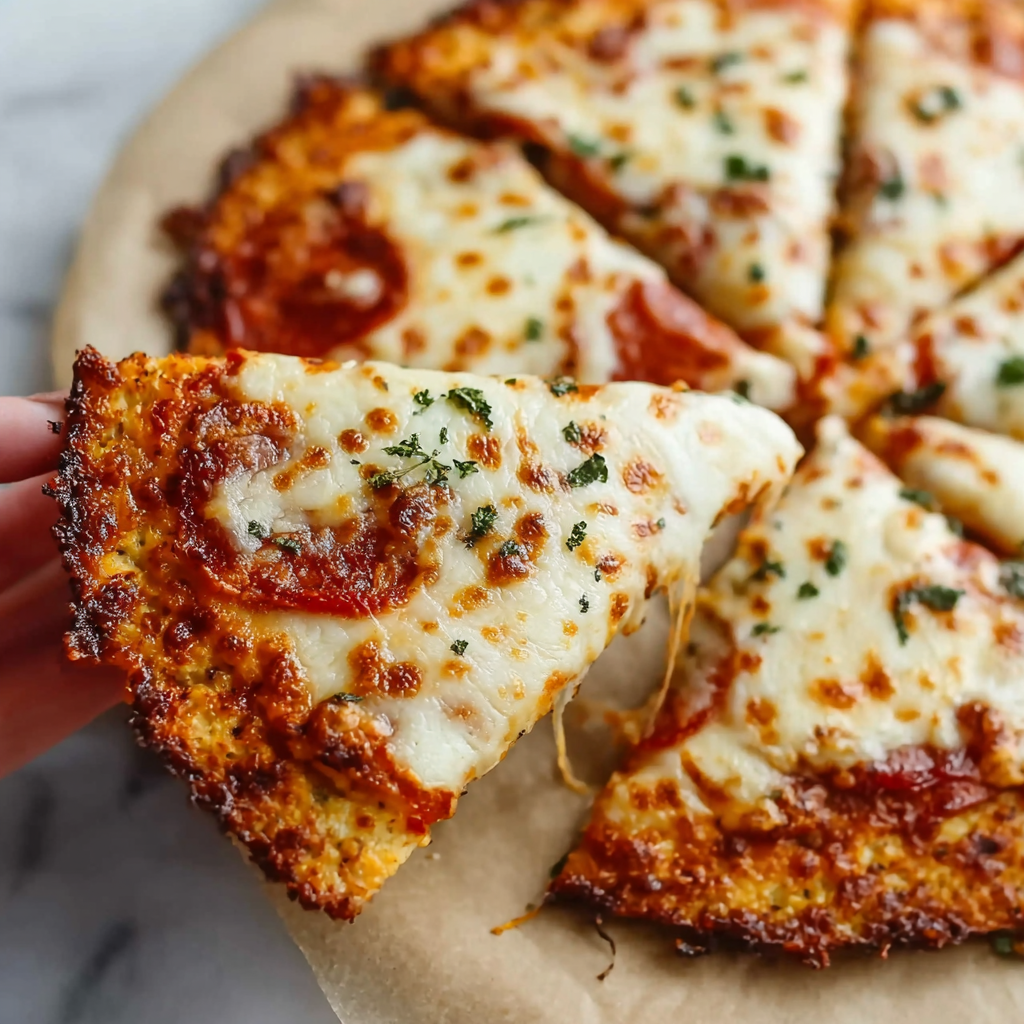
For the final 2 minutes, switch to the broiler setting and watch closely — the broiler rapidly browns the cheese surface into the characteristic spotty golden pattern of a properly baked pizza. Remove the moment the desired color is achieved.
Step 7: Rest, Slice, and Serve
Remove from the oven and rest for 3–4 minutes before slicing — this rest allows the cheese to firm slightly and prevents it from sliding entirely off the first slice. Cut with a sharp knife or pizza wheel. Top with fresh basil, a drizzle of extra virgin olive oil, and a pinch of flaky sea salt. Serve immediately.
Nutritional Information
Per serving — based on 4 slices of the margherita pizza (crust with sauce and mozzarella).
| Nutrient | Per Serving | % Daily Value* |
|---|---|---|
| Calories | 235 kcal | 12% |
| Total Fat | 14g | 18% |
| Saturated Fat | 7g | 35% |
| Total Carbohydrates | 6g | 2% |
| Net Carbohydrates | 5.5g | — |
| Total Sugar | 2g | — |
| Protein | 22g | 44% |
| Dietary Fiber | 0.5g | 2% |
| Sodium | 520mg | 23% |
| Calcium | 28% DV | 28% |
| Vitamin B12 | 18% DV | 18% |
| Selenium | 22% DV | 22% |
*Based on a standard 2,000-calorie daily diet.
At 22 grams of protein and 5.5 grams of net carbohydrates per serving — for a full quarter of the pizza — this crust produces one of the most nutritionally favorable pizza experiences available. For context, a conventional flour-based pizza slice typically delivers 6–8 grams of protein and 30–35 grams of net carbohydrates per equivalent serving.
Healthier Alternatives
Higher protein: Add 2 tablespoons of unflavored whey or egg white protein powder to the batter — the additional protein increases the crust’s structural rigidity and pushes the protein content above 28 grams per serving. The flavor remains neutral.
Dairy-free: Replace cottage cheese with a dairy-free ricotta — made from cashews, tofu, or a commercial plant-based alternative — blended until completely smooth. The crust will be slightly less protein-dense but retains its structural characteristics with comparable results.
Lower sodium: Use a low-sodium cottage cheese and reduce the salt in the batter to a pinch. The garlic and Italian seasoning provide sufficient flavor that the salt reduction is largely undetectable in the finished crust.
Added fiber: Stir 1 tablespoon of ground psyllium husk into the batter — it thickens the mixture slightly, improves the crust’s ability to hold its shape during baking, and adds prebiotic fiber without altering the flavor.
Cauliflower hybrid: Replace half the cottage cheese with ½ cup of finely riced cauliflower that has been cooked and squeezed completely dry. The hybrid crust has a slightly more complex, earthy flavor and a somewhat crispier texture than the cottage cheese-only version.
Serving Suggestions
Classic margherita: The simplest and most revealing application — a thin layer of crushed tomato sauce, fresh mozzarella, and basil reveals the neutral, pizza-crust-like character of the base without distraction.
Loaded protein pizza: Top with diced cooked chicken breast, turkey pepperoni, extra mozzarella, and a drizzle of hot sauce after baking. This format pushes the total protein content of a full pizza above 100 grams — a genuinely impressive macronutrient outcome for a meal that tastes indistinguishable from a conventional pizza experience.
Breakfast pizza: Top the pre-baked crust with a thin layer of cream cheese, 3 soft-scrambled eggs, crumbled bacon, and shredded cheddar. Return to the oven for 8 minutes. This format transforms the crust into a protein-rich breakfast option that requires no additional preparation beyond the base recipe.
Flatbread format: Cut the pre-baked crust into smaller rectangles before topping — each piece functions as an individual flatbread that can be customized with different toppings for a mixed platter suitable for entertaining.
With fresh toppings after baking: Bake the cheese-topped pizza as directed, then immediately add arugula dressed with lemon and olive oil, shaved Parmesan, and thin-sliced prosciutto. The contrast of the warm pizza and the cold, dressed greens is one of the most sophisticated pizza presentations available.
Common Mistakes to Avoid
Not blending the cottage cheese smooth. Visible curd pieces in an unblended cottage cheese crust produce an uneven texture, a more pronounced cottage cheese flavor, and structural weak points where the unincorporated curd creates soft patches that tear when the pizza is lifted. Blend completely smooth — this step determines the quality of the finished crust more than any other.
Spreading the crust too thin. A crust thinner than 5mm dries completely during the first bake and becomes brittle rather than firm — cracking when lifted or cut. The 6–8mm thickness is calibrated to produce a crust that is dry enough to support toppings without being so thin that it shatters.
Skipping the first bake. Adding toppings directly to the unbaked batter produces a crust that cannot support the weight and moisture of sauce and cheese — the batter liquefies around the toppings and never fully sets, producing a wet, unstructured result. The two-stage baking is not optional.
Using wet toppings without pre-cooking. Fresh mushrooms, fresh tomatoes, and other high-moisture vegetables release water during baking that soaks the already-delicate crust from above. Pre-cook and drain any high-moisture vegetables before adding them as toppings.
Cutting immediately after the second bake. The cottage cheese-based crust is slightly more delicate than a conventional flour crust when very hot — the 3–4 minute rest allows the proteins to firm and the cheese to set, producing clean slices rather than collapsed ones.
Storing Tips
Pre-baked crust: The first-baked, un-topped crust can be stored between sheets of parchment paper in an airtight container at room temperature for up to 2 days or refrigerated for up to 5 days. This make-ahead approach allows individual pizzas to be assembled and baked in under 15 minutes on any given evening.
Finished pizza: Store leftover slices in an airtight container in the refrigerator for up to 3 days. Reheat in an air fryer at 375°F (190°C) for 3–4 minutes — the crispiest reheating method. A 350°F (175°C) oven on a wire rack for 8 minutes is equally effective. The microwave reheats but produces a soft crust.
Freezer: Freeze the pre-baked, un-topped crust between parchment sheets for up to 2 months. Add toppings directly from frozen and bake at 400°F (200°C) for 12–15 minutes — the crust thaws and the toppings bake simultaneously.
Batter storage: The mixed but unbaked batter can be refrigerated in a sealed container for up to 24 hours before baking. Stir well before pouring and spreading — the mixture may have separated slightly during refrigeration.
Conclusion
Flourless cottage cheese pizza crust proves that the most nutritionally favorable pizza crust is not a compromise — it is a genuinely clever application of one of the most protein-dense, most versatile, and most overlooked ingredients in the dairy case. Five ingredients, 40 minutes, 5.5 grams of net carbohydrates, and 22 grams of protein per slice — a pizza that makes the dietary math work without asking anyone at the table to pretend they are satisfied with something they are not.
Make it and share your results in the comments — tell us which toppings you chose, whether you used a pizza stone for the crispiest base, and whether it passed the pick-up test. Leave a review, share with someone following a low-carbohydrate or high-protein diet, and subscribe to our newsletter for more creative, nutrition-forward recipes every week.
FAQs
Can I use low-fat or fat-free cottage cheese? Yes — both work but produce a slightly drier, less cohesive crust than full-fat cottage cheese. The fat in full-fat cottage cheese contributes to the tender, slightly chewy interior of the crust. If using low-fat, add 1 tablespoon of olive oil to the batter to compensate for the reduced fat content and improve the texture.
Why is my crust still soft after 30 minutes of baking? The three most common causes are batter that was spread too thick, an oven temperature that is lower than indicated, or cottage cheese with an unusually high moisture content. Check the oven temperature with a separate thermometer, spread slightly thinner in the next attempt, and drain the cottage cheese briefly through a fine mesh sieve if it appears particularly liquid.
Can I make this crust without eggs? The eggs provide the primary structural binding for the cottage cheese — without them the crust cannot firm during baking. A flax egg — 1 tablespoon of ground flaxseed mixed with 3 tablespoons of water, rested for 5 minutes — provides comparable binding properties and produces an acceptable crust, though slightly denser and less golden than the egg version.
Does the crust taste like cottage cheese? When properly blended smooth, the cottage cheese flavor is significantly less detectable than most people expect — the garlic, Italian seasoning, and smoked paprika in the batter, combined with the pizza sauce and mozzarella toppings, provide sufficient flavor to mask the dairy base almost entirely. The dominant flavor is savory and neutral — genuinely pizza-like rather than dairy-forward.
Can I make a larger crust for more servings? Yes — double the batter and spread across two parchment-lined baking sheets simultaneously, or spread a thicker batter across a single larger sheet. For a double batch on one large sheet, increase the first bake time to 35–40 minutes and verify firmness across the entire surface before adding toppings.
Is this crust suitable for someone with gluten intolerance or celiac disease? The crust itself is naturally gluten-free — it contains no flour or gluten-containing ingredients. Verify that the cottage cheese, Italian seasoning, and any toppings are certified gluten-free, as cross-contamination can occur in shared processing facilities. With verified gluten-free ingredients throughout, this is a safe and genuinely satisfying pizza option for those with celiac disease or gluten sensitivity.