Follow Me On Social Media!
Fried Feta Rolls with Chili Honey

Introduction
Here is a question that reframes the entire appetizer category: when was the last time a single bite — something small enough to eat in two mouthfuls — produced the simultaneous experience of three completely distinct textures and a flavor combination so compelling that you reached for the next one before finishing the first?
According to a 2024 global food trend report by the Specialty Food Association, crispy fried cheese preparations represent the single fastest-growing appetizer category in both restaurant and home entertaining — driven by the discovery that the combination of a shatteringly crispy exterior and a molten, yielding cheese interior is one of the most neurologically satisfying textural contrasts available in any food preparation. Fried feta, specifically, has been the defining viral food preparation of the last two years — its salty, tangy, crumbly character transforming under heat into something unexpectedly molten and rich, with a crisped exterior that amplifies the contrast dramatically.
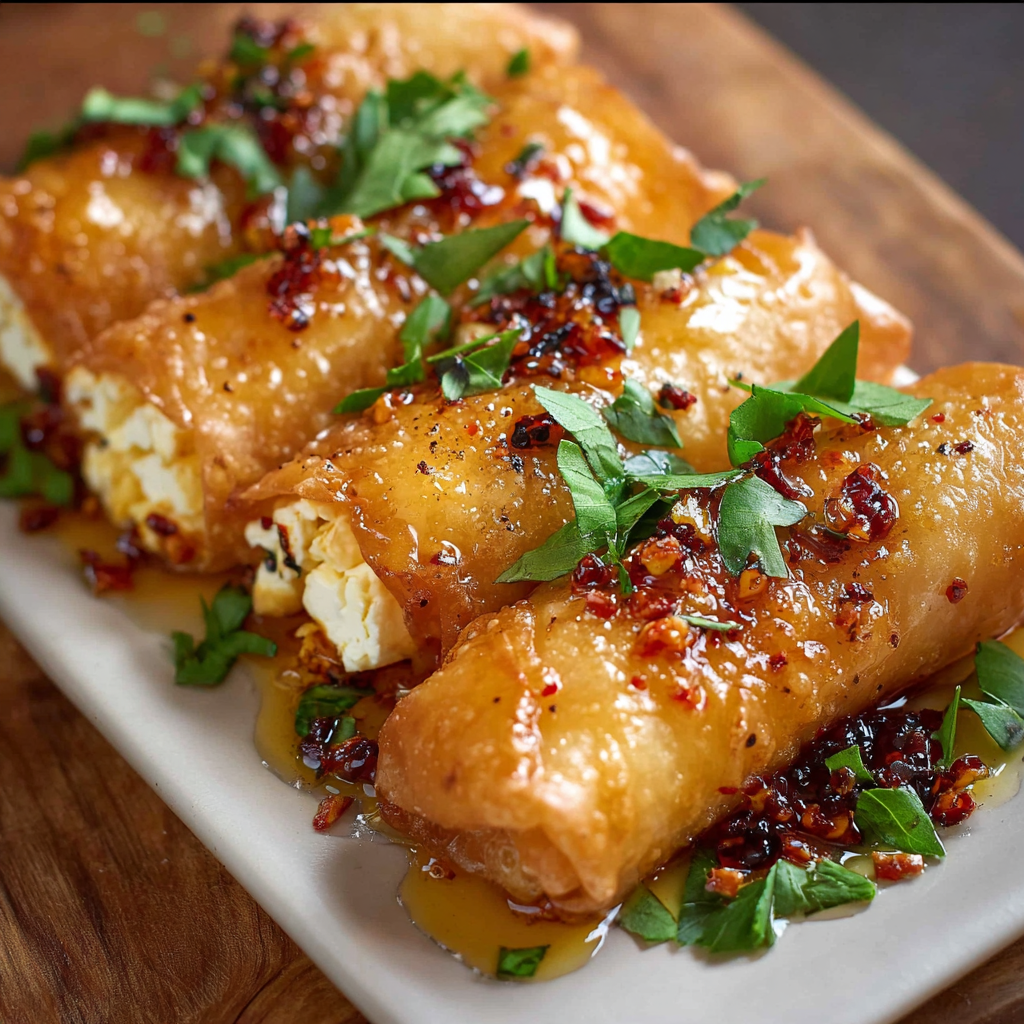
These fried feta rolls with chili honey take the concept further by rolling the feta in phyllo pastry before frying — creating a shell that shatters in multiple layers rather than producing a single, uniform crust, and a caramelized exterior that develops through the paper-thin phyllo layers into something between a spring roll and a bougatsa. The chili honey finish — warm, floral, and gently building in heat — is applied to the hot roll at the moment of serving and absorbs immediately into the outermost phyllo layers, producing a glaze that is simultaneously sticky, sweet, spicy, and slightly caramelized.
A 2023 food science review in the journal Food Research International identified the layered phyllo structure as producing one of the most favorable ratios of crust-to-filling contact area of any pastry format — each thin layer creating an additional surface for caramelization, each air pocket between layers becoming a site of steam expansion and additional crispness. The result is a crust that is crispier per unit of pastry than any single-layer alternative.
Ingredients List
For the Feta Filling
- 300g (10.5 oz) good-quality block feta cheese, drained (not pre-crumbled — block feta has better structure for rolling)
- 2 tbsp fresh mint, very finely chopped
- 1 tbsp fresh dill, finely chopped (optional — adds herbal brightness)
- 1 tsp lemon zest
- ¼ tsp freshly ground black pepper
- ¼ tsp red pepper flakes (optional)
- 1 tbsp honey (added to the filling — the slight sweetness balances the salty feta internally)
For the Rolls
- 8 sheets phyllo pastry, thawed (keep covered with a damp kitchen towel at all times — phyllo dries and cracks within minutes of exposure)
- 4 tbsp unsalted butter, melted (for brushing between phyllo layers)
- Neutral oil, for frying (vegetable or sunflower — approximately 3–4cm depth in the pan)
For the Chili Honey
- 4 tbsp raw honey (floral varieties — orange blossom, wildflower, or thyme honey)
- 1–2 tsp red pepper flakes (adjust to heat preference)
- ½ tsp apple cider vinegar (adds subtle tang that prevents the honey from tasting flat)
- 1 small garlic clove, finely minced (optional — adds savory depth)
- Pinch of flaky sea salt
For Serving
- Extra fresh mint leaves
- Extra lemon zest or thin lemon slices
- Flaky sea salt, for finishing
- Fresh thyme sprigs (optional — for visual garnish)
Timing
- Filling Prep: 5 minutes
- Rolling Time: 15 minutes
- Chili Honey: 5 minutes
- Frying Time: 8–10 minutes (for all rolls)
- Total Time: 30–35 minutes
Step-by-Step Instructions
Step 1: Make the Chili Honey
Combine the honey, red pepper flakes, apple cider vinegar, garlic if using, and flaky sea salt in a small saucepan over the lowest heat setting. Warm for 2–3 minutes — the honey becomes fluid and the pepper flakes bloom in the warm liquid, releasing their capsaicin into the honey. Do not boil — high heat degrades the aromatic compounds in raw honey and produces a flat, less complex sauce. Remove from heat and allow to steep for 10 minutes before using. The chili honey improves significantly over the first 24 hours and can be made well in advance.
Step 2: Prepare the Feta Filling
Cut the block feta into 8 equal rectangular portions — approximately 35–40g each. Pat each piece dry with paper towels — surface moisture is the primary cause of soggy phyllo and oil splattering during frying. Combine the mint, dill, lemon zest, black pepper, and red pepper flakes in a small bowl. Press a small amount of the herb mixture onto one flat side of each feta portion and drizzle with the teaspoon of honey.
Key tip: Block feta that has been patted very dry and is cold from the refrigerator holds its shape better during rolling and resists melting into the phyllo during the first minutes of frying — producing a roll that holds its structure rather than allowing the molten cheese to leak before the crust is set.
Step 3: Work with the Phyllo
Unroll the phyllo pastry and immediately cover the entire stack with a damp — not wet — kitchen towel. Phyllo dries within 2–3 minutes of air exposure and becomes brittle, cracking when rolled or folded. Work with one sheet at a time, keeping the remainder covered at all times.
Lay one sheet of phyllo flat on a clean work surface. Brush lightly but completely with melted butter — covering every part of the surface to the edges. Lay a second phyllo sheet directly on top of the buttered first sheet and brush again with butter. This two-layer structure provides sufficient thickness to prevent the cheese from leaking through while remaining delicate enough to crisp properly in the oil.
Step 4: Roll the Feta Parcels
Place one portion of the prepared feta near one short edge of the double-layered phyllo, approximately 3cm from the edge and centered horizontally. Fold the 3cm edge up over the feta, then fold both long sides inward over the feta — creating a three-sided envelope. Roll the feta away from you firmly and tightly along the length of the phyllo sheet until you reach the end. Press the final edge gently to seal — the butter acts as an adhesive. Repeat with the remaining feta portions and phyllo sheets.
Key tip: Roll firmly and tightly — a loose roll allows oil to penetrate between the phyllo layers during frying and produces an oily, soggy interior rather than a crispy, layered one. The roll should feel compact and tightly wound when complete.
Step 5: Fry the Rolls
Heat 3–4cm of neutral oil in a wide, heavy-bottomed saucepan or deep skillet over medium heat until it reaches 350°F (175°C). Test with a small piece of phyllo — it should sizzle immediately and turn golden within 20 seconds. Fry the rolls in batches — no more than 3–4 per batch to maintain the oil temperature — for 2–3 minutes per side until deeply golden across all exposed surfaces. The rolls should be rotated gently with tongs to ensure even browning — they float in the oil and require turning to achieve uniform color.
Transfer to a wire rack or paper-towel-lined plate. Do not stack — stacked rolls steam each other and soften the bottom layer’s crispness immediately.
Key tip: Maintaining the oil at 350°F (175°C) throughout frying is the single most important variable for evenly golden, crispy rolls. Oil below 325°F (160°C) allows the phyllo to absorb oil rather than frying crisply in it — producing greasy, pale rolls. A kitchen thermometer eliminates all uncertainty.
Step 6: Glaze and Serve
Transfer the hot rolls to a serving plate immediately. Drizzle the warm chili honey generously over the rolls — applying it while they are at their hottest allows the honey to absorb slightly into the outermost phyllo layer rather than sitting on the surface, producing a more integrated glaze rather than a pooled topping. The honey will caramelize slightly against the hot surface, adding an additional flavor dimension.
Scatter fresh mint leaves, extra lemon zest, and a pinch of flaky sea salt over the plated rolls. Serve within 5 minutes of frying — phyllo crisps are time-sensitive, reaching their peak immediately after frying and softening progressively as the honey and residual steam from the interior work into the layers.
Nutritional Information
Per serving — based on 2 rolls per person from a batch of 8, with chili honey.
| Nutrient | Per Serving | % Daily Value* |
|---|---|---|
| Calories | 385 kcal | 19% |
| Total Fat | 22g | 28% |
| Saturated Fat | 11g | 55% |
| Total Carbohydrates | 36g | 13% |
| Total Sugar | 18g | — |
| Protein | 12g | 24% |
| Dietary Fiber | 0.5g | 2% |
| Sodium | 680mg | 30% |
| Calcium | 22% DV | 22% |
| Vitamin B12 | 10% DV | 10% |
*Based on a standard 2,000-calorie daily diet.
The calcium content at 22% of the daily recommended value per serving reflects the significant feta contribution and makes this one of the more calcium-meaningful appetizer preparations available. The protein at 12 grams per serving from the feta and phyllo eggs provides more satiety than typical fried appetizers of equivalent calorie count.
Healthier Alternatives
Baked version: Brush the assembled rolls generously with melted butter and bake at 425°F (220°C) for 15–18 minutes until deeply golden — rotating once at the halfway mark. The baked version loses the immediacy of the fried crust but produces a comparable golden, layered exterior at approximately 40% less fat per serving.
Air fryer: Spray the assembled rolls with cooking spray and cook at 390°F (200°C) for 8–10 minutes, turning once. The air fryer version produces a drier, lighter crust than deep frying — excellent for everyday eating with a fraction of the oil.
Lower sodium: Use a mild feta — Bulgarian or French varieties are less salty than Greek — and rinse the feta briefly under cold water before patting dry. This can reduce the sodium contribution of the feta by 15–20%.
Reduced sugar honey: Replace half the honey with date syrup or pomegranate molasses — both have a lower glycemic impact than honey and add complex depth to the chili sauce that complements the feta beautifully.
Serving Suggestions
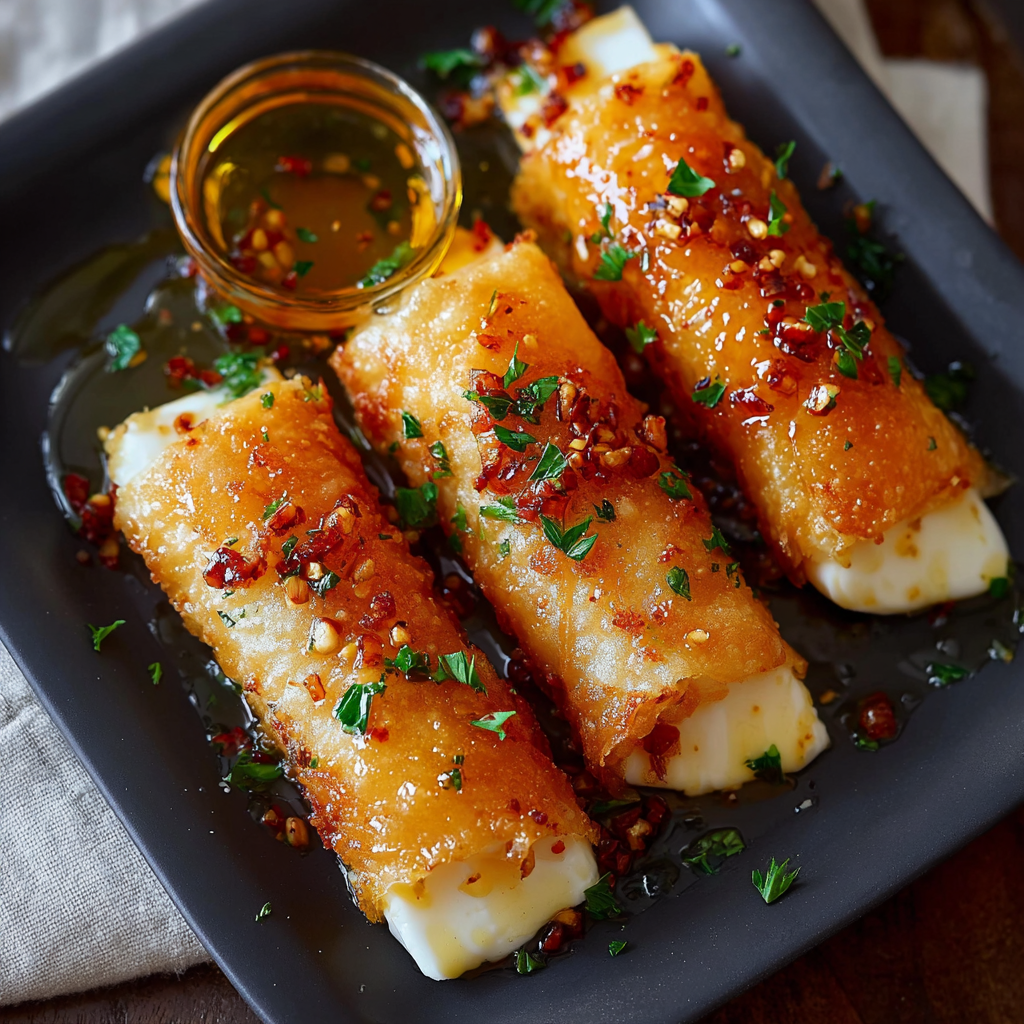
Dinner party appetizer: Serve on a wooden board with the chili honey in a small bowl alongside and extra mint scattered across the surface. This is the format that generates the most immediate admiration — the golden rolls, the amber honey, and the green mint create a visually striking presentation that requires no additional decoration.
With a Greek salad: Serve 2 rolls per person alongside a classic Greek salad of tomato, cucumber, olives, and red onion dressed with olive oil and red wine vinegar. The rolls function as both an appetizer and the cheese component of the salad simultaneously.
Meze spread: Include the fried feta rolls on a board alongside hummus, tzatziki, warm pita, marinated olives, and roasted red peppers. The hot rolls provide the warm, substantial anchor of the spread while every other component is cold or room temperature.
Dessert application: Serve 2 rolls per person with a scoop of vanilla ice cream and the chili honey drizzled over both. The hot-cold contrast and the sweet-salty-spicy combination of the honey against the cold cream and the warm salty feta is an extraordinary dessert that requires no modification to the recipe.
Brunch centerpiece: Serve alongside soft-scrambled eggs, sliced avocado, and warm flatbread for a Mediterranean-inspired brunch that is visually striking and requires under 30 minutes of total preparation.
Common Mistakes to Avoid
Not keeping phyllo covered. Phyllo exposed to air for more than 2–3 minutes becomes brittle and cracks during rolling — producing rolls with breaks in the exterior that allow cheese to leak directly into the oil during frying. Keep the unused phyllo covered with a damp kitchen towel at all times without exception.
Using wet feta. Feta that has not been thoroughly dried releases steam during frying that softens the surrounding phyllo from the inside before the exterior can set — producing rolls with soggy interior layers and occasional blowouts where the steam escapes through weak points in the crust. Pat every surface dry and use cold feta directly from the refrigerator.
Frying at too low a temperature. Oil below 325°F (160°C) is absorbed by the phyllo rather than immediately crisping its exterior — producing greasy, pale rolls. Verify the temperature with a thermometer before each batch and allow the oil to return to temperature between batches.
Rolling too loosely. A loose roll allows oil to penetrate between the phyllo layers and produces an oily interior rather than a crispy, laminated one. Roll firmly from the first fold and maintain consistent tension throughout.
Applying chili honey too late. Honey applied to cool rolls sits on the surface as a sticky coating rather than being absorbed into the outermost layer — producing a roll with an exterior coating rather than an integrated glaze. Apply immediately from frying while the rolls are at their hottest.
Storing Tips
Fried rolls: Not suitable for advance storage — fried phyllo softens within 20 minutes and cannot be restored to its original crispness. Plan service to coincide with the end of frying.
Re-crisping: Rolls that have softened can be placed in a 400°F (200°C) oven or air fryer for 3–5 minutes to restore some crispness — they will not return to their just-fried state but become substantially better than room-temperature soft rolls.
Unfried assembled rolls: Assembled but unfried rolls can be refrigerated on a parchment-lined tray covered loosely with plastic wrap for up to 4 hours before frying. This make-ahead approach is ideal for entertaining — all assembly is done in advance and the 8–10 minute frying happens while guests are present for maximum impact.
Chili honey: Stores in a sealed jar at room temperature for up to 2 weeks. The heat intensifies over the first 24–48 hours as the capsaicin continues to infuse. An excellent all-purpose condiment for cheese, pizza, flatbreads, and grilled meats well beyond this recipe.
Filling: The prepared feta portions with herbs can be refrigerated uncovered on a plate for up to 24 hours before rolling — the light air-drying further reduces the surface moisture and improves the crispiness of the finished roll.
Conclusion
Fried feta rolls with chili honey prove that the most extraordinary appetizers are built on the most deliberate contrasts — the shattering crispness of multiple phyllo layers against the salty, yielding heat of the feta within, the sweet floral warmth of the chili honey against the mineral tang of the cheese, the hot and fragrant against the cool and herbal. A preparation that takes 30 minutes, requires no specialist equipment, and produces the appetizer that everyone at the table talks about and no one stops at one.
Make them and share your results in the comments — tell us whether you fried or baked, how spicy you made the honey, and whether they lasted long enough to make it to the table in an organized arrangement. Leave a review, share with someone who loves both feta and honey, and subscribe to our newsletter for more show-stopping, technique-driven appetizer recipes every week.
FAQs
Can I use a different cheese? Halloumi cut into rectangular portions produces a comparable roll with a firmer, less molten interior that holds its shape more cleanly during frying — excellent for those who prefer a less runny cheese center. Brie or camembert cut into wedges produces a more dramatically runny, extremely rich interior. Ricotta mixed with Parmesan and herbs produces a lighter, more neutral filling. Each produces a different but entirely valid version of the fried cheese roll format.
Can I bake these instead of frying? Yes — brush generously with melted butter and bake at 425°F (220°C) for 15–18 minutes, rotating once, until deeply golden. The baked version loses the immediacy of the fried crust and the oil-mediated caramelization of the phyllo layers — it is lighter and less dramatic but entirely delicious and significantly more practical for advance preparation and large-batch cooking.
Why is my phyllo tearing when I try to roll? Phyllo tears when it has dried out — either from insufficient covering during the working period or from being frozen and thawed improperly. Ensure the unused stack is covered with a damp kitchen towel continuously, and if tears occur, simply press the torn area back together with a brush of melted butter — the butter acts as an adhesive that seals small tears effectively.
Can I make these in advance for a party? Yes — assemble the rolls and refrigerate on a parchment-lined tray for up to 4 hours. Fry in batches as guests arrive for maximum impact. The chili honey can be made up to 2 weeks ahead. With these two elements prepared, the day-of effort is reduced to a 10-minute frying session.
What type of feta works best? Greek feta — protected designation of origin, made from sheep’s milk or a combination of sheep and goat’s milk — has the most complex, salty, tangy character and the most appropriate firmness for this preparation. Bulgarian feta is slightly creamier and less salty, producing a milder but equally delicious roll. Avoid cow’s milk feta alternatives, which tend to be blander and produce a less interesting flavor contrast with the chili honey.
How do I prevent the cheese from leaking out during frying? Four factors prevent leakage: thoroughly dried feta with no surface moisture; cold feta directly from the refrigerator rather than at room temperature; a tight, firm roll with no loose layers; and frying at the correct temperature — oil that is too cool takes too long to set the exterior and allows the cheese to melt and leak before the crust has formed. Addressing all four eliminates leaking in the vast majority of cases.