Follow Me On Social Media!
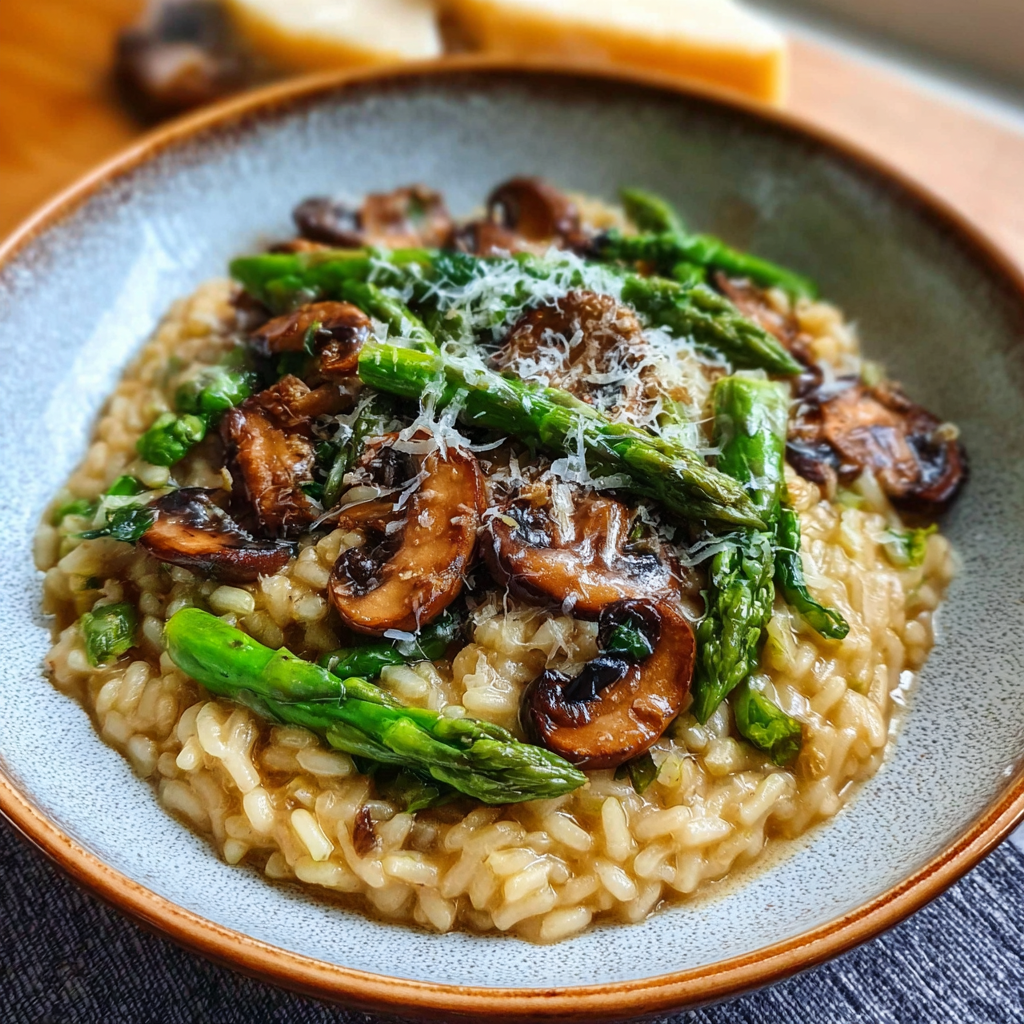
Mushroom & Asparagus Risotto

Introduction
Here is a question that challenges the most persistent myth in Italian cooking: why does risotto — a dish built from rice, stock, and patience that has been made in Northern Italian kitchens for centuries — inspire more anxiety, more avoidance, and more “I could never make that at home” responses from home cooks than almost any other preparation, when the actual technique requires nothing more than attention, a good wooden spoon, and the understanding of a single principle that, once grasped, makes every risotto you will ever make entirely manageable?
According to a 2024 culinary skills survey by the American Culinary Federation, risotto ranks as the number one dish home cooks most want to master and most consistently describe as intimidating — yet professional chefs consistently identify it as one of the most forgiving preparations in the Italian repertoire, because the rice itself communicates its needs at every stage and the technique is entirely correctable throughout the cooking process in a way that most other precision cooking methods are not.
This mushroom and asparagus risotto teaches the technique through one of its most compelling ingredient combinations — the deep umami of mixed mushrooms, the fresh, slightly bitter green of asparagus, and the creamy, silky rice that absorbs both flavors completely. The mushrooms provide the earthiness and savoriness that make this a genuinely substantial main course; the asparagus provides the freshness and color that prevent the dish from feeling heavy; and the Parmesan and butter stirred in at the end produce the characteristic wave of creaminess — called mantecatura in Italian — that is the moment when a good risotto becomes a great one.
A 2023 nutritional review in the European Journal of Nutrition identified mixed mushrooms as one of the most meaningful dietary sources of ergothioneine — an antioxidant amino acid with exceptional cellular protective properties that the human body cannot synthesize and must obtain through diet, with mushrooms representing one of the only significant sources available in the plant kingdom.
Ingredients List
For the Risotto
- 320g (1⅔ cups) Arborio or Carnaroli rice (Carnaroli is the professional’s choice — it holds its shape better and produces the creamiest result)
- 1.2L (5 cups) good-quality chicken or vegetable stock, kept warm in a separate saucepan
- 150ml (⅔ cup) dry white wine (Pinot Grigio or Sauvignon Blanc)
- 1 medium onion or 2 shallots, very finely diced
- 3 garlic cloves, finely minced
- 3 tbsp unsalted butter, divided (1 tbsp for cooking, 2 tbsp cold for the mantecatura)
- 2 tbsp extra virgin olive oil
- 50g (½ cup) Parmesan, finely grated, plus extra for serving
For the Mushrooms
- 400g (14 oz) mixed mushrooms (cremini, shiitake, oyster, or porcini — a combination produces the most complex flavor)
- 2 tbsp unsalted butter
- 2 garlic cloves, finely minced
- 1 tsp fresh thyme leaves
- Salt and black pepper to taste
- 2 tbsp dry white wine or sherry
For the Asparagus
- 1 bunch (approximately 350g / 12 oz) asparagus, woody ends snapped off
- 1 tbsp olive oil
- Salt and black pepper to taste
- 1 tsp fresh lemon juice (applied after cooking — preserves the vivid green)
For Finishing
- 2 tbsp cold unsalted butter (the mantecatura butter — must be cold)
- 1 tsp fresh lemon juice
- 1 tsp lemon zest
- Extra Parmesan, for serving
- Fresh flat-leaf parsley or chervil, roughly torn
- Flaky sea salt and cracked black pepper
Timing
- Prep Time: 15 minutes
- Mushroom and Asparagus Cook Time: 15 minutes (done in parallel while stock heats)
- Risotto Cook Time: 22–25 minutes
- Total Time: approximately 45–50 minutes
Step-by-Step Instructions
Step 1: Prepare the Stock and Mise en Place
Heat the stock in a separate saucepan over low heat until gently steaming — not boiling, but consistently warm throughout the cooking process. Cold or room-temperature stock added to the risotto drops the pan temperature and disrupts the even, gradual starch release that produces the characteristic creamy consistency. The stock must remain warm throughout — this is the single most important setup step in risotto cooking.
Prepare all remaining ingredients before the risotto begins — finely dice the onion, mince the garlic, grate the Parmesan, and measure all other components. Risotto cooking is continuous and does not permit pausing to prepare ingredients mid-process.
Step 2: Cook the Mushrooms
Heat 2 tablespoons of butter in a large skillet over high heat until the foam subsides. Add the mushrooms in a single layer — do not stir for 2 full minutes until one side is deeply golden and caramelized. Add the garlic and thyme, toss briefly, and cook for another minute. Add the white wine or sherry and allow to evaporate — 30 seconds. Season with salt and pepper. Remove from heat and set aside. The mushrooms will be stirred into the risotto near the end of cooking rather than added at the beginning — this preserves their individual caramelized character rather than allowing them to dissolve into the rice.
Step 3: Cook the Asparagus
Cut the asparagus into 3–4cm pieces, leaving the tips whole for presentation. Heat 1 tablespoon of olive oil in a skillet over medium-high heat. Add the asparagus pieces and cook for 3–4 minutes until just tender with a slight bite and vivid green in color. Season with salt and pepper. Add the lemon juice and toss. Remove from heat and set aside — the asparagus will be folded in at the very end of cooking to preserve its color and texture.
Step 4: Begin the Risotto — Toast the Rice
In a large, wide, heavy-bottomed pan over medium heat, heat 1 tablespoon of butter and 2 tablespoons of olive oil together. Add the finely diced onion and cook for 4–5 minutes until softened and translucent — not golden, which would add bitterness. Add the minced garlic and cook for 30 seconds. Add the dry Arborio or Carnaroli rice and stir continuously for 2 full minutes until every grain is coated in the fat and the edges of the grains turn translucent — this toasting step seals the exterior starch of each grain, which is essential for producing rice that releases starch gradually into the surrounding liquid rather than becoming mushy from the first ladleful of stock.
Key tip: The toasting step is not optional. Under-toasted rice releases starch too quickly and produces an overly thick, stodgy risotto. Properly toasted rice releases starch gradually over the entire cooking process, producing the characteristic flowing, creamy consistency — all’onda in Italian, meaning “in waves.”
Step 5: Add the Wine
Pour in the white wine and stir continuously until completely absorbed — approximately 2 minutes. The wine sizzles dramatically on contact with the hot rice, and the alcohol evaporates rapidly, leaving the wine’s flavor compounds — acidity, fruitiness, complexity — in the rice. Allow the wine to absorb completely before adding any stock — wine added before full absorption creates an unevenly flavored rice base.
Step 6: Add the Stock — The Core Technique
Reduce the heat to medium-low. Add the warm stock one ladle at a time — approximately 120ml (½ cup) per addition — stirring continuously after each addition until the stock is almost completely absorbed before adding the next ladle. The stirring serves two purposes: it generates the friction that releases starch from the rice grains into the surrounding liquid, and it maintains the even heat distribution that cooks each grain uniformly.
The most important principle: Each ladle of stock should be almost fully absorbed — the rice should look creamy and moist but not soupy — before the next ladle is added. This gradual hydration is what produces the characteristic flowing, velvety consistency of a properly made risotto. Continue adding stock and stirring for 18–22 minutes until the rice is cooked — creamy outside, with a barely perceptible firmness at the very center of each grain, what Italians call al dente.
Key tip: Taste the rice regularly after the 16-minute mark. The only reliable doneness indicator is the texture of the rice itself — not the time, not the appearance, and not the amount of stock remaining. The rice is done when it is creamy and flowing but each grain retains a very slight resistance at its core.
Step 7: Mantecatura — The Final Creaminess
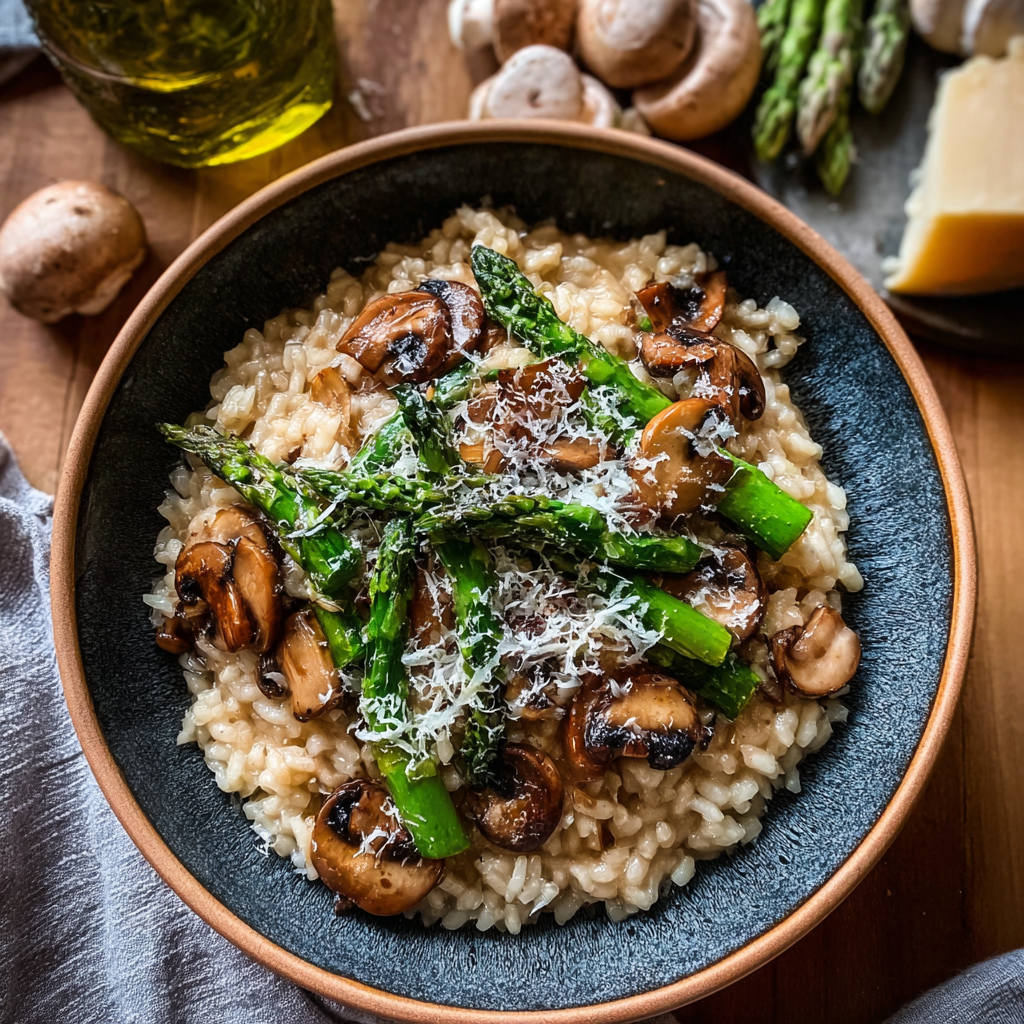
When the rice reaches the correct doneness, remove the pan from the heat entirely. Add the cold cubed butter — 2 tablespoons — and the grated Parmesan. Stir vigorously and continuously for 60–90 seconds with the pan off the heat — this vigorous off-heat stirring is the mantecatura, the emulsification technique that incorporates the cold butter fat into the starchy cooking liquid to produce the silky, glossy, wave-like consistency that defines restaurant-quality risotto. Add the lemon juice and lemon zest and stir through. Fold in the reserved mushrooms and asparagus gently.
Key tip: The butter for mantecatura must be cold — cold butter emulsifies into the starchy liquid and produces creaminess. Warm butter melts immediately and pools as a separate fat layer rather than emulsifying into the sauce. This is why the final 2 tablespoons are held cold and added off the heat.
Step 8: Serve Immediately
Divide between warm plates — warming the plates briefly in the oven at 200°F (95°C) prevents the risotto from cooling rapidly on contact. The finished risotto should flow slowly across the plate when a spoonful is added — if it holds a stiff, mounded shape, it is too thick and needs a final small ladle of warm stock stirred through. Scatter extra Parmesan, torn herbs, and a pinch of flaky sea salt over the top. Serve immediately — risotto waits for no one.
Nutritional Information
Per serving — based on 4 servings.
| Nutrient | Per Serving | % Daily Value* |
|---|---|---|
| Calories | 520 kcal | 26% |
| Total Fat | 20g | 26% |
| Saturated Fat | 10g | 50% |
| Total Carbohydrates | 64g | 23% |
| Total Sugar | 5g | — |
| Protein | 18g | 36% |
| Dietary Fiber | 5g | 18% |
| Sodium | 680mg | 30% |
| Potassium | 680mg | 14% |
| Vitamin C | 20% DV | 20% |
| Vitamin K | 55% DV | 55% |
| Folate | 22% DV | 22% |
*Based on a standard 2,000-calorie daily diet.
The Vitamin K content at 55% of the daily recommended value per serving reflects the combined contribution of asparagus and fresh herbs, making this one of the most meaningful single-meal Vitamin K sources available from a grain-based preparation. The ergothioneine from the mushrooms — not represented in standard nutritional tables — is an additional distinctive micronutrient contribution unique to the mushroom component.
Healthier Alternatives
Dairy-free: Replace butter throughout with olive oil and use a plant-based Parmesan or nutritional yeast for the mantecatura. The emulsification behavior is slightly different without butter fat — add the olive oil gradually with vigorous stirring off the heat for the closest result to the butter version.
Lower fat: Reduce the butter to 1 tablespoon total and the Parmesan to 30g. Increase the stock slightly to compensate for the reduced fat content. The risotto will be less rich and the mantecatura less pronounced but the technique and flavor profile remain intact.
Higher protein: Add 150g of cooked, shredded chicken breast or a handful of shelled edamame stirred through with the mushrooms and asparagus. Either addition increases the protein content meaningfully without altering the fundamental character of the dish.
Whole grain: Use brown arborio rice in place of white — increase the total stock by 20% and the cooking time by 10–15 minutes. Brown risotto rice produces a nuttier, more textured result with significantly more fiber and a lower glycemic index.
Additional vegetables: Add 1 cup of frozen peas in the final 2 minutes of cooking — they warm through immediately and add sweetness, color, and additional fiber that complements both the mushrooms and the asparagus beautifully.
Serving Suggestions
As a standalone main course: Serve in warm, wide, shallow bowls with a generous scattering of Parmesan, fresh herbs, a thread of extra virgin olive oil, and cracked pepper. Bring a wedge of good sourdough to the table for sauce-mopping — risotto that has been allowed to spread to the plate edges always benefits from bread.
As a dinner party first course: Serve in smaller portions — approximately 80g of dry rice per person — in warm soup bowls as a refined first course before a fish or meat main. The asparagus and mushroom combination is light enough to open a formal dinner without overwhelming the courses that follow.
With a soft-poached egg: Place a soft-poached egg in the center of each bowl of finished risotto. The yolk breaks over the risotto when pierced and acts as an additional richness that amplifies the mantecatura — one of the most decadent and simplest upgrades available for any risotto.
Risotto cakes the next day: Press cold leftover risotto into patties approximately 2cm thick. Coat in breadcrumbs and pan-fry in butter over medium-high heat for 3 minutes per side until golden and crispy. These are arancini-adjacent risotto cakes that are genuinely better than the original for some people — the cold rice firms and the fried exterior provides a completely different textural experience.
With truffle oil: A few drops of good-quality truffle oil — applied at the table rather than during cooking — add an aromatic depth that makes this risotto read as a luxury restaurant dish. Apply sparingly — truffle oil is powerful and should complement rather than overwhelm the mushroom character already present.
Common Mistakes to Avoid
Using cold stock. Cold stock dropped into the pan drops the temperature dramatically and disrupts the even starch release and absorption that produces the characteristic creamy consistency. Warm stock maintained at a consistent gentle steam throughout the cooking process is the technical prerequisite for properly made risotto.
Not toasting the rice. Untoasted rice releases starch too rapidly and produces a stodgy, over-thick risotto rather than the flowing, creamy consistency that distinguishes a great risotto from a merely adequate one. The 2-minute toasting step is not optional.
Adding too much stock at once. Risotto is not a pilaf — the stock is not added all at once and the rice is not left to absorb it passively. Each ladle is added individually and stirred continuously until nearly absorbed before the next ladle is added. This individual-ladle technique is what produces the characteristic flowing creaminess.
Not stirring enough — or stirring too much. Continuous stirring is the technique that releases starch from the rice into the surrounding liquid — insufficient stirring produces a less creamy result. However, vigorous, uninterrupted stirring throughout the entire cooking process overdevelops the starch and produces a gluey, dense risotto. Medium-frequent stirring — almost continuous but with brief pauses — is the correct rhythm.
Adding warm butter for the mantecatura. Warm butter melts into the starchy liquid and pools as a separate fat layer rather than emulsifying into the sauce. Cold butter, added off the heat with vigorous stirring, emulsifies into the starchy liquid and produces the characteristic silky, glossy, wave-like consistency. Keep the final butter portion in the refrigerator until the moment it is needed.
Serving too slowly. Risotto continues to absorb liquid and thicken after leaving the heat. A risotto that is correct at 6:00pm may be too thick to serve by 6:10pm. Serve immediately, add a small amount of warm stock to loosen if it thickens while waiting, and plate directly from the pan to warm bowls.
Storing Tips
Refrigerator: Store in an airtight container for up to 3 days. The risotto will thicken considerably during refrigeration as the starch continues to absorb the surrounding liquid. Add 2–3 tablespoons of warm stock or water per serving when reheating and stir over medium-low heat until flowing and creamy again.
Reheating: Stovetop reheating with added liquid, continuous stirring over medium-low heat, is the only method that restores the creamy consistency. The microwave produces a softened, drier result — acceptable but a shadow of the reheated stovetop version.
Freezer: Not recommended for the finished risotto — the starch structure breaks down during freezing, producing a watery, grainy result upon thawing that cannot be restored. Make fresh and refrigerate only.
Risotto cakes: Cold leftover risotto pressed into patties and pan-fried is the recommended approach for any remaining quantity — see the serving suggestions above.
Conclusion
Mushroom and asparagus risotto proves that the most intimidating preparations in Italian cooking are frequently the most rewarding ones to understand — because once the principle of gradual starch release, warm stock, and the cold-butter mantecatura is grasped, every risotto becomes reliable, every variation becomes possible, and the dish that once seemed exclusively the province of professional kitchens becomes one of the most satisfying things you can make on a Tuesday evening with a box of rice and a pan of warm stock.
Make it and share your results in the comments — tell us which mushroom combination you used, whether you mastered the mantecatura, and whether it finally converted you to regular risotto making. Leave a review, share with someone who has always wanted to make risotto but found it intimidating, and subscribe to our newsletter for more technique-first, deeply flavored Italian-inspired recipes every week.
FAQs
What is the difference between Arborio and Carnaroli rice? Both are short-grain, high-starch Italian risotto rices, but Carnaroli has a firmer structure and a higher starch-to-protein ratio that produces a creamier surrounding sauce while maintaining a more distinct al dente texture in each grain — it is less prone to overcooking and produces a more consistently excellent result. Arborio is more widely available and produces a softer, slightly stickier risotto that is equally delicious but less forgiving of over-stirring or excessive heat. Vialone Nano is a third variety — smaller, starchier, and the preferred choice in Veneto — that produces the most flowing, liquid risotto of the three.
Can I use an Instant Pot or pressure cooker for risotto? Yes — the Instant Pot produces a creditable risotto in approximately 6 minutes at high pressure with a 10-minute natural release. Add all ingredients except the mantecatura butter and Parmesan, cook at high pressure, and finish with the cold butter and cheese stirred in off the heat exactly as directed. The texture is slightly different from stovetop — less control over the final creaminess — but genuinely acceptable for a weeknight shortcut.
Why does my risotto turn out stodgy rather than flowing? Stodgy risotto results from one or more of these causes: not toasting the rice sufficiently, adding too much stock at once rather than ladle by ladle, over-stirring which overdevelops the starch, or allowing the finished risotto to sit too long before serving as the rice continues to absorb liquid. Address all four and the consistency problem resolves.
Can I make risotto ahead for a dinner party? Yes — with a technique called risotto al salto in professional kitchens. Cook the risotto to 75% done — slightly under-cooked, creamy but firmer than finished — then spread on a sheet pan, cool rapidly, and refrigerate for up to 6 hours. When ready to serve, return to a warm pan with 2–3 ladles of warm stock and finish cooking with the mantecatura as directed. This approach allows the most time-intensive part to be done in advance.
What stock works best — chicken or vegetable? Chicken stock produces a richer, more deeply flavored risotto that complements the earthiness of the mushrooms particularly well. Vegetable stock produces a lighter, cleaner-tasting result that allows the asparagus and mushroom flavors to be more distinctly present — it is also the better choice for a vegetarian preparation. A homemade mushroom stock — made by simmering dried porcini mushrooms and their soaking liquid with vegetables — is the most complementary option for a mushroom risotto and produces an extraordinary depth of flavor.
How do I know when the risotto is done? Taste it. The only reliable doneness indicator is the texture of the rice — creamy and flowing around each grain, with each grain offering the slightest resistance at its very center before yielding completely. This takes 18–22 minutes of gradual stock addition depending on the variety of rice, the temperature of the stock, and the heat of the pan. Begin tasting at the 16-minute mark and check every 2 minutes thereafter. The rice is done when it tastes correct — not when the time has elapsed or the stock is used up.