Follow Me On Social Media!
Greek Lemon Potatoes

Introduction
Here is a question that challenges everything you think you know about roasted potatoes: what if the most extraordinary potato dish you have ever eaten was not made with duck fat, not deep-fried, not smashed and crisped in a cast iron pan — but par-boiled in a deeply flavored lemon-chicken broth, transferred to a roasting pan, and baked until that broth absorbed completely into the potato flesh and the exterior caramelized into something golden, crispy, and unlike any other roasted potato in the world? According to a 2024 food culture report by Saveur, Greek lemon potatoes rank as one of the ten most searched international side dish recipes globally — driven by a growing awareness among home cooks that this preparation produces a result that neither fully roasted nor fully braised potatoes can achieve independently.
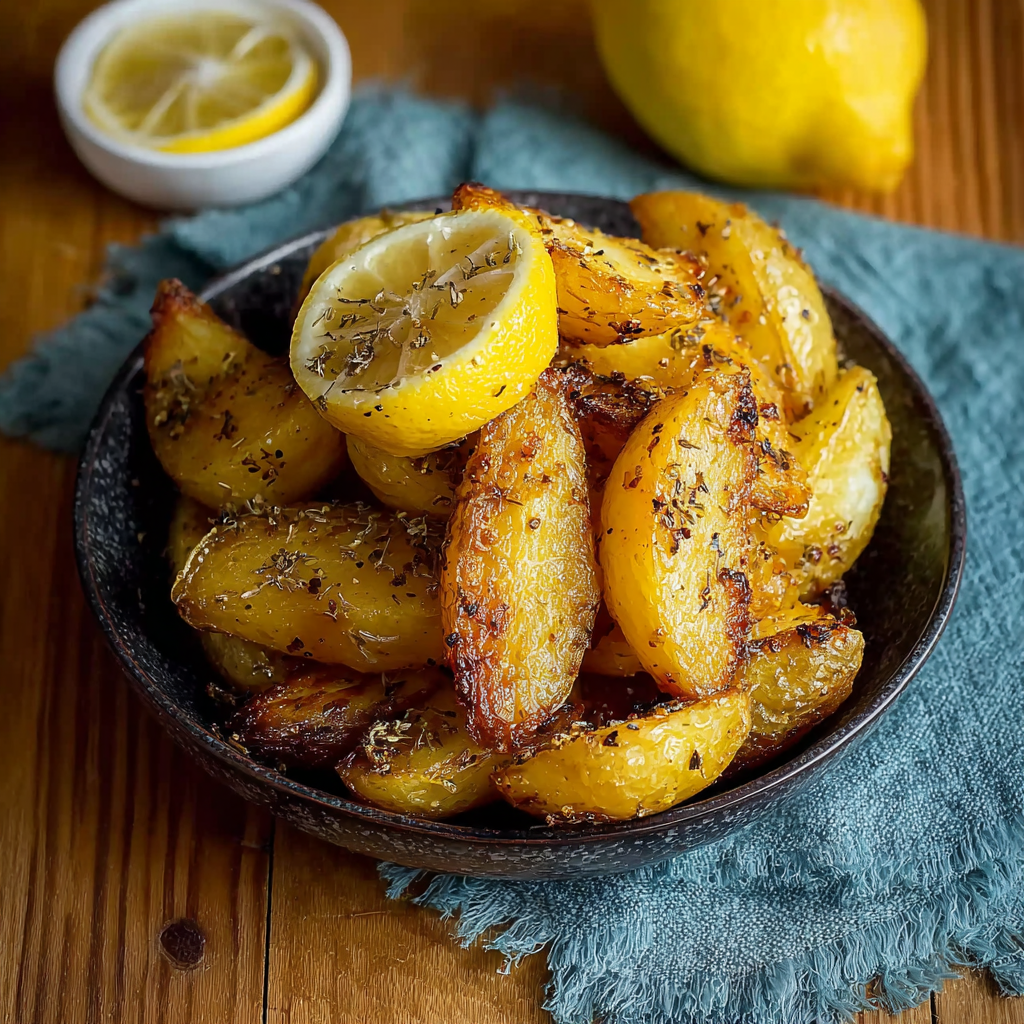
These Greek lemon potatoes occupy a unique culinary category. They are not simply roasted potatoes with lemon squeezed over the top — they are potatoes that have absorbed an entire braising liquid of lemon juice, chicken stock, garlic, and olive oil into their interior flesh during cooking, then continued in the oven until that absorbed liquid has caramelized the exterior into a deeply golden, slightly crispy crust while the interior remains extraordinarily creamy, custardy, and imbued with lemon and garlic flavor at every level. The technique — known in Greek cooking as lemonates — produces a side dish that is simultaneously crispy and melting, savory and bright, simple and deeply complex.
A 2023 culinary anthropology review in the Oxford Companion to Food identified the Greek practice of baking vegetables in an emulsified lemon-oil-stock liquid as one of the most flavor-efficient cooking techniques in Mediterranean cuisine — the same technique used for gigantes plaki, briami, and fasolakia — producing maximum flavor depth with minimum ingredient complexity.
Ingredients List
For the Potatoes
- 1.2kg (2.6 lbs) Yukon Gold or Maris Piper potatoes, peeled and cut into large wedges (6–8 wedges per potato — larger pieces absorb the braising liquid more effectively than small ones)
- 4 tbsp extra virgin olive oil
- 4 tbsp fresh lemon juice (approximately 2 lemons — fresh only)
- 1 tsp lemon zest
- 1 cup (240ml) chicken or vegetable stock (the stock is absorbed into the potato — quality matters)
- 6 garlic cloves, minced or thinly sliced
- 1½ tsp fine sea salt
- 1 tsp freshly ground black pepper
- 1 tsp dried oregano (Greek dried oregano — more intense than Italian varieties)
- ½ tsp smoked paprika (optional — adds color and subtle warmth)
- 1 tsp Dijon mustard (optional — emulsifies the sauce and adds a barely perceptible depth)
For Finishing
- 2 tbsp extra virgin olive oil, for the final drizzle
- 1 tbsp fresh lemon juice
- 1 tbsp fresh flat-leaf parsley, finely chopped
- 1 tsp fresh oregano leaves (or an extra pinch of dried)
- Flaky sea salt, to finish
- Lemon wedges, to serve
Timing
- Prep Time: 10 minutes
- Bake Time: 60–75 minutes
- Total Time: 70–85 minutes (mostly hands-off)
The active preparation is under 15 minutes — cutting, seasoning, and transferring to the roasting pan. The oven transforms the raw ingredients into something extraordinary through the 60–75-minute baking process. Check at the 45-minute mark to ensure the liquid is absorbing correctly — if the pan looks dry before the potatoes are golden, add a small splash of additional stock.
Step-by-Step Instructions
Step 1: Prepare the Potatoes
Preheat the oven to 400°F (200°C). Peel the potatoes and cut into large, even wedges — approximately 6–8 wedges per medium potato, depending on size. Large pieces are intentional and important: smaller potato pieces cook too quickly for the braising liquid to fully absorb before the exterior begins to over-brown, and they do not develop the dramatic contrast between the creamy interior and crispy exterior that defines this dish. Place the cut potatoes in a single layer in a large, wide roasting pan — not too deep, as depth inhibits the surface caramelization that produces the crispy exterior.
Key tip: Do not rinse the potatoes after cutting. The surface starch that would be washed away is part of what helps the braising liquid cling to and eventually form the caramelized crust. Unlike crispy roasted potato techniques that demand starch removal, this method benefits from retaining it.
Step 2: Make the Braising Liquid
In a bowl or measuring jug, whisk together the olive oil, lemon juice, lemon zest, chicken stock, minced garlic, salt, pepper, dried oregano, smoked paprika, and Dijon mustard if using. Whisk vigorously for 30 seconds until the oil and stock are temporarily emulsified — the mustard acts as an emulsifier that helps the oil and lemon distribute evenly throughout the liquid rather than pooling separately. The braising liquid is the soul of this dish — taste it before it goes into the oven and adjust the lemon and salt to your preference.
Step 3: Pour and Arrange
Pour the braising liquid over the potatoes in the roasting pan and turn each wedge to coat all surfaces thoroughly. Arrange the potatoes cut-side down — flat surface facing the pan — in the most single-layer configuration the pan allows. The liquid should come approximately halfway up the sides of the potato wedges. If the pan is too small to accommodate a single layer, use two pans rather than stacking — overlapping potatoes produce steamed rather than caramelized results.
Step 4: Bake — First Phase
Bake at 400°F (200°C) for 35–40 minutes without disturbing. During this phase, the potatoes are absorbing the braising liquid — the stock, lemon, and garlic are being drawn into the potato flesh as the liquid evaporates and reduces. By the 35-minute mark, most of the visible liquid should have absorbed into the potatoes or evaporated, and the potatoes should be beginning to show golden color on the surfaces in contact with the pan.
Key tip: Resist the urge to check too frequently during this phase. Opening the oven drops the temperature and slows the absorption process. Set a timer and trust the oven for the first 35 minutes.
Step 5: Flip and Bake — Second Phase
After 35–40 minutes, remove the pan and carefully flip each potato wedge using tongs or a wide spatula — the bottom surface should be golden to deep golden at this point. If it is pale, return to the oven for 10 more minutes before flipping. Once flipped, return the pan to the oven for a further 25–35 minutes until the new top surface is deeply golden, the edges are beginning to develop slightly dark, caramelized patches, and a fork slides through the thickest part of each wedge with absolutely no resistance.
Key tip: The darkened, almost charred edges and corners are not mistakes — they are the most flavorful parts of the finished potato, concentrated caramelized lemon and garlic that adds a depth the paler surfaces cannot match. Do not pull the potatoes early to avoid this — embrace it.
Step 6: Finish and Serve
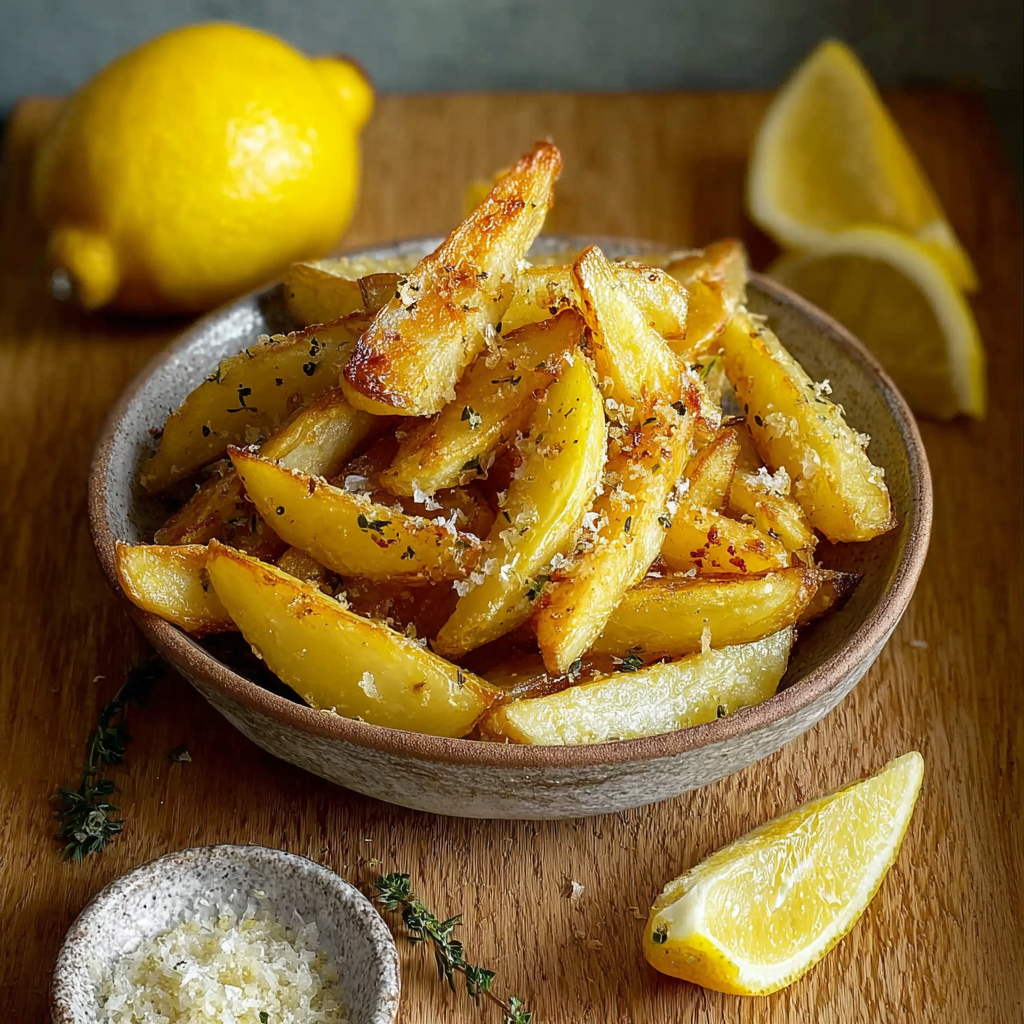
Remove from the oven and allow to rest in the pan for 5 minutes. Drizzle with the final 2 tablespoons of fresh olive oil and a tablespoon of fresh lemon juice — both absorb into the hot potatoes and add a layer of fresh, bright flavor over the deep, caramelized notes from the oven. Scatter fresh parsley, fresh oregano, and a generous pinch of flaky sea salt over the top. Serve directly from the roasting pan or transfer to a warm serving dish with lemon wedges alongside.
Nutritional Information
Per serving — based on 4 servings.
| Nutrient | Per Serving | % Daily Value* |
|---|---|---|
| Calories | 340 kcal | 17% |
| Total Fat | 16g | 21% |
| Saturated Fat | 2.5g | 13% |
| Total Carbohydrates | 46g | 17% |
| Total Sugar | 3g | — |
| Protein | 5g | 10% |
| Dietary Fiber | 5g | 18% |
| Sodium | 580mg | 25% |
| Potassium | 1,050mg | 22% |
| Vitamin C | 35% DV | 35% |
| Vitamin B6 | 28% DV | 28% |
| Iron | 10% DV | 10% |
*Based on a standard 2,000-calorie daily diet.
The potassium content — 22% of the daily recommended value per serving — reflects the meaningful mineral contribution of Yukon Gold potatoes and makes this an unexpectedly strong potassium source for a side dish. At 340 calories with 16 grams of predominantly monounsaturated fat from olive oil and 5 grams of dietary fiber, this is one of the more nutritionally complete potato preparations available.
Healthier Alternatives
Lower fat: Reduce the olive oil to 2 tablespoons in the braising liquid and compensate with an additional 2 tablespoons of chicken stock. The potatoes will be slightly less rich but the lemon and herb flavors remain vibrant — the fat reduction is meaningful without compromising the essential character of the dish.
Vegan: Replace the chicken stock with a good-quality vegetable stock or water with 1 additional tablespoon of olive oil and a pinch of nutritional yeast for depth. The flavor profile shifts slightly but remains entirely within the Greek lemonates tradition — the dish was made with vegetable stock for centuries before chicken stock became a kitchen staple.
Lower carbohydrate: Replace half the potatoes with large chunks of celeriac or turnip, cut to the same size and treated identically. Both root vegetables absorb the braising liquid in a comparable way and develop a similar caramelized exterior — producing a lower-carbohydrate variation with a slightly more complex, less starchy flavor.
Higher flavor intensity: Add 1 tablespoon of capers to the braising liquid and 6 Kalamata olives, pitted and halved, scattered over the potatoes after the flip. The brine from both adds a salty, fermented depth that intensifies the Mediterranean character of the dish significantly without any additional preparation effort.
Serving Suggestions
With roasted chicken: The defining pairing in Greek home cooking — the potatoes roasted in the same pan beneath a whole chicken, absorbing the chicken drippings alongside the lemon-stock braising liquid. If roasting chicken over these potatoes, reduce the stock quantity to ½ cup as the chicken releases additional liquid during cooking.
With grilled lamb: Serve alongside grilled lamb chops or a slow-roasted leg of lamb. The brightness of the lemon potatoes cuts through the richness of lamb fat with a precision that makes this the most complementary side dish in the Greek culinary tradition.
As part of a mezze spread: Serve at room temperature alongside tzatziki, hummus, warm pita, a Greek salad of tomato, cucumber, and feta, and a plate of stuffed grape leaves. Greek lemon potatoes served at room temperature develop an even more concentrated lemon-garlic flavor as they cool and are entirely suited to the mezze format.
With grilled fish: Serve alongside grilled sea bass, branzino, or red snapper with a simple salad. The lemon in the potatoes mirrors the lemon typically squeezed over grilled fish and creates a cohesive, Mediterranean-themed plate of understated elegance.
As a standalone vegetarian main: Increase the portion size, add a generous scoop of cold tzatziki on the side, crumble feta over the top of the hot potatoes, and serve with warm pita bread. This treatment elevates the potatoes from side dish to satisfying, complete vegetarian main course.
Common Mistakes to Avoid
Cutting the potatoes too small. Small potato pieces cook through before the braising liquid has time to fully absorb and before the extended oven time required for caramelization can occur without burning. Large wedges — 6 to 8 per medium potato — are the correct cut and cannot be substituted for convenience.
Using a pan that is too deep or too small. A deep roasting pan with high sides prevents the steam from escaping that allows the braising liquid to reduce and the potatoes to caramelize. A wide, shallow pan — with sides no more than 5cm high — maximizes the surface area exposed to dry oven heat and produces the correct result.
Rinsing the potatoes after cutting. Unlike crispy roasted potato techniques that benefit from starch removal, this recipe uses the retained surface starch to help the braising liquid adhere and form the caramelized crust. Rinsing removes this advantage.
Pulling the potatoes before they are deeply golden. Pale golden potatoes are under-caramelized potatoes — they lack the concentrated flavor that comes from the Maillard reaction on the lemon-and-olive-oil-coated surface. The potatoes should be deeply, confidently golden with dark caramelized edges before leaving the oven. When in doubt, return for another 10 minutes.
Using dried lemon juice or bottled lemon juice. The volatile aromatic compounds in fresh lemon juice are the defining flavor of this dish — they are absent from bottled juice and produce a flat, slightly artificial result. Fresh lemon juice is non-negotiable.
Storing Tips
Refrigerator: Store cooled potatoes in an airtight container for up to 4 days. They soften during refrigeration — reheating is essential for any recovery of the original crispy exterior.
Reheating: A 425°F (220°C) oven on a wire rack for 10–12 minutes restores significant crispiness. An air fryer at 400°F (200°C) for 6–8 minutes is the most effective reheating method and produces a result closest to freshly roasted. The microwave reheats the interior but eliminates all surface crispiness — use only when texture is not a priority.
Freezer: Freeze fully cooled potatoes in a single layer until solid, then transfer to a freezer bag for up to 2 months. Reheat from frozen in a 425°F (220°C) oven for 18–22 minutes or in an air fryer at 400°F for 12–15 minutes. The texture after freezing is softer than fresh but the flavor remains excellent.
Make-ahead: The braising liquid can be prepared up to 2 days ahead and refrigerated. The potatoes can be cut, placed in the roasting pan, and covered with the braising liquid up to 4 hours before baking — refrigerate covered and bring to room temperature 15 minutes before placing in the oven. This approach is ideal for dinner parties — all preparation is done in advance and the oven does the work.
Conclusion
Greek lemon potatoes prove that the most distinctive side dishes are often the ones built on technique rather than complexity — a simple braising-to-roasting process that produces a result no standard roasting method can replicate. Crispy, caramelized, deeply flavored on the exterior. Custardy, lemon-infused, extraordinary on the interior. A side dish that earns its place alongside the finest proteins and the most celebrated Mediterranean tables.
Make them and share your results in the comments — tell us which protein you served them with, whether you added capers or olives, and how the table reacted to the first bite. Leave a review, share with someone who loves Greek food, and subscribe to our newsletter for more globally inspired, technique-driven recipes every week.
FAQs
What potato variety works best? Yukon Gold potatoes are the top recommendation — their naturally buttery flavor, medium starch content, and firm structure make them ideal for this technique: absorbent enough to take on the braising liquid, firm enough to maintain their structure through 70+ minutes of oven time, and flavorful enough to add their own character to the finished dish. Maris Piper is the closest European equivalent. Avoid waxy varieties like red potatoes, which do not absorb the braising liquid as effectively, and avoid russets, which can become mealy under prolonged moist-heat cooking.
Can I make this recipe in a slow cooker? The slow cooker produces a good lemon potato but not the crispy-outside, melting-inside result the recipe is designed around — it lacks the dry oven heat necessary for caramelization. For the closest slow cooker approximation, cook on low for 5–6 hours, then transfer to a hot oven or air fryer for 15 minutes to develop surface color. The flavor will be comparable; the texture will be softer.
Why is my braising liquid not absorbing into the potatoes? Insufficient absorption is caused by either cutting the potatoes too small — they cook through before fully absorbing — or using a pan that is too small and deep, trapping steam that prevents the liquid from reducing and concentrating. Switch to a wider, shallower pan and cut larger wedges for the correct result.
Can I add other vegetables to the pan? Yes — large chunks of zucchini, quartered artichoke hearts, and halved cherry tomatoes all work well added for the final 20–25 minutes of baking. Add them after the potato flip so they do not overcook. Green beans added in the final 15 minutes become silky and lemon-infused in a way that makes them an exceptional addition.
How do I make this recipe for a large group? The recipe scales directly — double all ingredients and use two wide, shallow roasting pans rather than one deep pan. The cooking time remains the same. Rotate the pans between the upper and middle oven racks at the halfway flip point to ensure even browning.
Is this dish served hot or at room temperature? Both are entirely appropriate and each has its advocates in Greek home cooking. Served hot from the oven, the potatoes are at their crispiest and most dramatically flavored. Served at room temperature — as they frequently are in Greek homes and tavernas — they develop a more concentrated, cohesive lemon-garlic flavor as they cool and the absorbed braising liquid settles into the flesh. Both versions are excellent; the choice depends entirely on timing and preference.